On August 11, the Urban Development Department quietly published the draft Greater Bengaluru Authority (Parking) Rules, 2026 — the legal framework meant to give teeth to Bengaluru’s much-discussed Parking Policy 2.0. Citizens have thirty days to send in objections. Yet, few will read all eighteen pages of the notification. Fewer still will notice that a law framed as a way to curb traffic demand is, on close reading, a plan to expand parking supply and hand over enforcement to private players, while leaving the ordinary resident worse off.
That gap between the promise and what’s on paper matters, because parking is not just about cars. It is about who gets to use the fifteen feet of road right outside a home — the child walking to school, the ambulance trying to turn a corner, the elderly resident who doesn’t own a car and never agreed to turn the street into a parking area in the first place.
Adding more supply, not managing demand
Parking Policy 2.0’s central insight was simple: Bengaluru cannot build its way out of its parking crisis. Every extra parking spot attracts a new vehicle. The answer, the policy argued, was to manage demand through dynamic pricing, permits and strict limits, rather than adding more space.
In practice, the draft Rules do the opposite. Seven of the first ten operative rules are devoted to creating new parking: on-street bays, off-street lots on corporation land, and, most strikingly, leasing vacant private plots to run commercial parking, with a 100% property tax waiver thrown in as an incentive. Rule 7.4 even allows “temporary” parking lots on disputed land still tied up in litigation. Only in Rule 11, seven clauses in, does the draft turn to restricting or pricing parking — the tools the policy itself claimed were its top priority. By putting supply first and demand management last, the draft Rules have quietly reversed its own premise.
A task force with no residents on it
The draft also creates a “Parking Task Force” in each city corporation to identify parking areas and approve local plans. Its members include the Commissioner, a police officer, Regional Transport Officers, and an engineer. Not one resident or a representative of a resident welfare association (RWA). No one representing pedestrians, cyclists or persons with disabilities — the very citizens Parking Policy 2.0 promised would be central to “Area Parking Plans.”
This is a striking omission, because Bengaluru already has the institution the Rules needed and ignored. The Greater Bengaluru Governance Act, 2024, which restructured the city’s civic administration this year, created statutory Ward Committees — fourteen members per ward, including RWA representatives, with powers that explicitly cover “regulation of parking of private vehicles on public places.” The proposed law to regulate parking never once asks these committees for inputs. A street’s parking plan can be decided entirely at the level of the City Corporation Commissioner, without the residents of that street being consulted, notified, or given a right to object.
There is an obvious fix, and it costs nothing to implement: route every Area Parking Plan through the Ward Committee of the wards it covers before it goes to the Task Force. Require each Ward Committee, once a year, to run a simple household exercise: how many vehicles a street’s residents actually have, whether they are owners or tenants, which lanes most need permits. Then, feed that data into the plan. Call it a Ward Parking Demand Charter. It would replace a bureaucratic guess with verified, street-level fact, and it would use a structure that already exists in law rather than inventing a new one.
Read more: 28,544 cases for parking on Bengaluru footpaths in 5 months speak of disregard for rules
Who has the power to fine the citizen?
The most legally troubling provision is Rule 14. It designates private parking operators — for-profit contractors — as “public servants,” empowering them to decide that a vehicle has broken the rules, issue a notice, impose a fine, and tow the vehicle away. The towing charge is kept by the operator itself; only the fine goes to the city corporation.
Deciding that a specific person has violated a rule and imposing a consequence on them is not a clerical task. It is an adjudicatory one, the kind of decision the law usually insists be made by someone with no financial stake in the outcome.
The Karnataka High Court made exactly this point in 2021, in a case involving the BBMP Commissioner’s own powers: such authority “will have to be exercised only by such officer who is empowered to exercise it and not by any other authority,” the court held, invoking the old legal principle that the person who decides a case must be the one who hears it. A private towing contractor who earns money each time a vehicle is towed is about as far from that standard as it is possible to get.
The court has separately and repeatedly made clear that footpaths and streets must be kept free of obstruction, including from parked vehicles, because encroachment on them violates the constitutional right to life and personal liberty under Article 21.
As recently as last year, a Division Bench of the High Court was still recording its frustration that Bengaluru’s footpaths “have been turned into parking lots.” And, that history argues for stronger, more accountable enforcement — a named municipal officer answerable to the court and to citizens — not for outsourcing the job to a contractor whose commercial interest lies in maximising paid parking rather than clearing space for pedestrians.
A one-size-fits all fee for every Bengaluru resident
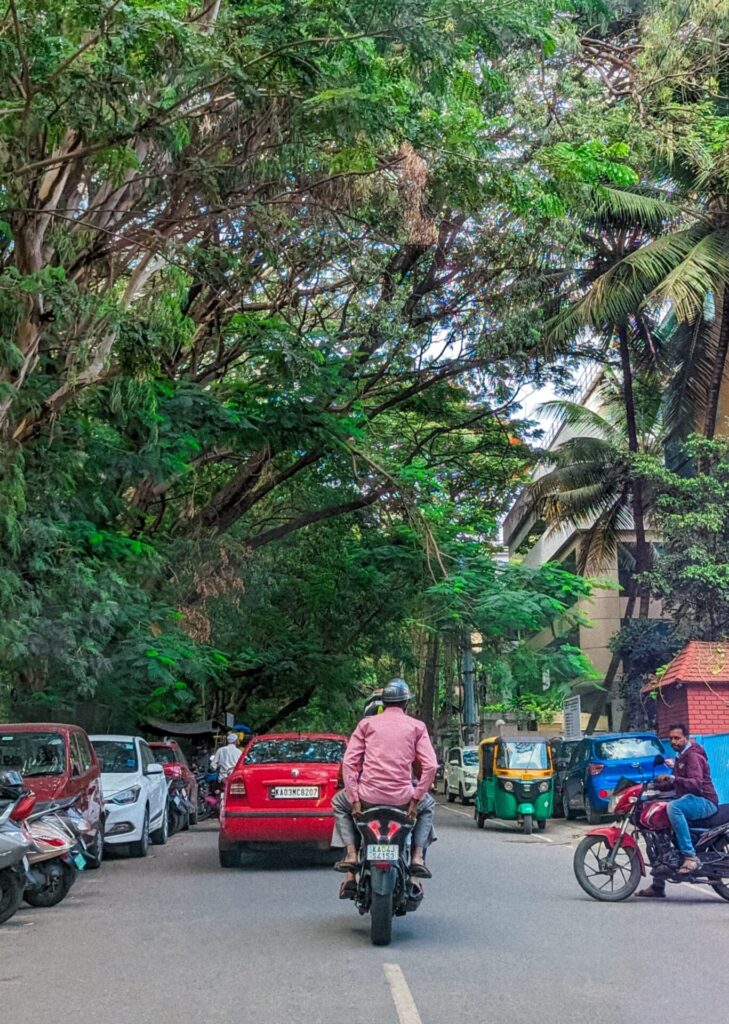
Parking outside your home requires a paid residential parking permit. Residents have to pay a minimum annual permit fee of ₹15,000 for a hatchback, ₹20,000 for a sedan, and ₹25,000 for an SUV — with no adjustment for income, no distinction between a homeowner and a tenant, and no limit tied to how many families actually live in a subdivided house. A household in an old Basavanagudi or Malleswaram lane, with no off-street parking and no realistic alternative, will pay the same flat fee as a household with a private garage that never needs the permit at all.
None of this means Parking Policy 2.0 was a bad idea. Treating road space as scarce, pricing it, and discouraging all-day occupation of narrow lanes are sound principles. The problem is that the Rules meant to implement that policy have drifted from it — toward more supply, less citizen voice, and enforcement handed to whoever profits most from strict enforcement.
Read more: Bengaluru’s footpath crisis: What would it take to improve journeys on foot?
What the rules should change
The thirty-day objection window that closes on September 11 is the only formal chance citizens have to correct this before it becomes binding.
Three changes would go a long way:
- Give Ward Committees a real role in deciding local parking plans.
- Keep the power to fine and tow in the hands of accountable public officials rather than private contractors.
- Calibrate residential fees to what a household can actually pay rather than a flat, one-size-fits-all number.
Bengaluru does not need more parking. It needs a fairer, more accountable way of deciding who gets to use the road it already has.
Citizens can send in their objections and suggestions to the draft Greater Bengaluru Authority (Parking) Rules, 2026 by September 11 to: The Additional Chief Secretary, Urban Development Department, Vikasa Soudha, Bengaluru: 560001.
You can also submit your feedback through this simple WhatsApp Chatbot, by Civis, a non-profit platform that promotes increased citizen participation in the lawmaking process.
Firstly introducing parking fees in this proposed methodology is necessary for cities like Bengaluru. But, the charges described are exorbitantly very high and it shouldn’t exceed more than 3K per year per car.
Secondly, just paying parking charges by car owners should not provide them the right to claim the space in front of their houses as theirs own property to park their own vehicles.
In today’s scenario, every houses in most of the areas don’t allow other vehicles to park in front of their house compounds even for small time when we need to park and they make huge high and cry. They go to the extent of damaging the car, puncturing the tyres / tubes, mirrors, glass etc. Many times it leads to road rages.
If any one wants to reserve such spaces in front of their houses for their own vehicles, let them pay 10 times the parking fees the govt finalises ultimately.
Secondly, the govt for having collected the parking fees for vehicles, they should provide added surveilance to reduce thefts and damages to vehicles.
how much money govt want already too many tax illigal building approval just pay money money, make affordable paking space penalize all illigal building approver first than penalize middle class.