While the Special Intensive Revision (SIR) process aims to clean up electoral rolls, the enumeration forms created innumerable hurdles for existing voters. From tracking down elusive 2002 voter details to coordinating with overworked Booth Level Officers (BLOs), citizens across Bengaluru faced a daunting task completing the registration process.
Recognising these challenges in their own neighbourhoods, volunteers led by three active citizens—Poongothai, Aparna Shamanth, and Venkatachalam Subramaniam—took it upon themselves to help people in their community and beyond.
Mapping the confusion in Gottigere
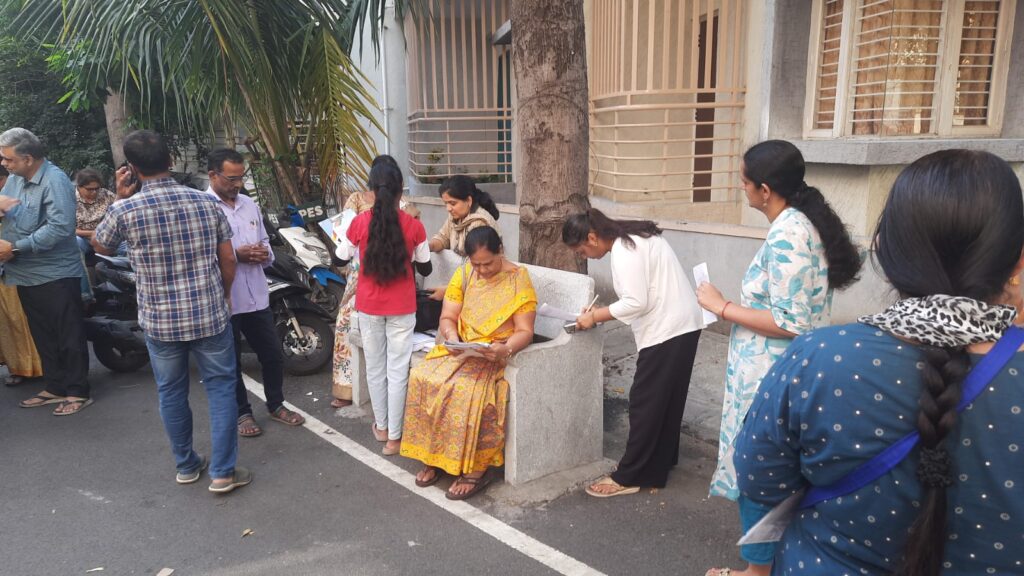
Poongothai lives in Gottigere, which falls under the Bengaluru South assembly constituency. Her community consists of around 400 households, all spread across multiple booths. Every year, she and a team of volunteers from the community assist residents with locating their election booth details. Assuming the residents would be divided across five to seven booths, the group launched a Google Form campaign to collect residents’ information and match them against booth and part numbers.
To their surprise, the electors from the layout were spread across 13 different booths. This made the BLOs’ work quite difficult as they had to locate all the homes on their own. “We have around 250 voters, and more than 90 residents came forward to fill the form with our help,” says Poongothai.
Here what they managed to achieve:
- About 90 residents cooperated to give their details through digital forms
- Enumeration forms were handed directly to residents without extra coordination with BLOs.
- The team helped citizens retrieve their required 2002 voter details.
“Whatever problems I had, they were able to help me. It was a really good experience,” says Saroj, a resident from the locality.
Managing the door-to-door maze in Banashankari
In Kamakya Layout, Banashankari 3rd Stage, Aparna tackled a different logistical problem. Her neighbourhood spans 23 apartment complexes. Because physical enumeration forms are organised by serial number rather than physical address, BLOs were forced to knock on every door.
On July 2, Aparna began accompanying local BLOs on their rounds, because she had a good rapport and could coordinate with Apartment Managing Committees.
“That’s when they need our help because they don’t know who belongs to which part. Many times, the doors are locked, people have gone out for work, or they’ve gone abroad, which increases the chances of them being left out,” Aparna explains.
This initiative, however, was not always seamless. Some residents objected to BLOs setting up in building basements rather than walking door-to-door. Aparna and other volunteers mediated to explain how the BLOs were overworked. She also addressed concerns from local officials who initially questioned people other than BLOs handling electoral records, assuring them that the team had no ill-intentions.
Read more: Missing documents for SIR? Here’s how to get a Permanent Residence Certificate
Overcoming language and other barriers
Looking for 2002 progeny details was a challenge for many residents. Moreover, the Kannada-only forms only made matters worse, as non-Kannada speakers were not able to understand them.
So, for the first two to three days, Aparna went on ground to help people personally and find the 2002 details for those who were not comfortable going online. “I used to take their details, get back home, sit on my laptop, search it up at night and then send them the details by morning,” Aparna says.
Other residents faced the issue of changed addresses not being updated. Hari and his wife, who earlier lived in the same community as Aparna, moved out a year ago. They have since not been able to update their permanent address, and their enumeration forms were handed over to their old address. “Aparna coordinated with us, got the form, kept it with her, and then we filled it up and gave it back. She helped us ensure we submitted it on time,” says Hari.
Scaling up with SIR online assistance
As the on-ground process became overwhelming, Aparna partnered with Venkatachalam Subramaniam (both members of the Bengaluru NavaNirmana Party – BNP) to scale their efforts online and help more people. Starting July 13, the duo launched daily late-night online SIR sessions running from 8 pm to 9 pm, and continued them till August 8.
Highlight of the online sessions:
- Around 70 to 75 citizens attended these sessions every day.
- Here’s what they covered: Locating 2002 voter details online, filling the SIR form with the help of an English-translated version, finding EPIC numbers, dealing with misspelled names, and contacting BLOs.
Aparna and Venkatachalam continued these sessions till August 8.
“This is not something which people have experienced because the last one was in 2002. So, this means people have forgotten or many people have never gone through the process,” notes Venkatachalam, who also conducts local awareness sessions in his neighbourhood on Sarjapur Road.
He also volunteers to help BLOs with their work. “BLOs are very hardworking. They are usually government school teachers and are probably already working 12-14 hours,” he says.
Recommendations for future elections
Based on their extensive work with voters on the ground, the volunteer team shared their insights on improving the voter revision process:
- Ensure all residents of a single gated community or layout belong to one booth, so that the BLOs are able to locate voters easily during the door-to-door visits.
- Provide dedicated civic helpdesks at every polling booth, where citizens can resolve issues by interacting directly with government officials.
very true Aparna madam was with BLO and residents throughout and solved almost all problems faced by the members (complicated SIR) She made it so easy. We all thank her for spending her precious time attending this work as well as her family. Thanks again