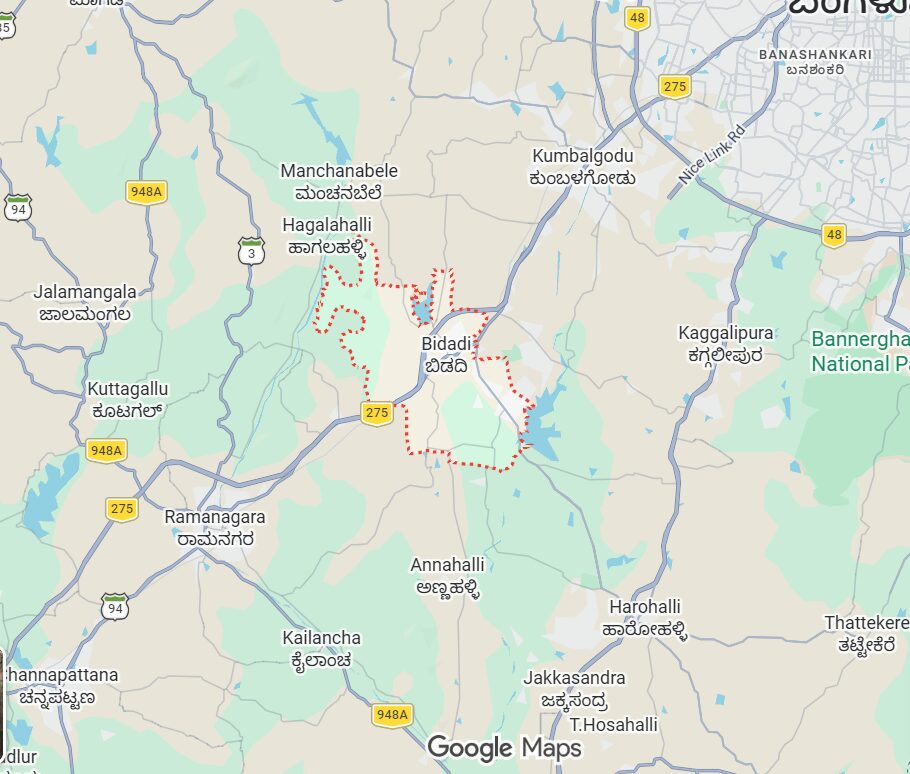
The Greater Bengaluru Integrated Township (GBIT) in Bidadi, first notified in March 2025, received its final notification in June 2026 under the Karnataka Urban Development Authorities Act (KUDA Act), 1987. The project is branded as India’s first and largest AI City, featuring an AI-integrated township. The project will be implemented by the Greater Bengaluru Development Authority (GBDA) under the same act. Three villages, Kempainapalya, Vaderahalli, and Mandalahalli are notified in the Gazette under Section 19(1) of the KUDA Act for the implementation of a development scheme, deemed as public purpose. The development scheme is spread over a total of 7,481 acres. Of this, approximately 1,800 acres shall be developed as residential layouts. The remaining 5,681 acres are proposed for commercial, infrastructure, and other township-related developments.
The notification details the lands proposed for acquisition, including survey numbers, ownership particulars, total extent, and boundaries of the land. Simultaneously, the GBDA has circulated a Request for Proposal (RfP) for preparation of Master Plan, DPR and Project Management Services for the township.
Even as the bureaucratic procedures continue, protests are escalating at a time when land acquisition has become a contentious issue. Recent instances, including the withdrawal of the proposed acquisition in Devanahalli, raise questions on the premises of land acquisition and the associated socio-economic transformations.
Land acquisition for this project can follow two statutes:
- Section 35 of the KUDA Act, empowering the authority (in this case the Greater Bengaluru Development Authority) to acquire land through agreement with landowners, and
- Section 36, which in the absence of agreements, links acquisition to the Right to Fair Compensation and Transparency in Land Acquisition, Rehabilitation and Resettlement Act (LARR Act), 2013. (This is to be read along with the Karnataka-specific amendments introduced to the LARR Act in 2019.)
What does the final notification tell us about land acquisition and compensation?
Based on the information available in public domain, there is little clarity on the approach to and compensation for land acquisition. As per the final notification, acquisition will be facilitated under section 36 of KUDA Act, with compensation in accordance with the LARR Act, 2013. Affected landowners will be offered a choice between monetary compensation and developed residential sites. The former is proposed at three times the guidance value of the land, estimated to range between ₹2.07 crore and ₹2.55 crore per acre.
Properties with road frontage will receive additional compensation. Separate compensation is noted for trees, standing crops, and other assets situated on the acquired land. Under the latter, landowners will receive 9,693 square feet (0.22 acres) of developed residential land for every acre acquired. This will be allocated from the 1,800 acres. In cases where landowners do not agree, the state will deposit the compensation amount in court and proceed with the acquisition process.
On the one hand, under Section 36 of the KUDA Act, the project legally rests on the acquisition powers available under the LARR Act, enabling authorities to secure the notified lands even where agreements are not reached. On the other hand, compensation to landowners who have voluntarily entered into agreements is underway, indicating the acquisition-by-agreement route under Section 35 of the KUDA Act.
There is also little clarity on how the figures are arrived at in relation to the compensation provisions of the LARR Act, 2013. Prima facie, the full compensation framework under the LARR Act would apply if the land were acquired under Section 36. In such cases, The LARR Act, 2013 outlines an elaborate mechanism for determining compensation as against a simple multiplier of the guidance value.
Under its Section 26(1), the market value of land is to be determined by adopting the highest of three values:
(i) the notified stamp or guidance value
(ii) the average sale price of similar lands situated in the nearest village or vicinity area
(iii) the amount agreed upon between landowners and purchasers in specified cases.
Once this is determined, a multiplication factor, ranging between 1 and 2 is applicable. In addition, there is a solatium equivalent to 100 per cent of the compensation amount in cases of compulsory acquisition. Compensation for trees, crops, structures, and other assets situated on the land is calculated separately.
Little clarity about compensation and resettlement
Further, the Act provides for rehabilitation and resettlement entitlements in addition to compensation. However, Rule 29A(4) of the Karnataka Amendment Rules have exempted these entitlements while providing ₹50,000 to ₹5,00,000 in lieu of comprehensive rehabilitation and resettlement entitlements as per the LARR Act.
What is not clear is one, to what extent does the current compensation package reflect the valuation methodology prescribed under the LARR Act?
Second, what would be the implications of the government’s position that compensation may be deposited in court and the acquisition proceeded with, despite the absence of agreement?
Concerns around compensation calculation have been at the heart of land acquisition debates in India. The persistent reliance on ‘guidance’ values, often substantially lower than actual market prices, has led to a systematic undervaluation of acquired lands in the earlier acquisition regime, as argued by Namita Wahi (2017).
Despite repeated court judgments emphasising compensation based on the market value and development potential of the land, simple guidance value continues to be the premise for acquisition.
Read more: No city is an island: Urbanists warn against Bengaluru’s unfettered expansion
The question of public purpose: Does the project need a social impact assessment?
Apart from the question of compensation, two critical concerns include: First, the nature of the land proposed for acquisition. Opponents argue that the notified areas are well-irrigated and highly productive agricultural lands supporting a wide range of crops, including fruits and vegetables, with claims that “not even an inch of land is dry”.
Counterclaims argue that agricultural produce from the region faces marketability issues owing to concerns over contamination from the polluted Byramangala Lake. They say that farmers are neither able to effectively market their produce nor realise value from their land because of its perceived toxicity.
These competing narratives point towards a broader set of questions concerning agriculture and the socio-economic transformations owing to the consistent neglect of natural ecologies and rapid urbanisation without the provision of basic services. Chapters II and III of the LARR Act, 2013 are pertinent in this context and point to the second concern: what constitutes public purpose?
Chapter II outlines that public purpose should be determined through a Social Impact Assessment (SIA) that evaluates the stated public purpose, lays out the likely social consequences of a project, identifies available alternatives and puts out measures to avoid, minimise, or mitigate adverse impacts.
Chapter III deals with food security, outlining provisions to safeguard irrigated multi-crop land and other agricultural lands from acquisition, except under specified circumstances.
However, Section 10 A of the Karnataka amendment exempts certain projects from the application of Chapters II and III. These include national security and defence, irrigation and drinking water, affordable housing, industrial corridors, and certain infrastructure projects, including public-private partnership projects where ownership of the land continues to vest with the State Government.
Under the BMRDA, the project was exempted from conducting a SIA under Section 10A of the Karnataka amendment. With the transition to the GBDA now, there is no notified clarity on whether the exemption continues and if so, under which category of Section 10A the project is exempt. This clarity is critical in not just establishing the public purpose, additionally it has a direct impact on the applicability of the SIA safeguards and food security clauses introduced through the LARR Act, 2013.
Farmers challenge the public purpose
A further cog in the wheel is the clause in the RfP, requiring SIA professionals. This clause adds to the confusion. As per the final notification, acquisition under Section 36 of the KUDA Act would require a statutory SIA unless exempted under Section 10A of the Karnataka amendment. Yet, the process followed so far, including compensation paid to landowners through voluntary agreements, appears more consistent with Section 35 of the KUDA Act.
At the time of writing this article, some of these questions are already a part of judicial scrutiny. Fourteen small farmers approached the Karnataka High Court challenging the public purpose. The petition argues that the project is essentially a resurrection of an earlier failed project under a different name, intended to facilitate commercial interests rather than serve a genuine ‘public purpose’. It further contends that the absence of a finalised development scheme undermines the very basis of the acquisition. The petition further contends that bringing the project within the ambit of the KUDA Act was a subterfuge intended to enable exemptions from the SIA provisions of the LARR Act.
In response to the Court’s question on whether the State has followed the provisions required as per the LARR Act, the State cited the exemption under Section 10A. The Court then questioned whether the project was, in fact, eligible for such an exemption.
The uncertainties surrounding the legal basis of the acquisition and the safeguards governing it are mounting. A statutory SIA under the LARR Act is intended to independently assess public purpose, social impacts, alternatives, and mitigation measures prior to acquisition. Whether these statutory safeguards apply to the GBIT project remains a question with significant implications for the transparency, legitimacy, and accountability of the acquisition process.
Broader implications and concerns
The discussion so far focuses on the legal questions emerging from the application of the LARR Act, 2013 in its amended form in Karnataka. The state amendments are also criticised for diluting critical key safeguards that the 2013 Act sought to introduce as a reform to the Land Acquisition Act of 1894.
Namita Wahi argues that amendments, particularly those provisioning exemptions (from Chapter II and III), have eviscerated a substantial part of the legal reforms intended by the LARR Act, 2013. Among the categories exempted by various state amendments, planned development (16 per cent) and housing (9 per cent) are most frequently contested for public purpose.
The exempted projects closely linked to the rapidly unfolding process of urbanisation in India are only likely to increase in the future. In such conditions these exemptions raise fundamental questions about the state’s commitment to public trust and to the democratic principles of scrutiny, participation, and accountability that the LARR Act sought to institutionalise.
This article is third of a four-part series that closely examines the consequences of indiscriminate urban expansion and land acquisition, and the impact this has on communities, in the backdrop of farmers’ protest against the Greater Bengaluru Integrated Township (GBIT) project in Bidadi.