Unlike a decade ago, terms like Air Quality Index (AQI), particulate matter, and AQ sensors have become a part of everyday vocabulary in almost all Indian cities today. The rising threat of air pollution makes it all the more important to generate greater awareness about its causes, manifestation and impact on people at large. Being informed is the first step towards playing an active part in finding and implementing solutions towards cleaner air.
Sarath Guttikunda, Founder/Director of UrbanEmissions believes that awareness creation on air quality should start as early as in schools. UrbanEmissions is a think tank that primarily focuses on air quality — its science, awareness building and advocacy.
Sarath and his team are working on various workshops, courses and interactive sessions to engage with high school and undergraduate students, to build an understanding of air quality, its impacts and most importantly, its solutions.
In an interview with Sarath, we discussed the techniques his team uses to engage with students, the importance and outcomes of such action and more.
Importance of AQ awareness
Why has it become critical today to introduce or build awareness on air quality to students early on?
Air quality is a technical and number crunching process understood by decision makers. But it is important that the lay citizens understand what it means, what it exposes them to, and the jargon related to it. It’s not just the science voices, we want more societal voices.
We are finding that engaging with students, especially with high school students and college students, has been very rewarding. They understand and have the curiosity to learn. Armed with the right knowledge, they become voices for telling the air quality story from their perspective. That got us started on putting together more of these hands-on exercises and some tools for schools.
From your experience, how have such exercises shaped the way young people understand public health and environmental responsibility?
Kids are aware of the problems, but what is important is to make them aware of the solutions. Even small things, for example, inflating tyres to a particular pressure will increase fuel efficiency. This is something we learned in textbooks, and if repeated enough, young people will remember. Even if the minor is not driving, when they see a flat or half-flat tyre, they will know pumping more air will help improve fuel efficiency, which helps the environment. Early awareness of such small, practical solutions can go a long way going forward.
Interactive workshops for effective education
So how does UrbanEmission engage with children? How effective have you found these methods to be?
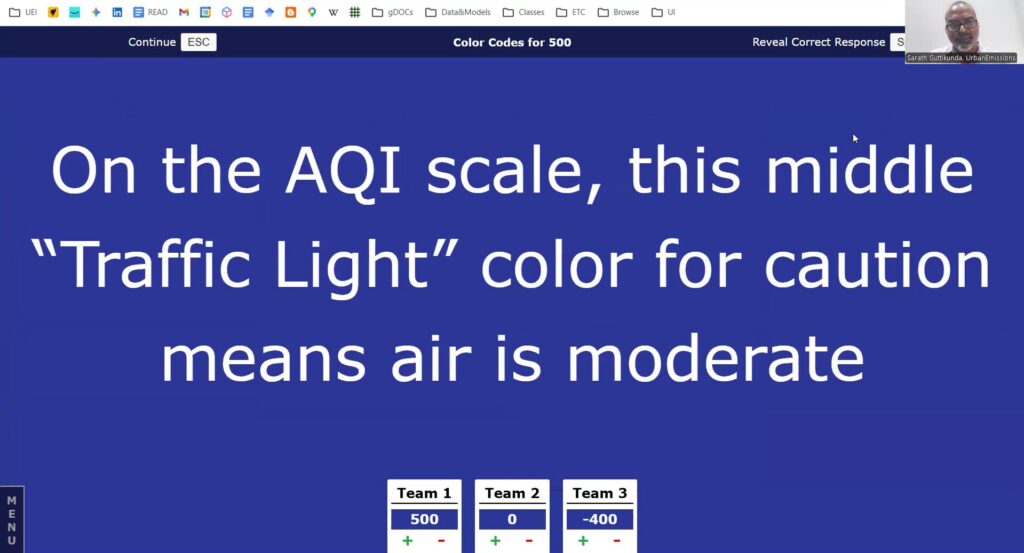
Students like the idea of playing games, being tested and being competitive. So, without getting into long lectures, through interactive activities, we tell them about the links between air quality and health. Apart from quizzes, we have games, and while we’re playing the game, we pass on the information that we think is relevant. For high schools we have designed modules for 10 hour courses, with interactive sessions like these.
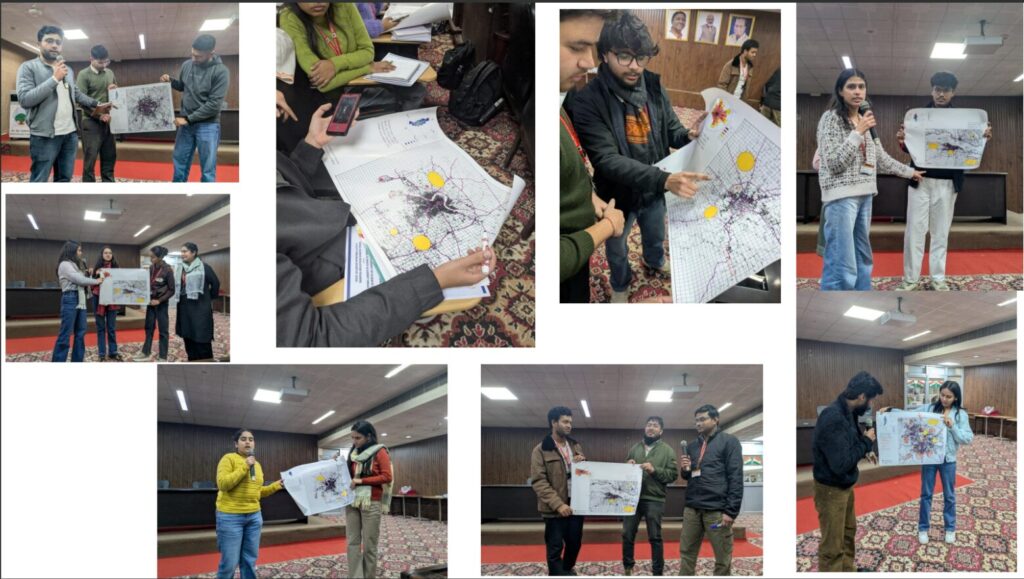
There are other hands-on exercises too: for example, the kids get a big map with the open grid and they are asked to draw something — it could be their school compound or the city’s layout. After half an hour, they explain two things that they don’t like in whatever they drew. And then discuss the solution or alternatives to that.
The idea is if 10 groups come up with 10 things, and they are put together, that’s actually the start of people-centric urban planning.
Any particular approach that has worked really well in terms of making a complex issue like air quality relatable to children?
When we personalise things, it definitely helps a lot. For example, discussing the impact of their individual actions: how using private transport for school commute could affect their health, or helping them calculate emissions based on the distance they travel. Understanding one’s carbon footprint personalises one’s energy consumption intensity. Teaching these things by referring to students’ personal experiences as examples definitely helps them understand the depth of air pollution impact.
Taking air quality to the classroom
Many schools already have packed curricula. How can air quality education be meaningfully integrated without it becoming just another theoretical subject?
Students are getting enough theory with textbooks. We want to impart some practical knowledge in an interactive way. Air pollution also connects to chemistry and physics, from how pollutants form to how they move; it connects to maths in all the number crunching involved. Through simple exercises, such as calculating how many buses are needed if 500 out of 1000 cars shift to buses, we introduce concepts like occupancy and quick math. This way, we integrate math, physics and chemistry in a hands-on, engaging manner.
Read more: From garbage burning to traffic: Why Bengaluru needs hyperlocal air monitoring
You are working towards institutionalising air quality courses. What gaps in the existing education systems does this effort aim to address?
One of the gaps that I found is teaching the practical applications of all these new emerging technologies there.
I can’t just ask AI, “I’m breathing bad air, give me a solution”. That will give generic useless stuff. Students can ask relevant questions even while using AI only if they have the basic understanding of the science behind air quality. So that’s the kind of specific knowledge that we want to impart through this course.
Another example: even when we discuss simple solutions such as setting up monitoring stations, we have thumb rules on where you monitor. So, in one of the exercises that we do, we give the groups a city map marked with residential areas, industrial areas etc. Then the group has to decide where they will place the 10 monitors using the thumb rules.
How UrbanEmissions is engaging with students
- Focus on jargon building — helping students understand key air quality terms
- Teaching communication of data — how AQI and information are presented in media
- Identifying and mapping local pollution sources in their neighbourhoods
- Using hands-on exercises like drawing maps and spotting problems + solutions
- Encouraging problem-solving — bottom-up urban planning
- Integrating math, communication and planning concepts through activities
- No lectures — fully interactive, activity-based learning
Beyond classrooms
Beyond classrooms, do you think there is scope for engaging RWAs, parents and local communities to build sustained awareness and action on air pollution?
We haven’t successfully approached any RWAs, but if the option exists, we’ll definitely go there as well. Awareness is not just talking to school kids or graduate students, we want to do it for everybody. And all the modules, games that we’re building, everything will be in the open platform and anyone can access it and make use of it.
Do you expect initiatives like this to have an impact on the air quality in our cities and towns?
It’s wishful thinking, perhaps. Hopefully, in the future, the generation will be more knowledgeable about the problem and become more conscious of their energy patterns, reducing both carbon and air pollution. As the saying goes, what you can’t measure, you can’t manage. With the right knowledge, they can understand the problem better and make the right decisions, leading to improved air quality.
Also read: Do or be doomed: Start now to safeguard children’s future from air pollution
Below is a Know Your Pollutants chart made by UrbanEmissions
How do you see the growth of this initiative so far? What role can other stakeholders play in scaling it up?
UrbanEmissions started these efforts a couple of years ago and the initiative is still at an early stage. But it is slowly expanding through schools, colleges and partnerships with institutions. Most engagements have been with private institutions, a Kendriya Vidyalaya school in Jammu and higher education spaces like IITs.
There is a clear need to reach government schools and wider communities. Going forward, for the team, the focus is on scaling these programmes, institutionalising them across more campuses, and working with different groups to take this awareness to more students.
Governments can help by integrating such interactive, hands-on modules into school programmes, especially in government schools, through partnerships with universities and organisations. By supporting and scaling these initiatives within existing education and youth programmes, they can ensure wider access and sustained engagement on air quality awareness.
How schools/institutions can run these programmes
- Reach out via the UrbanEmissions website (tools section). The tools and games are on an open platform.
- Contact through email enquiries for workshops/courses
- Follow their LinkedIn updates and request collaborations
- Programmes currently expand through word of mouth and partnerships
Excellent read! The idea of introducing air quality concepts in schools through interactive learning is very impactful. Experts like Sarath Guttikunda are doing commendable work in making complex environmental issues easy to understand for students.