TMN Deepak, a professor of social work who has a physical disability, commutes from Velachery to Loyola College in Chennai for work every day. He owns a wheelchair cum scooter that allows him to cover short distances comfortably, but he avoids public transport. “Instead, I have had to go for an automatic car, which has increased my overall spend, and I had to shell out an additional ₹2.5 lakh for modifications,” he says.
Deepak’s monthly petrol costs exceed ₹6,000. “I prefer not to use the bus because of inaccessibility,” he explains, highlighting how the lack of accessible public transport forces him into costly alternatives.
Deepak’s story reflects a wider problem. In earlier articles, we discussed how bus stops in Bengaluru and Chennai are not inclusive. Though the Rights of Persons with Disabilities (RPwD) Act, 2016, mandates public transport to be accessible, many urban systems still exclude people with disabilities. This not only creates physical barriers but also forces them to spend more on private options, adding heavy financial and emotional strain.
Poor accessibility to places and opportunities
Kamala D, a wheelchair user from Bengaluru, knows the struggle all too well. She survives on a disability pension of ₹1,400, though her monthly commute alone costs ₹1,500, with groceries and bills adding another ₹3,000. Disabled by polio at age eight, she studied up to the 10th grade and worked in data entry and voice processing for three years before resigning due to stress-related health issues. Since 2019, she has applied for jobs but received no callbacks. “After my father died in 2023, I chose to rely on my pension while caring for my ageing mother,” she says.
Though the government provided Kamala with a wheelchair and an adjusted two-wheeler, her home cannot accommodate the wheelchair, and repair and fuel costs for the two-wheeler heavily affect her finances. “I’m not aware of any skill training or employment opportunities for people like us. If we receive some support from the government to sustain our livelihoods, our dependency on the pension amount would reduce as well,” she adds.
Read more: Accessibility in crisis: Climate disasters expose neglect of persons with disabilities
Chennai and Bengaluru unjustly expensive for persons with disabilities
While Kamala grapples with managing her commute with her pension amount, 45‑year‑old Smita Sadasivan has been unable to access public transport for over a year. The Chennai‑based disability rights advocate, living with multiple sclerosis, was shaken by two traumatic incidents highlighting basic accessibility failures. During an audit at the Anna University bus stop, a hydraulic lift malfunction caused her to fall while boarding. In another incident at a city bus terminus, she and a friend with disabilities were forced to navigate buses moving in multiple directions with no designated safe zone.
“At one point, we didn’t even know which direction we could move to avoid the buses,” she recalls. This incident occurred about three months ago.
Her decision to avoid public transport comes at a steep financial cost. Although she works largely from home as an accessibility consultant, even stepping out twice a week requires spending at least ₹2,000, adding up to ₹8,000 a month — an avoidable burden if Chennai’s buses and infrastructure were inclusive. “It’s a huge financial strain,” she says. “Even going to the airport means taking a taxi or SUV that can fit the wheelchair, both far more expensive.”
TN and Karnataka disability pensions barely cover costs
For individuals with disabilities who do not have a fixed income, the disability pension is supposed to be a lifeline. In reality, the meagre amount provides little relief. D Balamurugan (44), a resident of Perumbakkam, receives ₹1,500 as pension every month. He is visually impaired and relies on odd jobs and daily wage work to support his family. With colour blindness, low vision, no side vision and near complete loss of sight post sunset, most work is out of reach for him. However, even when he does secure some work, travel proves to be nearly impossible.
“My wife is a tailor and the family depends on her income. So I can’t ask her to stop work and accompany me to the bus stop or drop me till the workplace,” says Balamurugan. “Even if I do decide to go by myself, getting into the right bus is a huge challenge. There are no bus announcements and I can’t read the LED boards. Even if I try to ask passengers around me, the bus I need leaves before I can confirm if it is the right one,” he points out.
This severely hampers Balamurugan’s ability to step out for work, and in the off-chance he does, he relies on share autos, spending a minimum of ₹75 to leave and return home. In a month, despite his efforts to budget, he spends at least ₹2,500 on travel.
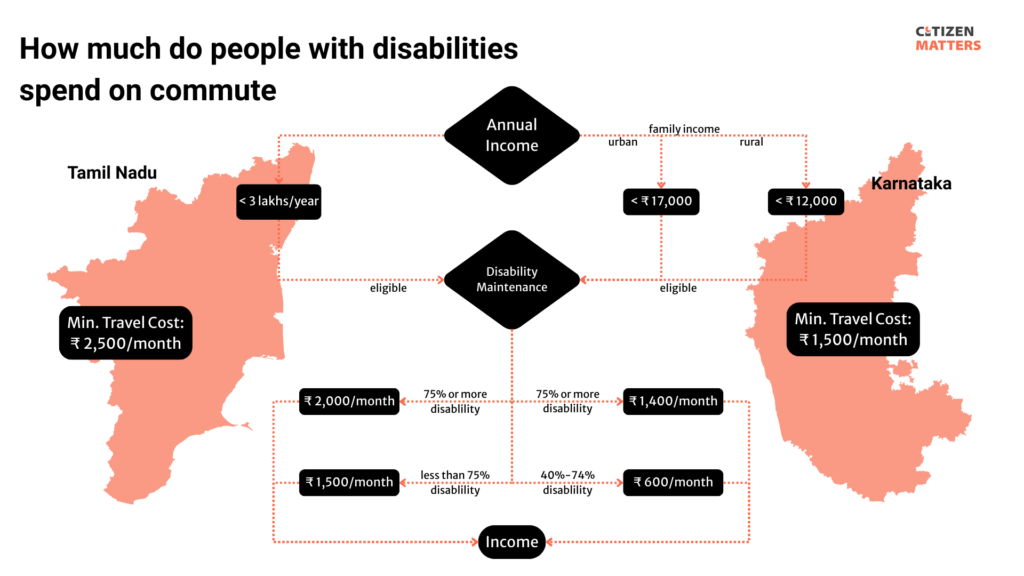
“Pension rates have not kept pace with inflation and remain below the subsistence level provided by the Sustainable Development Goals,” says Rama Krishnamachari, director at Diversity and Equal Opportunity Centre (DEOC).
Unstable finances and restricted commute
Moreover, a lack of awareness about skill training and employment opportunities continues to force people with disabilities to survive on unstable income and constant stress.
The Tamil Nadu Association for the Rights of All Types of Differently Abled and Caregivers (TARATDAC) has, over the last several years, urged the State government to increase the allowance for persons with disabilities to ₹6,000. Similarly, members of Karnataka State Disabled and Caregivers Federation have been demanding a hike in the monthly pension to ₹10,000.
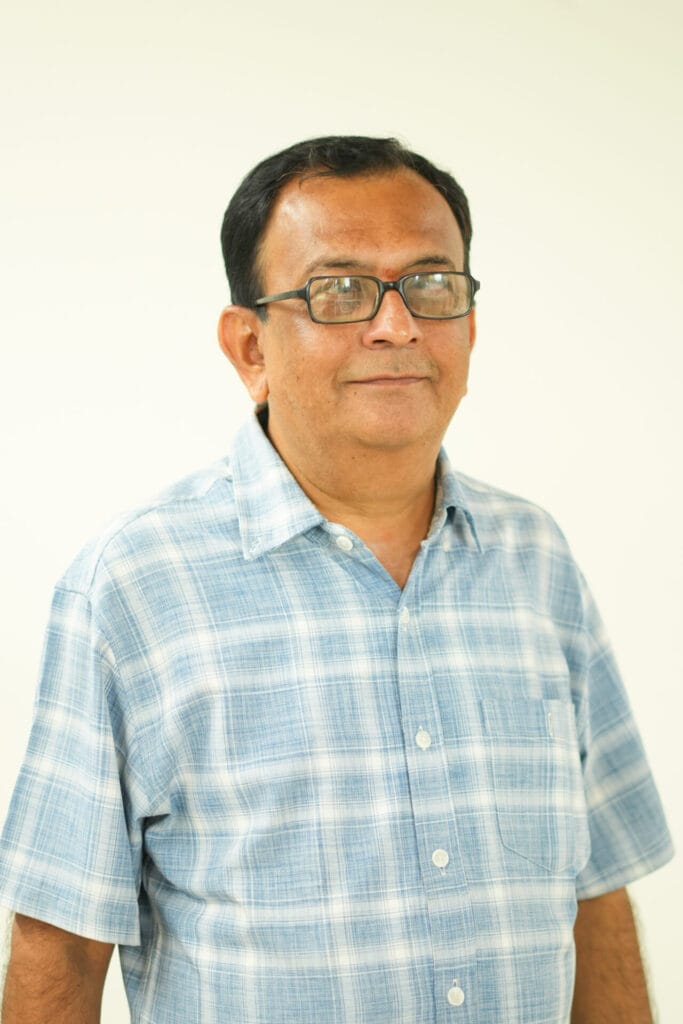
“While an increase in pension is crucial, it can never substitute the infrastructural accessibility to enable public transport commute. Pension can only act as a supplement and not a main source of income,” says Ganesh Rao Yadav, Associate Manager, Livelihoods, Enable India.
Ganesh changed his career at the age of 38, when he was diagnosed with macular degeneration. This resulted in zero vision in one eye and 30% vision in the other. Despite that, Ganesh commutes 60 kilometres every day via bus and metro to and from his office. “People with disabilities should go out there and start using public facilities. There are severe risk factors, but only if we step out and demand our rights will our voices be heard.”
Commuters with disabilities face discrimination
However, people with disabilities are viewed more as an “inconvenience,” rather than a resource, stemming from extreme prejudice.
“Despite having cards that will reduce their travel cost to at least one-fourth the total amount if they travel by bus, there is no uniformity in how this rule is enforced,” says Jansi Rani, General Secretary, TARATDAC.
“Conductors demand ID proof, disallow caretakers if their cards don’t carry their names and harass disabled passengers. The lack of accessibility only multiplies the existing difficulties. Given these issues, commuters with disabilities are forced to take private transport, depleting their pockets,” she adds.
Awareness and inclusivity in the workforce increases productivity
Meenakshi Balasubramanian, senior associate, Centre for Inclusive Policy, recommends that the state must conduct a needs-assessment survey to revise the existing benefits given to disabled persons. According to her study, Direct Costs of Disability to Families in Tamil Nadu, government programmes only fulfil 2-30% of the overall needs of some persons with disabilities. Most of the services, particularly human assistance is borne by the family members and remain unpaid. Though Karnataka offers a monthly allowance of Rs. 1,000 for caregivers, the margin is extremely low to meet needs.
“A big chunk of the 4% reservation spots for people with disabilities remain unfilled mainly due to the absence of skill training programmes focussing on the community,” says Mamatha S, a wheelchair user working in the Karnataka Health Department (anonymity of designation requested due to administrative restrictions). Mamatha emphasises that there is a strong demand for people with disabilities to be included in the workforce, however a lack of awareness about the existing opportunities prevents them from claiming their rights.
“States must put human and financial resources to work on implementation and monitoring with subject matter expertise. The RPwD Act gives persons with disabilities a right to go to court, but rigorous implementation and monitoring have to be built within the system to bring crucial change,” adds Rama.
This eye-opening report reveals the “hidden tax” that inaccessible cities impose on people with disabilities in Chennai and Bengaluru. 🏙️🚫 When public transport fails, citizens are forced to spend thousands on private travel, often exceeding their meager ₹1,400 pensions. 💸📉 It’s a systemic failure where lack of ramps and bus announcements don’t just block movement—they block livelihoods. 🛑💼 True urban progress isn’t just about speed; it’s about making sure everyone can get to work safely and affordably! 🤝♿