The Karnataka government has notified the draft Bengaluru Metropolitan Land Transport Authority (BMLTA) rules — over three years after the BMLTA Act came into being — and has invited suggestions/objections by February 2nd, 2026.
The BMLTA was meant to be a unified transport body to regulate, monitor, develop and plan urban mobility in Bengaluru. The government had failed to constitute the Authority within the statutory timeline of six months. Now, the much-delayed draft rules propose to strip away all forms of transparency and accountability!
One controversial clause (Rule 24) proposes to grant deemed approval to projects initiated between 2022 and 2025, effectively shielding them from BMLTA review. This means projects like the Tunnel Road, BDA’s elevated corridors, etc., will not need BMLTA’s approval. They will be approved retrospectively. This has led to much opposition as it is completely contrary to the spirit of the Act.
The importance of BMLTA
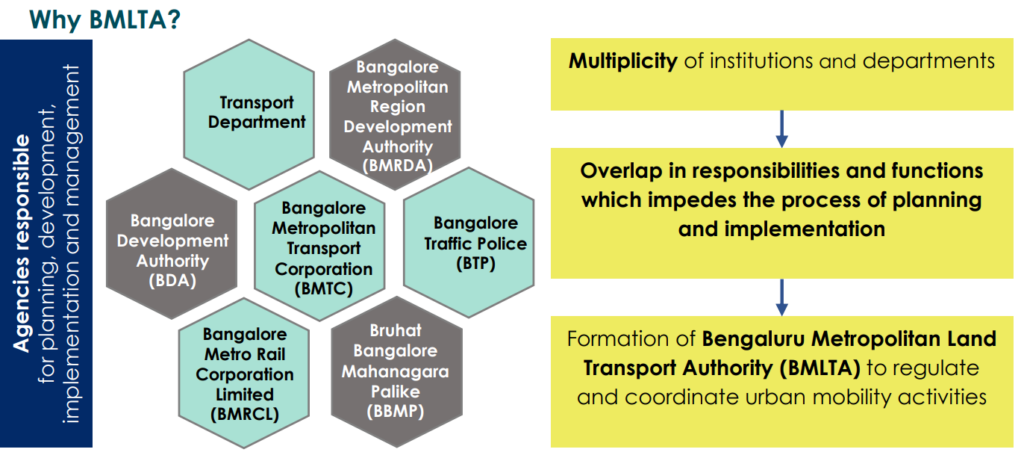
Currently, Bengaluru’s transport functions are under the control of various government entities like the BMTC, BMRCL, K-RIDE, the Bengaluru Traffic Police, and the transport department, leading to an overlap in responsibilities. So, there is a need for a single entity to integrate and manage all this as a Unified Metropolitan Transport Authority.
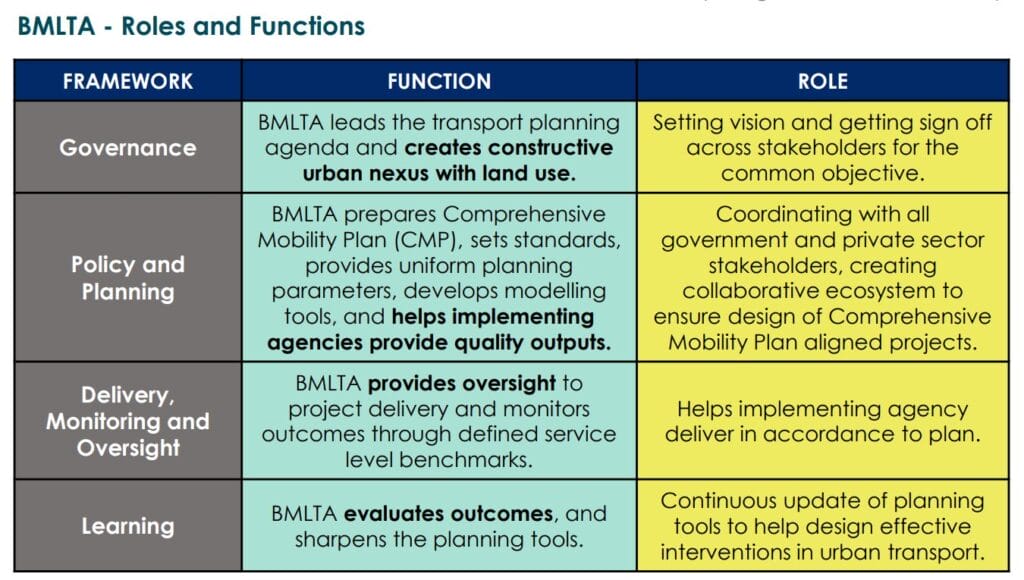
This is what the BMLTA is supposed to do: manage planning, implementation, financing, and regulation of all transportation in Bengaluru, prioritising public transport and enabling integration of multi-modal transport options.
BMLTA’s planning function aligns transport infrastructure with the city’s master plan and climate goals. It ensures that land use and transport planning are synchronised, preventing unplanned development that strains existing infrastructure (e.g., new layouts without adequate public transport). BMLTA develops and updates the Comprehensive Mobility Plan (CMP) every five years and prepares an annual Traffic Management Plan.
See: Bengaluru Comprehensive Mobility Plan
The Act also provides independent scrutiny of major infrastructure projects (e.g., flyovers, tunnels, elevated corridors) to ensure they align with the CMP and serve public interest.
Chronology
- 2007-10: The concept of a Unified Metropolitan Transport Authority (UMTA) for Bengaluru was first proposed in 2007, with the Directorate of Urban Land Transport (DULT) formed to assess transport demand and coordinate planning. BMLTA was set up by an executive order. In 2010, the then Director, Mohammed Mohsin, wrote on Citizen Matters, inviting public feedback on the draft BMLTA Act.
- 2022: The Legislative Assembly passed the Bengaluru Metropolitan Land Transport Authority Bill in December 2022.
- 2023: The BMLTA Act was officially notified in January 2023 and enforced on March 27th, 2023. From this date, any major mobility project in Bengaluru was required to obtain BMLTA approval, specifically under Section 19 of the Act, which mandates independent assessment and alignment with the Comprehensive Mobility Plan (CMP) and public transport needs.
- 2023–2024: Several high-profile projects, such as the tunnel road, were initiated without BMLTA scrutiny. In mid-2023, DULT reviewed the tunnel road project and recommended against its approval, citing misalignment with the CMP and Climate Action Plan. However, in December 2024, DULT retracted its comments, stating that BMLTA was not yet established!
- 2025: The government finally notified draft rules for the BMLTA in January, inviting objections and suggestions within 30 days.
Read more: Open letter to DULT and BMTC on improving public transport in Bengaluru
Activists say BMLTA should function as a professional, technical body, not as a rubber-stamp authority. There are also concerns about political interference and the inclusion of non-technical members, such as real estate representatives, in the BMLTA.
Jhatkaa has a petition calling for amending the draft BMLTA Rules. Citizens can endorse the email to be sent to the Additional Chief Secretary, Urban Development Department here.