“I am not fully convinced that my child’s and my personal data will be securely digitised under the APAAR ID initiative. I withheld some information, yet I’m anxious about my child’s safety and how this might affect her future education,” says Chaitra N, parent of a class 3 student in Bengaluru. Many parents share Chaitra’s growing unease about providing personal data for APAAR ID generation.
Tanuja R, mother of two undergraduate students, also had her reservations. “We place our trust in educational institutions to safeguard our children and their records, which ultimately shape their academic futures. That’s why, despite my hesitation, I did not oppose the APAAR initiative,” she says.
The Central government has been pushing for the Automated Permanent Academic Account Registry (APAAR) ID for school students, insisting that it will promote digital inclusion. Yet, the initiative has faced criticism from parents and activists for its implications on data privacy and whether it is actually required.
But first, what is an APAAR ID?
The APAAR ID is a unique academic identifier for every student in India. It is a 12-digit ID that contains the student’s certificates, degrees, mark sheets and achievements across their academic journey. This initiative is part of the ‘One Nation, One Student ID’ programme launched by the Ministry of Education in September 2023 and aligns with the National Education Policy 2020 (NEP 2020).
APAAR is linked to the Academic Bank of Credits (ABC), a digital platform by the ministry that is built to capture and store the academic portfolio for every student in India and allows for the transfer and accumulation of academic credits. The ABC shows that 33.85 crore students have created their APAAR ID in India as of November this year.
The identifier tracks every student’s transitions across institutions and degrees, maintaining a comprehensive record of academic data like degrees, diplomas and mark sheets, and co-curricular milestones like awards, skill training and sports. The Centre claims digitising these records will help simplify documentation, secure academic data and ease academic transfers.
Registering for APAAR is voluntary, and it is linked to the student’s Aadhaar number for verification purposes. Parents of minors are required to sign a consent form to generate an APAAR ID at the school level. It is stored on Digilocker, a cloud-based digital wallet for Indian citizens to store, share and verify official documents.
How to generate an APAAR ID?
Here is how the registration process works. Parents can either generate the ID through school authorities or do so themselves via digital platforms like Digilocker and ABC.
- Step 1: Verification: Parents must visit the school to verify APAAR details.
- Step 2: Parental consent: Parents must offer consent to provide students’ and their own details, if the student is a minor.
- Step 3: ID creation: Upon successful verification, the APAAR ID is created and added to DigiLocker for online access.
APAAR can also be generated digitally on the Digilocker or the ABC website.
Via Digilocker:
- Step 1: Log in to your Digilocker account/create a new account with a phone number linked to your Aadhaar card.
- Step 2: Under ‘Search Documents,’ look for ‘Academic Bank of Credits.’
- Step 3: Select the ‘APAAR/ABC ID Card’ option from the search results and fill in the required personal and academic details of the student.
- Step 4: Check the consent box and submit to generate your child’s APAAR ID.
To find your APAAR ID, navigate to ‘Issued Documents’ on Digilocker, find ‘APAAR/ABC ID Card’ and download the ID.
Via ABC:
- Step 1: Log in to your ABC account/create a new account with a phone number linked to your Aadhaar card.
- Step 2: Under ‘My Account,’ select ‘Student.’
- Step 3: When prompted, log in to your Digilocker account and authorise via KYC verification.
- Step 4: Fill in your personal and academic details and submit.
As per APAAR’s privacy policy, the following data is collected during registration:
- User account information: When creating an APAAR account, users may voluntarily provide personal information such as name, date of birth, gender, contact details, and authentication credentials.
- Educational records: APAAR may collect and store academic records, credentials, and other relevant educational information provided by users or authorised educational institutions. This may include marksheets, grade sheets, transcripts, diplomas, certificates, and other academic achievements.
- Technical information: The system also collects information about the user’s device and internet connection, such as IP address, browser type, and operating system, to ensure the ‘proper’ functioning of APAAR.
Voluntary or forcibly mandated?
But the initiative has been problematic from the beginning. While APAAR is not mandatory, reports reveal that the Ministry of Education issued letters to state chief secretaries, urging schools to persuade students to create APAAR IDs. Many states are aggressively pushing for compulsory registration, worrying students and parents.
Moreover, educational institutions have little clarity over the “voluntary” nature of APAAR ID generation and data usage. “We were given a two-month deadline to generate IDs for all the students. Class teachers needed to complete APAAR generation for every child,” says Tina Caroline, nursery teacher at a private school in Bengaluru.
“No consent form was given to the parents. We follow any directives that come from the state/centre. Additionally, our students’ parents are not very well-informed and most of them are daily-wage workers, so we cannot explain every administrative task to them,” says a principal of a state government school in Bengaluru, who requested anonymity for administrative reasons.
“APAAR is unconstitutional; violates right to privacy and RTE”
Research by the Internet Freedom Foundation (IFF), an Indian digital rights advocacy organisation, reflects that right from the implementation stage, APAAR has been dodging legal barriers. IFF points out that no policy document or law backs the APAAR framework, except for a PowerPoint presentation. No press releases, frameworks of implementation, data use or privacy policies are specified. Education falls under the concurrent subject, meaning states and the Centre have legislative power for education. However, no state has officially refused the APAAR ID initiative.
“Any collection of personal information, whether through a legal process or otherwise, is a violation of the constitutional right to privacy. There is no two ways about it. So, APAAR in itself is unconstitutional,” says Niranjanaradhya VP, Bengaluru-based development educationist.
Read more: Most urban schools violate law, exclude children with disabilities
After a prolonged delay, the Digital Personal Data Protection Act, 2023 (DPDPA) and the Digital Personal Data Protection Rules, 2025 (DPDP Rules, 2025) came into effect on November 13, alongside the establishment of the Data Protection Board of India (DPB). The IFF warns that the DPDP Rules allow state agencies to collect personal data with scant oversight, reinforcing state control. The foundation demands that privacy and transparency be constitutionally safeguarded, DPB be given independent status and state exemptions and surveillance power be curtailed—issues overlooked in the DPDPA.
Denial of the right to education
As APAAR is founded on the Aadhaar mandate, it conflicts with the Right of Children to Free and Compulsory Education Act, 2009, which makes education a fundamental right for all children aged 6 to 14. “Aadhaar number is compulsory to generate APAAR ID. With schools strongly pushing for the APAAR ID generation, what will happen to children who do not have Aadhaar cards? Will they be denied education, disrupting their right to education?” asks Niranjanaradhya.
He adds that although APAAR is described as “voluntary,” directives from the Central government often become mandatory, leaving parents and students with little choice.
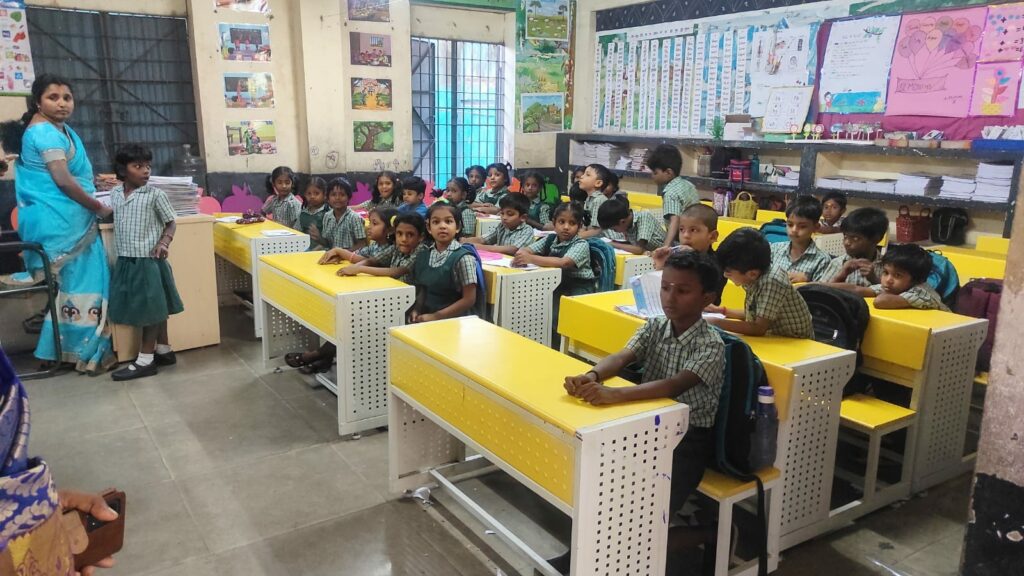
Representative Image. Pic: Padmaja Jayaraman
Edu spaces lack clarity over APAAR guidelines and usage
Teachers and principals this reporter spoke to said Aadhaar was mandatory for school admissions. While students without it will not be denied a seat, parents must obtain Aadhaar cards for their children within a set timeline to complete the process.
Teachers also expressed confusion about APAAR ID, as they already record student data in the Unified District Information System for Education (UDISE). The UDISE interface is a digital portal for maintaining student records, managed by the Ministry of Education. It is a comprehensive Management Information System (MIS) designed to collect, manage, and analyse real-time data from over 1.5 million schools across the country.
UDISE was earlier managed by the National Institute of Educational Planning and Administration (NIEPA), an autonomous body that stores academic data for research purposes only. In 2018-19, UDISE came under the Ministry of Education, which, experts say, offers no better security than APAAR. “The ministry is a political body, so we can never be sure how the data will be used. So, UDISE or APAAR, our children’s data is at risk,” says Niranjanaradhya.
Many parents registering at schools are not briefed about consent forms and their significance.
“I had no idea I was signing a consent form for the Central government to store my child’s data. I assumed it was for internal documentation purposes,” said Chaitra, who confronted teachers about APAAR and data usage, only to be met with perplexed expressions as teachers and administrative staff remain unaware of post-APAAR ID generation processes.
Understand APAAR before generating ID
“When there was resistance to the National Education Policy 2020 (NEP 2020), the Centre conceptualised APAAR to dominate and take complete control over students’ data,” says Niranjanaradhya. He cautions that placing student data in the public domain could open children up to serious vulnerabilities — from the misuse of their information in AI-driven content to dangers such as child trafficking.
Educationists pin the responsibility on educational institutions to reject unlawful initiatives like APAAR. However, IFF encourages parents to voice their concerns repeatedly.
- Parents must know their rights: APAAR is voluntary, and an Aadhaar card is not mandatory for school admissions. Section 6(4) of the Data Protection Act, 2023 allows parents to withdraw consent at any time, with the process required to be as simple as initially granting consent.
- Form parent collectives: The participation of parent groups is crucial in questioning and responding to initiatives like APAAR.
- Ask questions: School administrations are answerable to parents to document their children’s data. IFF lists some important questions to ask school authorities:
- What will happen if I deny consent for my child to be enrolled in APAAR ID?
- What is the process for giving consent?
- How can I withdraw my consent later?
- What happens to my child’s data if I withdraw consent?