As the monsoon continues to wreak havoc in Mumbai, residents of Appa Pada, living along the slopes of the Malad hillocks within the Sanjay Gandhi National Park (SGNP), are among the worst affected. As soon as the rainy season begins, they find eviction notices pasted on their doors. The Forest Department also erects banners warning residents to vacate the area because of monsoon-related hazards. These notices seem to absolve the government of any responsibility in the event of an accident.
Appa Pada continues to be susceptible to landslides, posing danger to the hillock’s inhabitants. Despite this, the Brihanmumbai Municipal Corporation (BMC) is yet to build a retaining wall to protect the families who live there precariously, risking life and limb. Neither have they received safe housing.
Residents are still haunted by the memories of July 2nd, 2019, when the wall along the Malad Hill water reservoir collapsed, claiming 32 lives and injuring about 120. Although the Maharashtra government took steps to rehabilitate some affected residents—relocating about 84 families to Mahul in 2021 and another 73 to transit accommodation in Malad in 2023—many others remain behind, living with emotional scars and constant fear, as reported by Citizen Matters.
The aftermath of the wall collapse
The BMC, tasked with rehabilitating those impacted by the landslide, claims to have fulfilled its responsibility. However, only the 150-odd families directly affected by the wall collapse have been resettled in new homes, while 500 families continue to live in Ambedkar Nagar on the same stretch even today, facing imminent danger from landslides.
In a report following the accident, a joint fact-finding team of civil society organisations, volunteers and independent experts termed it a man-made disaster caused by socio-economic and planning failures. The team blamed the State government for delays in rehabilitation that had led residents to live in unsafe conditions, and called for immediate measures to provide new homes for the community.
Families affected by the tragedy were either relocated to Mahul or given temporary housing near their original homes in Malad. The transit homes were allotted in 2022 after residents protested against moving to Mahul, which was deemed unfit for living due to overcrowded, poorly ventilated buildings, inadequate sewage and waste management, lack of clean water, and severe pollution from nearby industrial plants.
Read more: Appapada fire: Did authorities do enough to support affected families?
The current scenario
“I was relocated to this transit house at Malad on August 22nd, 2022, with the assurance that we would receive our own home in five to six years. It’s already been three years here, and there is no sign of our permanent house,” says Munni Ramakant Gaud.
Munni lost her 23-year-old son in the wall collapse. She was granted accommodation in Mahul, which she refused. Later, Munni sat on a hunger strike demanding better housing, after which she was allotted transit accommodation in Malad. The transit homes are not in the names of the occupants, and the authorities have allotted them on the condition that these homes would have to be vacated whenever alternative accommodation becomes available in the future, informs Munni.
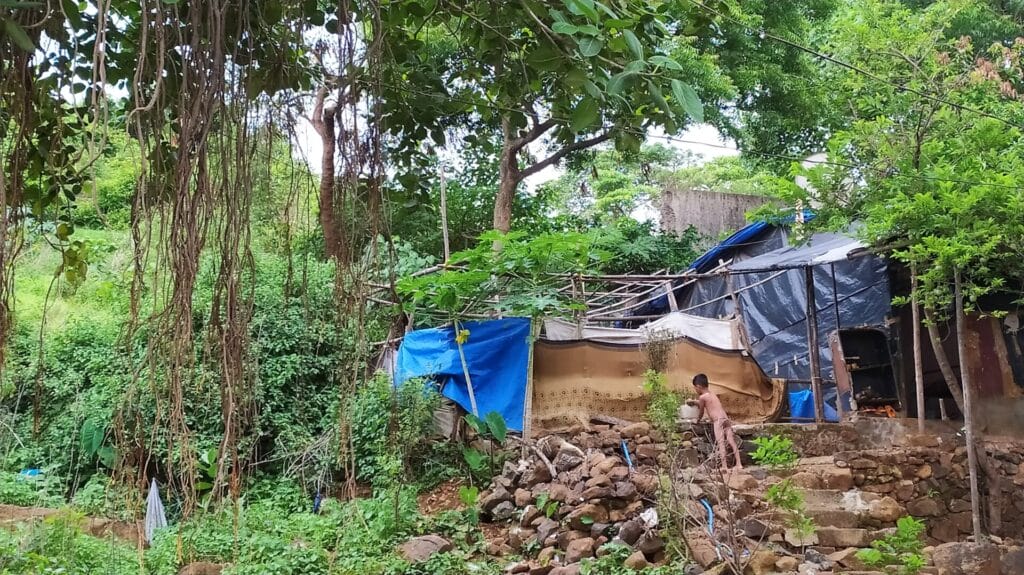
While residents like Munni are worried about home security, many others, living in hutments, fear for themselves and their families whenever heavy rains batter the hills.
When it rains, it pours
With the collapsed walls yet to be rebuilt, the nights are especially difficult, say residents. “We are unable to sleep and stay alert all night. We call up our neighbours and warn them if we feel that the water levels could rise,” says Krishna Dodekar, 57, who lives along the water channel.
“During heavy rains, the rainwater that flows alongside my house carries with it loose soil and stones. Due to the slopes, at times, the rush of water leaves a depression in the ground that can get treacherous particularly at night when it is pitch dark. Worse, since the electricity lines are temporary, the wires often break leading to disconnection of power supply.”
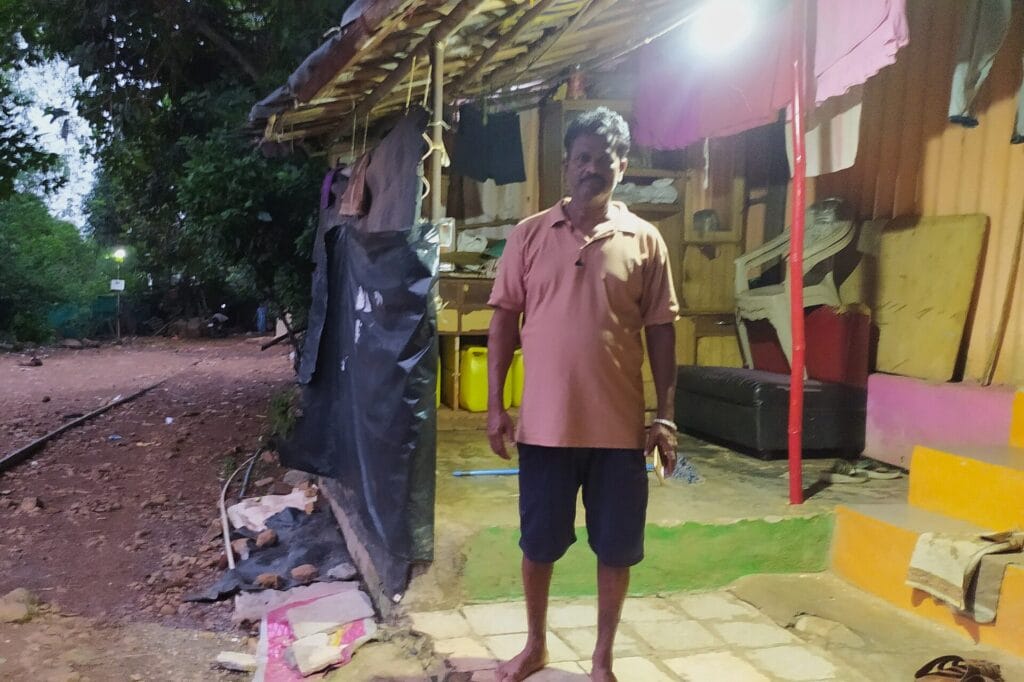
Many step out of their homes to check the water flow and clear blockages to prevent flooding. They follow a familiar routine, shifting the women and children to the local temple yard and the local school when the downpour intensifies. The men scurry together and shift important household items. While it is a difficult time, the trust and camaraderie among neighbours keep them going.
Lack of basic amenities
The informal settlement lacks basic infrastructure—no public electricity, roads, or clean water. Residents have to climb stone paths to reach their homes. They rely on illegal utility connections, often charged arbitrarily without proper tariffs or bills.
One family living in a single-room hut pays ₹2,000 for electricity and ₹300 for water, while another pays ₹2 per 40-litre gallon from a nearby well. Most residents, employed in low-income jobs like driving or painting, cannot afford to stay in the plains and live on the Malad hillocks due to affordability, despite the severe risks and hardships.
Anil Chavan, a painter, whose mother has moved to Mahul, continues to reside at his mother-in-law’s house at Appa Pada, as he works in the neighbourhood. He recalls how every monsoon continues to be a story of trying to protect electrical gadgets such as televisions and refrigerators from the wrath of the rains. Even though the hut has a cement floor, during heavy rainfall, water still seeps through it, he says.
Since the land belongs to the Forest Department, several restrictions have been imposed on the people. Anil adds that they are prohibited from shifting their homes and bringing in new furniture or other household items. “The forest guards stop our vehicles and even prevent our houses from being painted. Most of the homes here lack basic furniture, and it is common for household items to get damaged by rainwater.
Anand Salvi, who has been staying here since 1992, says that for the residents left behind, the only protection from the relentless rain is the use of plastic sheets over their huts and protective bunds of bricks, cement and soil built by residents to train flow of runoff water.
Read more: Alleged arson, road plans and builders’ greed: All that Dindoshi Hills is fighting
Uncertain future for park inhabitants
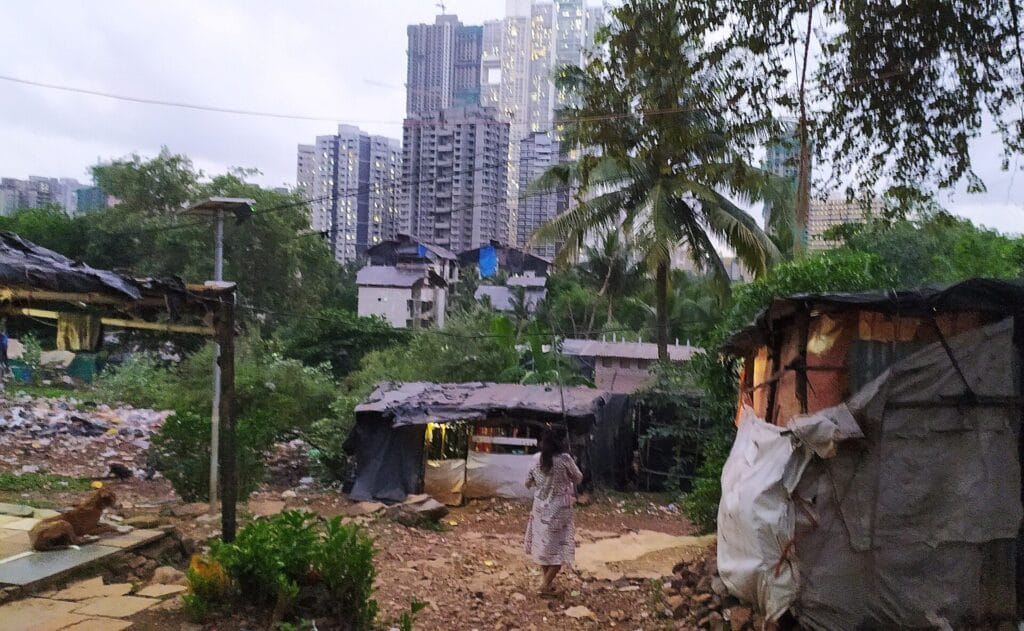
Bilal Khan, housing activist and founder of Ghar Bachao Ghar Banao Andolan, doesn’t seem hopeful that the government will provide new homes for Appa Pada residents, as the authorities have been citing a shortage of land to rehabilitate them. Also, with the courts denying them housing rights within the national park, their chances of being rehabilitated closer to their old homes look bleak.
In a written response during the 2025 budget session of the Maharashtra Legislative Assembly, Forest Minister Ganesh Naik informed that the state government is currently scouting for a location in Thane to rehabilitate affected residents. A survey will be conducted to identify eligible individuals, as the cut-off date for eligibility has now been extended from those residing in the area since 1995 to those who settled there before 2011.
To date, approximately 25,144 families living within the boundaries of SGNP before 1995, were deemed eligible for relocation and alternative housing outside the forest. Of these, over 11,359 families have already been allotted homes in Chandivli near Powai.
However, housing for the remaining 13,486 families is still pending, with many continuing to reside within forested areas. With the revised eligibility criteria now including residents who lived in SGNP up to 2011, the number of households qualifying for free alternative housing is expected to rise significantly.
“These people have been living inside the forest areas devoid of basic facilities like water, electricity or toilets. We have been unable to improve their condition using our developmental funds because of objections from the forest department, which refuses to provide the required no-objection certificate for them,” says member of legislative council Rajhans Singh, who has been keenly following this issue.
Alternative accommodation: A dream or reality?
Kundan Valvi, Assistant Municipal Commissioner (P-N Ward), told Citizen Matters that the issue has been resolved since the local people were provided with alternative accommodation. When it was pointed out that not all families living along the vulnerable stretch had received accommodation, he replied that he would check the details and revert.
The news of the authorities scouting for land in Thane has already unsettled residents. Anil wonders how he can manage to relocate to Thane when most of his work is based in Malad. “Families who shifted to Mahul have suffered a lot due to the loss of livelihood, owing to the bad public transportation there. Due to the poor frequency of BEST buses, there is over an hour-long gap between buses at times. This makes it difficult to commute to work from Mahul, unlike Malad, which is well-connected with trains and buses, making commuting easy, day or night,” he adds.
Others seem to have accepted the inevitable. “I have been living here for the last 40 years with no proper facilities or clarity about a permanent house for my family. I have lost my patience and might just accept the idea of going to live in far-off Thane just for the sense of security and having a safe place to live,” says Krishna.
Call to action
Here is what the activists and the residents have asked for:
- The government must speed up the rehabilitation process for Appa Pada residents.
- The alternative accommodation should be close to the current location to protect the livelihoods of residents and ensure their children’s schooling.
- In the meantime, residents must be accommodated in transit shelters that protects them from landslides and flooding.
- The authorities must ensure access to basic facilities such as roads, electricity, water and sanitation.