On January 6 2025, the Metropolitan Transport Corporation (MTC) launched the ‘Singara Chennai’ smart card, enabling cashless transactions not only on MTC buses but also on metro trains in Chennai. It can be used in Bengaluru and Delhi too, which accept the National Common Mobility Card (NCMC).
In the first phase of the rollout, MTC has partnered with the State Bank of India (SBI) and plans to distribute 50,000 cards free of charge. Within the first 15 days, MTC sold around 11,000 cards.
One of the challenges faced by MTC bus conductors and passengers is ensuring the correct change for tickets. To address this, MTC initially introduced UPI payment options. “However, this requires passengers to enter their UPI/ATM PIN in public, which could potentially expose their PIN. The smart cards will ensure safer digital transactions,” say MTC officials.
In this explainer, you will find all the answers to your queries about the Singara Chennai smart cards.
Read more: GPS speakers, panic buttons, pink buses and more: What the MTC rider in Chennai can look forward to
Where can you get the Singara Chennai cards?
MTC has selected 20 bus depot counters in high-traffic areas to issue the cards. The agency plans to expand availability to other locations soon. These counters will be open from 8.30 am to 6 pm.
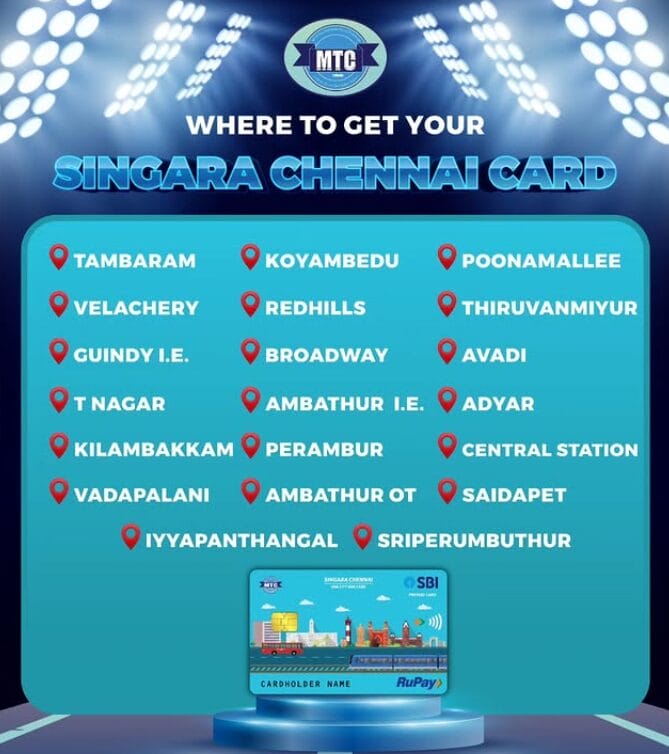
What proof do you need to get the Singara Chennai card?
No identity proof is required to obtain the card. You will need a mobile number to register it. Once linked, you will receive an OTP, which must be provided to the person in charge at the counter. When the OTP is entered, the card will be activated. While the card is free, a minimum recharge of ₹100 is required to start using it. There is no validity period for the recharged amount, and there is no need to maintain a minimum balance on the card.
How to recharge the cards?
The card is a prepaid top-up card and can be recharged in four ways:
- Phone Pe
- Airtel Thanks
- YONO SBI
- Transit.sbi webportal (You will have to first link the card and then recharge)
How to recharge using Phone Pe?
How to recharge using Airtel Thanks?
How to recharge using YONO SBI?
Since there is no provision for automatic updating of the balance in the card, you will have to update it at recharge counters in bus depots or Metro Rail stations. MTC is also working on enabling recharges through bus conductors. NCMC is collaborating with other mobile payment applications as well.
Where can you use the Singara Chennai card?
The same cards (the ones with the chip) are also provided at the Chennai metro stations. These cards can be used on Chennai’s MTC buses and metro trains. They are also valid in other cities such as Bengaluru and Delhi, which comply with NCMC standards. The old Chennai metro cards (those without the chip) can only be used in Chennai metro trains and will not be accepted in MTC buses or in other cities.
Read more: MTC focussed on intelligent bus system in Chennai: Managing Director Alby John Varghese
How to use the card in MTC buses?
The MTC bus conductor’s ticketing machine will have four options: cash, debit card, UPI and NCMC. The smart card operates using near-field connectivity, meaning you can simply tap the card to generate a ticket in a matter of seconds.
What to do if you lose the card?
If you lose the card, you can report it at a bus depot or metro station counter to block or deactivate it. Using the same mobile number, you can then obtain a replacement card. Currently, there is no provision to transfer the remaining balance from the lost card to the new one. However, MTC officials say they are in talks with banks to facilitate this transfer in the future.
What can we look forward to in further phases?
In the second phase of the project, passengers will be able to book tickets from anywhere using MTC’s customer application. In the subsequent phase, all passes, including student concession passes and seasonal passes, will be digitised.