Broken footpath puts students at risk

Hundreds of college students risk their lives everyday walking on the busy ORR in Nagarbhavi, thanks to broken footpaths.

A 600-metre stretch of footpath, along the Old Outer Ring Road in Nagarbhavi, has become a nightmare for pedestrians. This stretch starts from the main gate of Dr Ambedkar Institute of Technology (Dr AIT), a leading engineering college, and ends at Kengunte Circle. The Indian Institute of Plantation Management (IIPM), an educational institution under central government’s Ministry of Commerce and Industry, is also located along this stretch.

This stretch of footpath is perilous for the thousands of students and staff of IIPM and Dr AIT, and the general public, who use it everyday. It is ever-filled with vast volumes of garbage, which even overflows onto the ORR.

There are also many obstructions on the footpath, preventing free movement of the public. For example, the footpath was recently dug up to lay Optical Fibre Cable, but was not professionally closed.
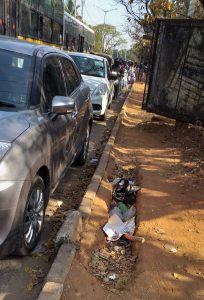
OFC and other obstructions on the footpath. Pic: Gundappa Srinivas

Because of these obstructions and garbage, and unevenness of the footpath, pedestrians end up walking on the very busy ORR, risking their lives. When vehicles stop at the traffic signal at Kengunte Circle, pedestrians get jammed up on the road, unable to walk freely.

Under the circumstances regular commuters are really crying out for authorities to:

  • Build a slip-proof footpath from Dr AIT to Kengunte Circle, that is accessible to both the elderly and people with disabilities
  • Have zero tolerance to garbage, with strict monitoring, to keep the footpath clean
  • Remove obstructions on the footpath, especially ugly structures like the BDA layout plan displayed close to Kengunte Circle, so that there is space to walk
  • Build spacious, disabled-friendly bus shelters at Kengunte Circle

Leave a Reply

Your email address will not be published. Required fields are marked *

Similar Story

Chennai’s ₹697 crore electric buses: Do they serve people who need it most?

While Chennai has invested crores in cleaner buses, public documents do not show if this deployment has improved mobility in high-density wards.

When Chief Minister M K Stalin flagged off Chennai's first batch of low-floor electric buses in June 2025, the programme was presented as a major step towards cleaner and more modern public transport. The first phase alone involves acquring 625 electric buses at a reported cost of ₹697 crore. The fleet includes 400 non-air-conditioned and 225 air-conditioned buses and is being operated from five depots: Vyasarpadi, Perumbakkam, Central, Tondiarpet-I and Poonamallee. The investment is substantial. Chennai has not inducted a fleet of this size in years. The buses are low-floor, wheelchair accessible and equipped with passenger information systems, CCTV cameras…

Similar Story

Riding the Chennai Metro is a breeze, but last-mile connectivity remains a worry

Chennai needs a unified transit system to ensure seamless travel for metro commuters on either side of the journey.

Stepping off the Thirumangalam metro at 6.45 pm, the train ride seemed effortless. It was cool, fast, and on time, taking just fifteen minutes from the office. Now comes the hard part. Standing at the station exit, finding a ride home is a struggle, as I switch between three apps to book an auto. The metro feeder bus only runs every 40 minutes and has just left. By the time I reach home, the "fast" metro trip has cost an extra half-hour and ₹120 in surge-priced rides, a last-mile problem the metro itself was built to solve. This is the…