Broken footpath puts students at risk

Hundreds of college students risk their lives everyday walking on the busy ORR in Nagarbhavi, thanks to broken footpaths.

A 600-metre stretch of footpath, along the Old Outer Ring Road in Nagarbhavi, has become a nightmare for pedestrians. This stretch starts from the main gate of Dr Ambedkar Institute of Technology (Dr AIT), a leading engineering college, and ends at Kengunte Circle. The Indian Institute of Plantation Management (IIPM), an educational institution under central government’s Ministry of Commerce and Industry, is also located along this stretch.

This stretch of footpath is perilous for the thousands of students and staff of IIPM and Dr AIT, and the general public, who use it everyday. It is ever-filled with vast volumes of garbage, which even overflows onto the ORR.

There are also many obstructions on the footpath, preventing free movement of the public. For example, the footpath was recently dug up to lay Optical Fibre Cable, but was not professionally closed.
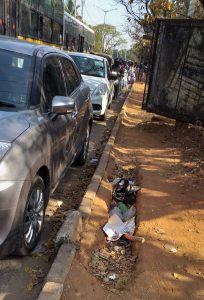
OFC and other obstructions on the footpath. Pic: Gundappa Srinivas

Because of these obstructions and garbage, and unevenness of the footpath, pedestrians end up walking on the very busy ORR, risking their lives. When vehicles stop at the traffic signal at Kengunte Circle, pedestrians get jammed up on the road, unable to walk freely.

Under the circumstances regular commuters are really crying out for authorities to:

  • Build a slip-proof footpath from Dr AIT to Kengunte Circle, that is accessible to both the elderly and people with disabilities
  • Have zero tolerance to garbage, with strict monitoring, to keep the footpath clean
  • Remove obstructions on the footpath, especially ugly structures like the BDA layout plan displayed close to Kengunte Circle, so that there is space to walk
  • Build spacious, disabled-friendly bus shelters at Kengunte Circle

Leave a Reply

Your email address will not be published. Required fields are marked *

Similar Story

A four-hour commute: The daily transport struggles of women from Chennai’s resettlement areas

Watch this video to understand how absence of last-mile connectivity and unreliable public transport in Chennai is failing those who need it the most.

Chennai has long had a tradition of public transport usage, with commuters having the choice of the suburban railway network, Metropolitan Transport Corporation (MTC) buses operating in the city and the Metro Rail for their daily transit. Despite the government introducing new services recently, especially electric buses, private vehicles numbers have soared and bus ridership has gone down considerably. Last mile connectivity issues, poor coverage in certain areas and the inability of the government to encourage residents to use public transport are major impediments. In fact, private vehicles make up 65 per cent of all motorised transport in the Chennai…

Similar Story

The infrastructure of waiting: How Bengaluru’s gridlock steals our right to time

Bengaluru needs accessible infrastructure that makes life easier for everyone, not tunnels and corridors built for a privileged few.

Selomi's text arrived at 7 am. "Let's leave by 8.30. The traffic will be brutal otherwise." We both live about 10 kilometres from the government office we had been going to every day for the last two weeks. The nearest metro station is four kilometres from our homes, which means forty minutes to reach it, twenty on the metro, and twenty-five on foot from Vidhana Soudha to the office. An hour and twenty minutes each way, assuming nothing goes wrong. In Bengaluru, something always does. By the end of the second week, we had the routine down. Coffee in a…