Each year, an MLA is given Rs 2 crore to spend on developmental works in his constituency. He/she can allocate the funds for government, community and health infrastructure, to create permanent solutions to the problems. This article gives an idea on how and what can the funds be spent on.
☛ Click here for full data set of works done/ sanctioned under N.A Haris’ MLA Local Area Development Funds.
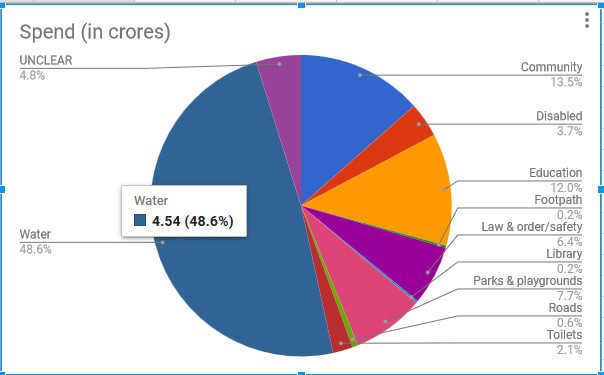
An MLA is given Rs 10 crore for spending on his constituency in five years. N.A. Haris’ accounts show an expenditure of Rs 9.34 crores in five years. He appears to have spent almost half of this amount, Rs 4.54 crores, on water-related infrastructure. There are 59 items listing construction of borewells, priced at Rs 2.5 lakh to Rs 6 lakh each.
Haris has constructed almost 22 Reverse Osmosis plants for pure drinking water. Each plant cost around 9 to 10 lakh rupees.
Next, educational development has received allocations of Rs 1.12 crores. The work undertaken is mainly some additions to construction of school buildings. Meanwhile toilets, road development and health infrastructure got scanty support; no amount was spent on construction of bus shelters (like in Mahadevapura), or giving the disabled special facilities.
Strangely, there are almost 10 items listing expenditure on Muslim burial grounds at Wannar Pete Ward. It is interesting that some of these rows show ‘0’ expenditure, but overall Rs 82.5 lakh has been spent on this project.
There are three instances of a few names being and money listed, with no clear indication of what it was for. A total of Rs 45 lakhs has been spent thus, and mentioned in the chart below as ‘UNCLEAR’.
[During our interview with Haris when we asked for clarification, the MLA didn’t seem to recognise the spend, but has promised that he would get the details and get back to us. This article will be updated as soon as that happens.]
The category break up for all the five years looks like this:
|
Category |
Spend |
|
Community |
1.26 |
|
Disabled |
0.35 |
|
Education |
1.125 |
|
Footpath |
0.02 |
|
Law & order/safety |
0.6 |
|
Library |
0.02 |
|
Parks & playgrounds |
0.72 |
|
Roads |
0.056 |
|
Toilets |
0.2 |
|
Water |
4.54 |
|
UNCLEAR |
0.45 |
Bangalore Political Action Committee (BPAC) has done a LAD fund usage percentage video for Haris, from 2013 to 2016: https://www.youtube.com/watch?v=z8ql52ptB6s (Source:BPAC)
Check closely the MLA LAD data spend for Shantinagar constituency, in this list of data available here.
Citizen Matters invites citizens from the constituency to share their observations on the ground reality, as comments below this article.
This article was compiled jointly by Revathi Shivakumar and Shree D N.
Quite some good money seems siphoned off !