On Saturday, February 18th, Prof. Rajeev Gowda, Member of Parliament, spoke on ‘The Regulation of Risk’ at the Beyond Carlton Annual Memorial Lecture.
The Carlton Towers Fire on February 23 2010 claimed nine lives and injured over 60 people. Family members of those affected by this accident got together to form Beyond Carlton which focuses on advocacy, accountability and creating awareness about the hazards of fire accidents in India.
For the past few years, Beyond Carlton has been conducting an annual Memorial Lecture in February. Speakers in the past have included the likes of Swati Ramanathan, Co-founder Janaagraha; R.A.Venkitachalam, Managing Director of UL – the US-based Underwriters Laboratories that works on fire safety issues; Rajeev Chandrasekhar, Member of Parliament; V Ravichandar, civic evangelist; Justice Santosh Hegde, former Lok Ayukta; and Nitin Pai, Co-Founder, Takshashila institution.
Prof Gowda’s lecture at the TERI Auditorium, Bengaluru raised some important issues like:
- Why do societies tolerate certain risks and actively reject others?
- Are people rational in how they respond to risks?
- Do governments regulate risks appropriately?
- How and when does policy change occur?
- What does this all mean for India?
- What does this all mean for Fire Safety?
- Key challenges and potential solutions
He shared examples from various events and accidents that have occurred in different parts of the world and covered road accidents, nuclear fallouts, the Bhopal Gas Tragedy, the Uphaar Cinema Fire accident among others.
Talking about where communities can rally to make a difference, Prof Gowda talked about the Chennai floods a couple of years ago which were not just a natural phenomenon, but had some man-made triggers too, and how the community rallied around and where volunteers helped people get relief.
With respect to fire accidents he said, “Beyond Carlton is an extraordinary example of an initiative which is really making a difference. Otherwise imagine that there would have been no organization… that would have had (worked on fire safe safety)…”
Interacting with Prof Gowda after his talk, Lakshmi Rebecca, a long-term Beyond Carlton supporter who moderated the evening’s proceedings, asked about the social amplification of risk perception and how an effective campaign on fire safety could be created. The speaker’s response: “Look at smoking. Many youngsters today are aware of the danger of smoking. They don’t even take the first smoke where it all starts … Think about getting them young. Go into schools and bring in an awareness on fire safety. Do that in a creative way. Make it a competition for youngsters – they can do their own research, come up with their own posters, … and suggestions on what can be changed. Make it a part of school curricula across schools. Not just theory…”
Quoting some facts about fire accidents in India, Prof Gowda talked about how fire was killing an average of 49 people every day.
Post the lecture, well-known media personality Vasanthi Hariprakash, who is also a Member of Beyond Carlton’s Executive Council, interacted with Dharamvir Singh from Hyderabad. A Fire Superintendent in GHIAL, Hyderabad, Dharamvir Singh had, in June 2017, orchestrated the evacuation of 30 people trapped in the seventh floor of the Anupama Hotel in Madhuranagar at Shamshabad, Telangana, after the building caught fire.

Dharamvir Singh in conversation with Vasanthi Hariprakash. Pic: Deepa Vaishnavi
Singh shared interesting details about how the events unfolded that day. He also talked about how he and his colleagues handled the stress inherent in the job and how they tried to create an environment of camaraderie. Following the interaction, Prof Gowda handed over a Certification of Appreciation to him.
This was followed by a session in which trophies were given to firemen in Bengaluru chosen by their departments for the commendable work done by them. The awardees this year were:
- Prashanth Kumar, Fireman Driver – Hebbal Station
- B S Manjunath, Fireman – South Fire Station, Bengaluru
- K Suresh, Fireman – South Fire Station, Bengaluru
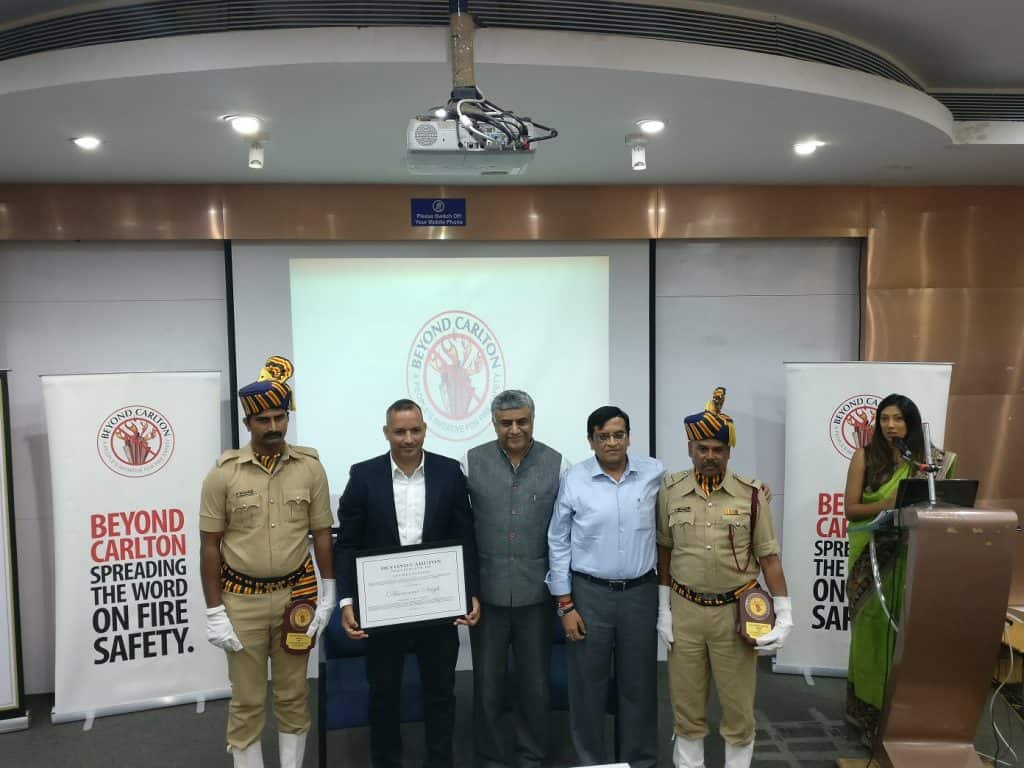
The awardees of the day with Rajeev Gowda, speaker of the day, Uday Vijayan of Beyond Carlton, and Lakshmi Rebecca. Pic: Deepa Vaishnavi
It was a stark reminder of the occupational risks that these firemen live with every day of their lives, when K Suresh, one of them chosen to be honoured, could not attend the function as he had been injured while helping the people trapped in the under-construction building in Sarjapur that collapsed a few days ago.