Sometimes dry, barren-seeming patches of land have so much of interest in them. Recently, my friend Manivannan S spotted, in a small empty lot, this Painted Grasshopper.
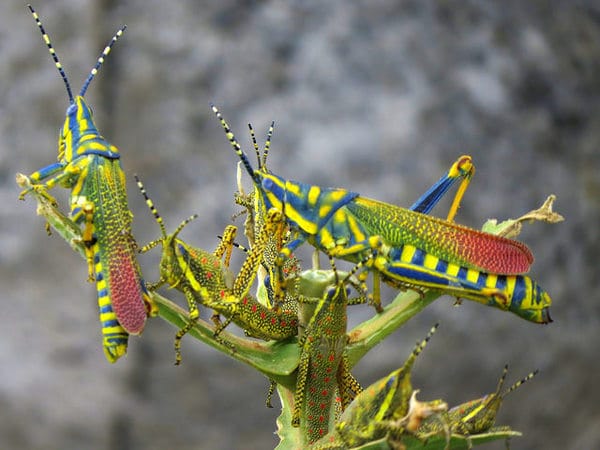
The wiki entry on this gorgeous-looking creature says that the grasshopper feeds on the poisonous plant Calotropis gigantea.
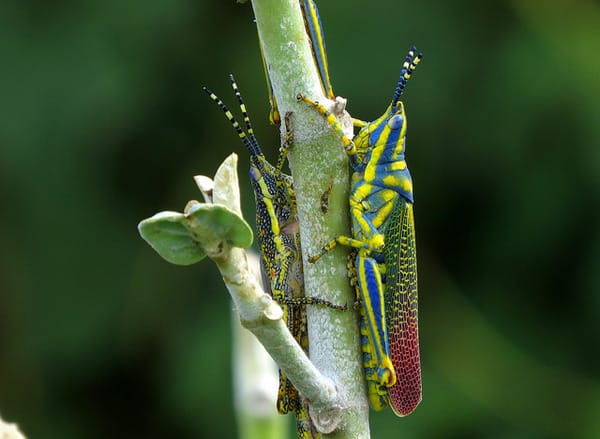
Certainly, these grasshoppers had stripped all the Calatropis (milkweed) plants nearby. Striking in appearance… The mature grasshopper has canary yellow and turquoise stripes on its body, green tegmina with yellow spots, and pale red hind wings.
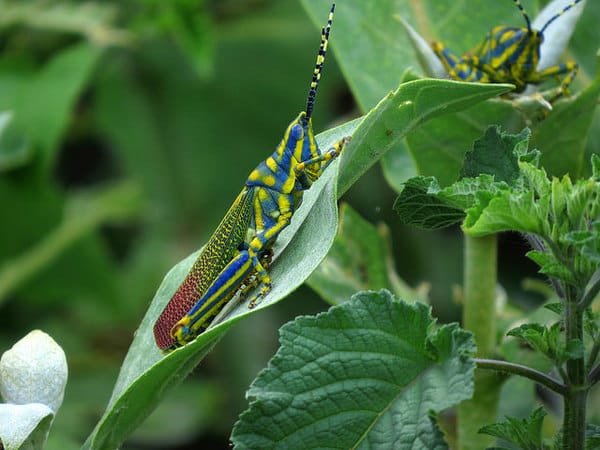
The wiki also mentions the interesting fact that these grasshoppers, when squeezed or handled, upon slight pinching of the head or abdomen, the half-grown immature form ejects liquid in a sharp and sudden jet, with a range of two inches or more, from a dorsal opening between the first and second abdominal segments. The discharge is directed towards the pinched area and may be repeated several times. The liquid is pale and milky, slightly viscous and bad-tasting, containing cardiac glycosides that the insect obtains from the plant it feeds upon.
Grasshoppers can eat their way rapidly through vegetation, being a veritable plague of locusts. They are plant-eaters, sometimes becoming serious pests of cereals, vegetables and pasture, especially when they swarm in their millions as locusts and destroy crops over wide areas.
Most grasshoppers are polyphagous, eating vegetation from multiple plant sources, but some are omnivorous and also eat animal tissue and animal faeces. In general their preference is for grasses, including many cereals grown as crops.
Grasshoppers seem extraordinarily sensitive to their environment through many of their senses. On the side of the head are a pair of large compound eyes which give a broad field of vision and can detect movement, shape, colour and distance. There are also three simple eyes (ocelli) on the forehead which can detect light intensity, a pair of antennae containing olfactory (smell) and touch receptors, and mouthparts containing gustatory (taste) receptors.
At the front end of the abdomen there is a pair of tympanal organs for sound reception. There are numerous fine hairs covering the whole body that act as mechanoreceptors (touch and wind sensors), and these are most dense on the antennae, the palps (part of the mouth), and on the cerci at the tip of the abdomen. There are special receptors (campaniform sensillae) embedded in the cuticle of the legs that sense pressure, too.
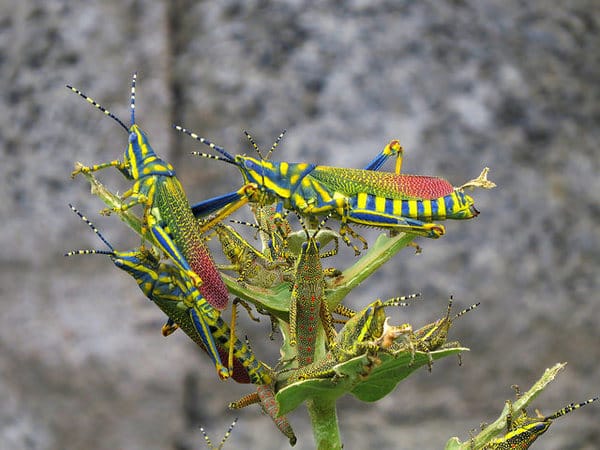
A large grasshopper such as a locust can jump about a metre (twenty body lengths) without using its wings! What a fascinating creature this is, and it was sheer chance that led me to this sighting, thanks to my friend Mani!
Related Articles