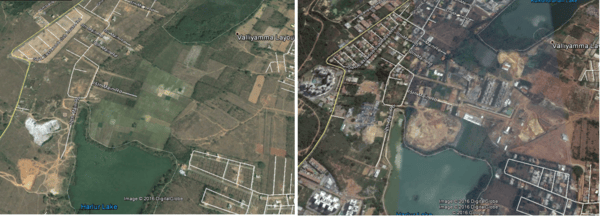
Difference between the topography of the land between Kasavanahalli and Kaikondrahalli lakes, in 2002 and 2016, as seen on Google Earth.
The Southern Bench of National Green Tribunal has dismissed the petition of Namma Bengaluru Foundation (NBF) and Mahadevpura Parisara Samrakshane Mattu Abhivrudhi Samiti (MAPSAS) related to a residential project coming up between Kasavanahalli and Kaikondarahalli lakes.
Stating that the case on the grounds that the developer has a valid Environmental Clearance, the NGT dismissed the petition and allowed the developer of Shriram Chirping Woods to continue with the project.
In an order delivered on April 26th, NGT bench comprising Dr P Jyothimani and P S Rao, dismissed the original application as well as the appeal made by the appellant. The court observed that according to the modified project plan approved by SEIAA, the project was coming up in a plot area of 62,927 sq metres, with a reduction of 1,112.07 sq metres from the original plan.
The modified plan intends to construct 17 towers with 810 residential units as against 21 towers and 870 residential units in the previous project plan. The NGT observed that the plan was modified to avoid the nala passing through the property. “It can not be said there has been any violation which substantially affects the original Environmental Clearance granted to the project proponent,” the court said.
Responding to the demands of the applicant’s counsel to consider the secondary rajakaluve running between the two lakes as primary rajakaluve, the court said that according to BDA RMP, the canal is a secondary canal and a minimum of 25 metres buffer zone has to be left out on both sides. The BDA has clarified that there has been no encroachment of Rajakaluve between Kasavanahalli and Kaikondarahalli lakes, the NGT bench observed.
However the court warned the developer not to disturb the course of Rajakaluve in future and in such case it will be always open before SEIAA to take action against the developer.
Citizen Matters had earlier written about the project, and had sought plans from the developer with regard to the drain in the valley zone, but had received no reply. Meanwhile, there is yet another construction coming up on the lake buffer zone in the wetland between Kaikondrahalli and Kasavanahalli lakes. Residents are concerned because these two lakes are interconnected with water from one lake flowing to another, and disturbing the flow pattern might affect the water inflow to the Kaikondrahalli lake.
Full order of National Green Tribunal:
Source: National Green Tribunal