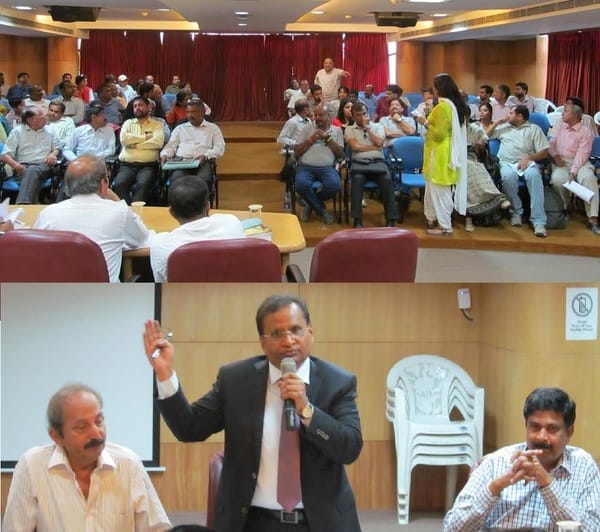
Pictures from the meet. Courtesy: KSPCB
Karnataka State Pollution Control Board (KSPCB) conducted a meeting with resident welfare associations of Bengaluru on March 9, 2016. Solid Waste Management and protection of lakes was discussed in the meeting. More than 150 associations participated in the meeting.
The meeting decided to:
– train public about protection and nurturing of environment around them
– have separate websites for each lake where people can place complaints if any.
– awareness drives on selected roads by students and public
– form a committee to monitor solid waste management and lake protection in Bengaluru/
Dr Arbind Kumar Gupta of One Bengaluru for Lakes team who attened the meet submitted a note to KSPCB. The note was compiled by Shubha Ramachandran of Biome Solutions. The letter urged the KSPCB to:
- Ensure that sewage is treated properly in private STPs:
- Tighten KSPCB CFE-CFO process for STP-approval and a formal process for handover of STP to RWAs.
- Survey all existing private STPs, and get them working and identify those residential / commercial units that are in violation of treating their sewage.
- Define and implement a monitoring mechanism for identifying RWAs that do not meet the regulatory requirement.
- Ensure that sewage is treated properly at BWSSB plants
- Set up public watch committees that will carry out periodic inspection of BWSSB STPs.
- Publish the result of auditing of all STPs on BWSSB on KSPCB website.
- Ensure that the rainwater, treated sewage and raw sewage are routed correctly
- Separate pipeline for sewage (do not use SWDs for sewage)
- Set up public watch teams to monitor solid waste dumped in road-side drains.
- Set up public watch teams to monitor sewage in Raj Kaluves and identify sources.
- Identify the sources of pollution that are hidden in the city (e.g. lead from batteries, heavy metals from plating shops, etc.).
- Conduct a city-wide GIS-survey to spot all polluting activities
- Find mitigation plan
- Implement it with area-wise citizen participation.
- Use and recycling of sewage water to meet water shortfall in the city.
- Set a deadline to prepare plans to recycle sewage and use it internally.
- Define mechanism for enforcement of violation to the regulation.
- Bring changes in existing laws relating to pollution to facilitate enforcement and control of entities that violate laws relating to pollution of water bodies.
- Regular monitoring of water quality of all lakes in Bangalore and sharing of data collected by the KSPCB by publishing it on their portal.
Related Articles
KSPCB asks BWSSB not to pollute water bodies
KSPCB releases STP guidelines, relaxes treated water norms