Wildlife surrounds us, and one doesn’t have to go anywhere except to the nearest patch of greenery to observe it.
Last week, I’d been to Lalbagh, and observed the wonder of the Weaver Ants . The scientific name for these ants (not that we need to bother much about it!) is Oecophylla.
Weaver ants, especially the worker ants, make their nests by creating an ‘ant-silk’… Workers construct nests by weaving together leaves using larvalsilk.
But this time, it was unusual to see the ants covering the fruit of the Soursop tree (Annona muricata) for their nests! Perhaps the ants were finding the fruit a ready source of nutrition.
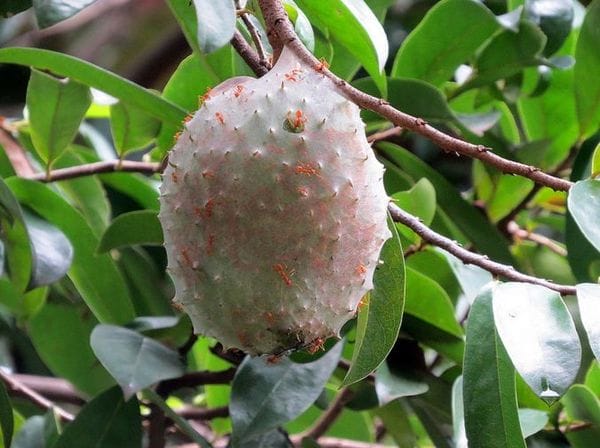
Here is an ant-silk covered Soursop fruit. Pic: Deepa Mohan
Many studies have shown the efficacy of using weaver ants as natural biocontrol agents against agricultural pests. Apparently, fruits harbouring weaver ants produce better quality fruit!
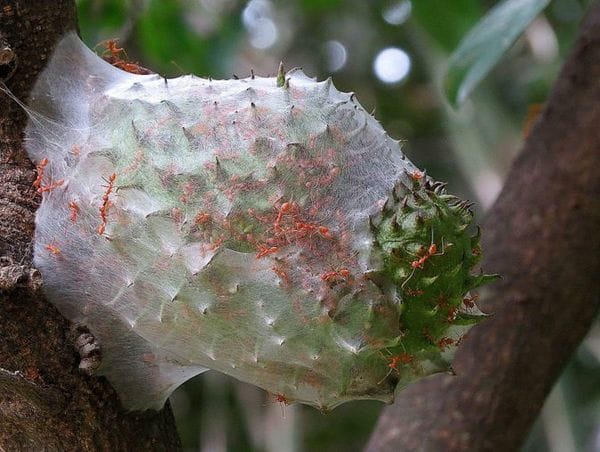
A side view of the fruit with the nest. Pic: Deepa Mohan
A surprising fact is that weaver ants are one of the most valued types of insects eaten by humans. This is called entomophagy. In Northeastern Thailand, the price of weaver ant larvae is twice the price of good quality beef!
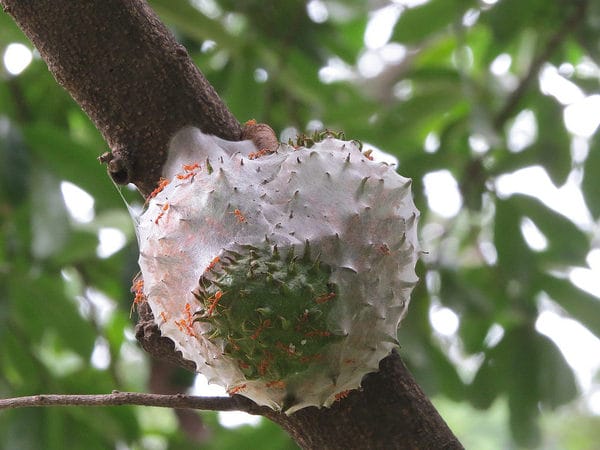
A frontal view of the fruit. Pic: Deepa Mohan
I also observed the behaviour that the Wiki entry talks about: “Oecophylla workers exhibit social carrying behavior as part of the recruitment process, in which one worker will carry another worker in its mandibles and transport it to a location requiring attention.”
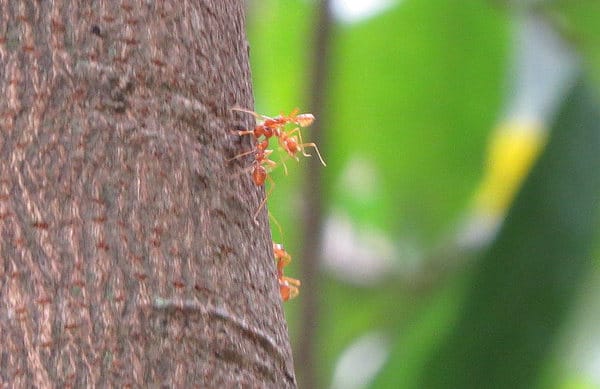
A weaver ant carrying the body of another ant. Pic: Deepa Mohan
Now that’s really like our ferrying our plumbers or carpenters to our house sites, isn’t it?
I left the busy ants running around on their silken home, and left, musing on the wonders that are there to be seen in every place one looks!
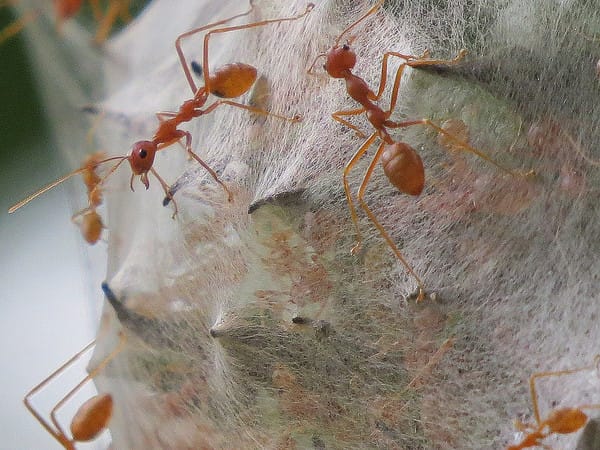
Weaver ants at Lalbagh. Pic: Deepa Mohan
So, the next time you spot a weaver ants’ nest… maybe you could take it home for a crunchy snack… you can bite into it, if you don’t get bitten first!
Related Articles
From Shrieks to Smiles – about the good insects
Dragons in the air
Website architecture