Weaving their way

The next time you visit Lalbagh, keep an eye out for the weavers of the insect world. Here's a look at the fascinating world of weaver ants.

Wildlife surrounds us, and one doesn’t have to go anywhere except to the nearest patch of greenery to observe it.

Last week, I’d been to Lalbagh, and observed the wonder of the Weaver Ants . The scientific name for these ants (not that we need to bother much about it!) is Oecophylla.

Weaver ants, especially the worker ants, make their nests by creating an ‘ant-silk’… Workers construct nests by weaving together leaves using larvalsilk.

But this time, it was unusual to see the ants covering the fruit of the Soursop tree (Annona muricata) for their nests! Perhaps the ants were finding the fruit a ready source of nutrition.
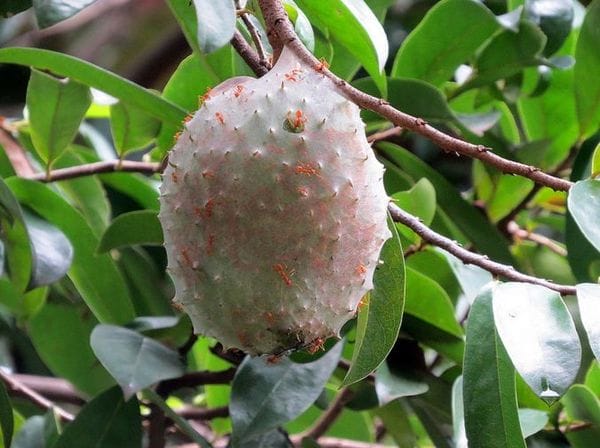
Here is an ant-silk covered Soursop fruit. Pic: Deepa Mohan

Many studies have shown the efficacy of using weaver ants as natural biocontrol agents against agricultural pests. Apparently, fruits harbouring weaver ants produce better quality fruit!
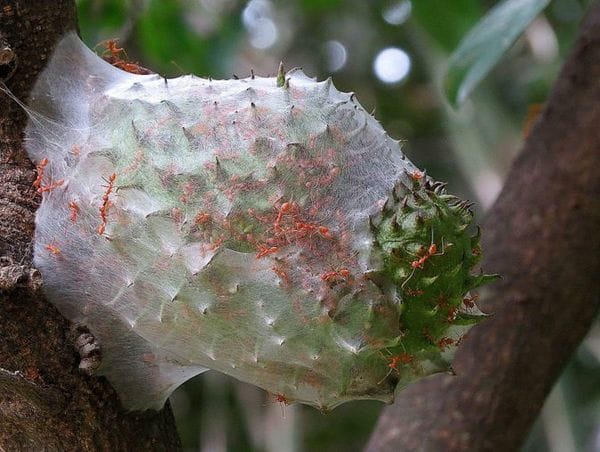
A side view of the fruit with the nest. Pic: Deepa Mohan

A surprising fact is that weaver ants are one of the most valued types of insects eaten by humans. This is called entomophagy. In Northeastern Thailand, the price of weaver ant larvae is twice the price of good quality beef!
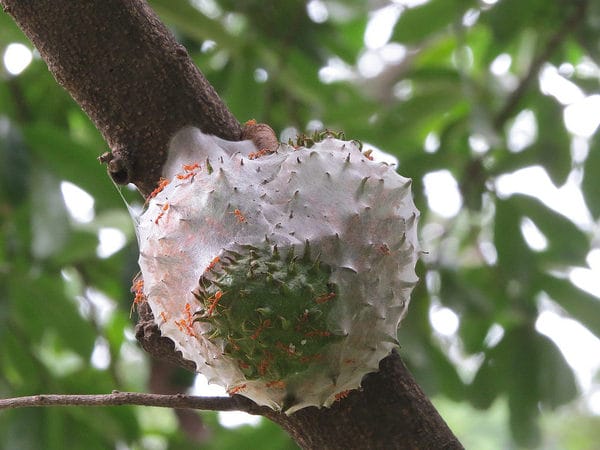
A frontal view of the fruit. Pic: Deepa Mohan

I also observed the behaviour that the Wiki entry talks about: “Oecophylla workers exhibit social carrying behavior as part of the recruitment process, in which one worker will carry another worker in its mandibles and transport it to a location requiring attention.”
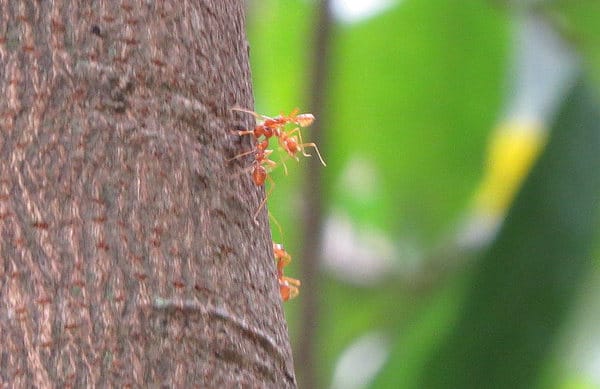
A weaver ant carrying the body of another ant. Pic: Deepa Mohan

Now that’s really like our ferrying our plumbers or carpenters to our house sites, isn’t it?

I left the busy ants running around on their silken home, and left, musing on the wonders that are there to be seen in every place one looks!
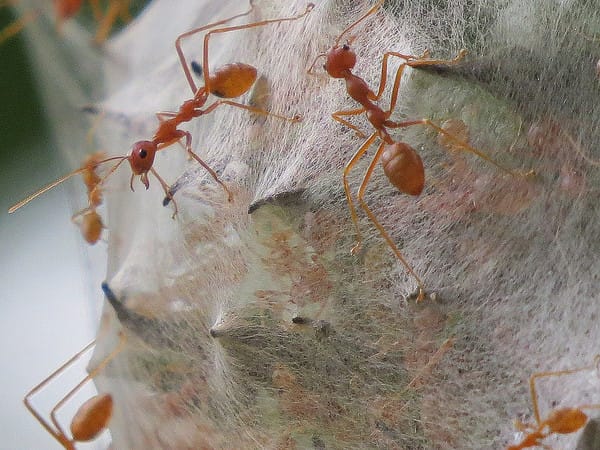
Weaver ants at Lalbagh. Pic: Deepa Mohan

So, the next time you spot a weaver ants’ nest… maybe you could take it home for a crunchy snack… you can bite into it, if you don’t get bitten first!

Related Articles

From Shrieks to Smiles – about the good insects
Dragons in the air
Website architecture

Leave a Reply

Your email address will not be published. Required fields are marked *

Similar Story

Open letter to Chief Justice of India: Withdraw unjust remarks made against environmental groups

In the letter, conservationists, lawyers and civil society groups highlighted the constitutional right of citizens to demand the enforcement of environmental laws.

A collective of citizens, environmentalists, legal experts and civil society organisations from across India has demanded that the Supreme Court withdraw oral remarks made by the Chief Justice of India (CJI) during the Pipavav Port hearing on May 11, 2026. The group aims to ensure these comments are not misinterpreted as questioning the legitimacy of genuine environmental public-interest litigation, or the constitutional right of citizens and affected communities to demand the enforcement of environmental laws. In an open letter to the CJI, the coalition outlined urgent environmental concerns and the right of citizens to question irregularities in projects negatively impacting…

Similar Story

The trees we forget: What a city loses when the canopy disappears

Bengaluru's trees are more than shade; they are memory, identity, and resistance. Their loss leaves the city harsher and emptier.

Summer in India has been merciless this year, with many states recording temperatures above 42 degrees Celsius and rising reports of fatalities. Despite these harsh conditions, urban support continues for development projects that clear trees, wetlands, mangroves, and forests near cities. A recent Article 14 report provides data on thousands of trees that will soon be sacrificed nationally for infrastructure projects. Those opposing such unscientific large-scale tree felling are often labelled 'tree-huggers', 'anti-development' and 'anti-nationals'. While capitalism accelerates environmental degradation and the world faces a growing climate crisis, societal divisions deepen.  Yet, we give trees too little credit: Beings necessary…