What’s crawly need not be creepy

The very word ‘Tarantula’ is something that strikes dread into most of our hearts. We’ve all heard the horror stories of ‘evil’ arachnnids delivering fatal bites.

However, though they may be deadly Tarantulas elsewhere, the ones we have nearby are generally more wary of us than we are of them, and do not bite until they are extremely disturbed.

Tarantulas comprise a group of very large and often hairy arachnids belonging to the Theraphosidae familyof spiders. Their large size and hairy appearance, combine to give most of us a dread of them. But they have some very interesting features!

Tarantulas do spin silk like other spiders do… but they do not have the kind of web that we often see. Instead, some of them, especially those which make homes in burrows, line their burrows with silk! Sometimes, to protect their babies, they even put up a “silk screen” in front of their holes.
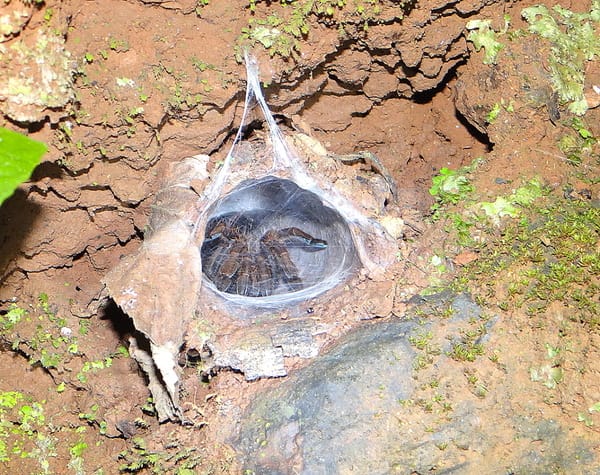
A tarantula under the silk-screen she has spun. Pic: Deepa Mohan

However, tarantulas themselves can be the prey for other insects. Here’s a video I took, as I once watched a Spider Wasp drag a Tarantula that she had stunned (you can still see it moving a little in the video), into a hole she made in the ground.

Such wasps then lay their eggs on the stunned spider, and when the larvae hatch later, they have fresh food. Another of the marvels of nature!

So, what’s crawly may not be creepy, if you get to know more about it… and the fear of the creature goes away, too!

Leave a Reply

Your email address will not be published. Required fields are marked *

Similar Story

Encroachment and drainage woes: Lessons to prevent flooding in Porur Lake

A study investigates the causes of flooding in Porur, flags the underutilised potential of the nearby sponge park and suggests connecting missing links.

When the northeast monsoon hits Chennai, a foreseeable result of the heavy downpour is severe flooding in several areas, including Porur Lake. As residents living near this 200-acre water body battle inundation every year, our team set out to investigate the root causes of flooding using available data. Environmental issues have often been dealt with a one-size-fits-all approach, but our study aimed to provide specific solutions tailored to the Porur catchment area. For this, we mapped inundation patterns, land gradient, land use change and the outlay of stormwater drains (SWDs).   At a recent datajam organised by the Oorvani Foundation…

Similar Story

From slums to skyscrapers: How Mumbai’s L Ward faces climate stress

Crowded lanes, shrinking green cover and increased construction make L Ward vulnerable to extreme heat.

Mumbai’s L Ward, covering Kurla, Chandivali, Saki Naka, and Powai, has been quietly heating up, and not just metaphorically. It is a ward of extremes: dense slums on one side, luxury high-rises and malls on the other. But when the mercury rises, the contrasts fade, and everyone feels the burn. With urban heat on the rise across the city, L Ward is emerging as one of Mumbai’s hotspots where everyday life is increasingly being shaped by climate stress. The heat problem Spread across 15.6 sq km, L Ward is home to more than nine lakh people, packed into one of…