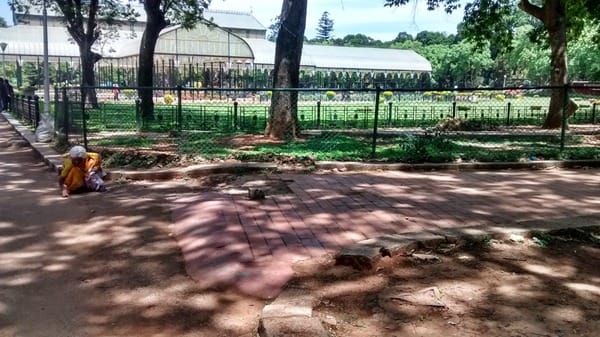
The wise woman at Lalbagh. Pic: Ashok Kumar S
This happened one sunny Saturday afternoon in Lalbagh. It was all green everywhere. Trees swayed all around me, a gentle breeze blew, birds chirped, squirrels ran down trees and grasshoppers hopped on the green grass.
I saw an old woman squatting down on a less-walked road in the park, plastic cover in hand, looking down at something. At first, I thought she was picking up tamarind, as there are a number of tamarind trees in the garden. I tilted my head and looked above to check if there was a tamarind tree, but no. So what was she doing then? Feeding ants with sugar?
I glanced at her for a while, and out of curiosity, I wanted to know what she was up to. I decided to walk up to her find out what she was really doing. Turns out, all my guesses were incorrect.
I went near her and with a low tone, greeted her. She greeted me back. I smiled at her and asked, “What are you doing? Are you feeding the ants?” “No”, she replied, “I’m not feeding the ants. I’m collecting the seeds fallen from the trees.”
Her response surprised me, so I asked her, “Are you going to use the seeds for some home remedy or Ayurveda medicine?”
She shook her head and said, “No, I’m going to sow these seeds in the ground – for the environment and its growth.”
It was very thoughtful of her. When you plant a seed, it may grow slowly at first; but it will become a tree one day and give shade to others.
If you are surrounded by trees, you would probably find no reason to complain about the hot weather. You know why? The trees understand the heat better than we do, and take it all in and give us shade. People who live in the heart of Bengaluru are lucky that they are surrounded by trees and big parks.
The old woman showed me one of the finest ways to give back to our society and nature. She set an example. Just like you take from nature, you give back to it. In her own small way, she was doing her part to combat the rising temperatures.
This lady truly inspired me! Please join me in appreciating her for her great display of character in the fight against global warming. The experience of meeting (or even reading about) good people like this woman can change the way one sees the world.
Related Articles
Painting the town red, green, yellow and every other colour
Your guide to tree-planting in Bangalore this season
Tradition helps protect sacred trees in old Bengaluru areas
During my childhood in Richmond Town, many of the houses had many trees. There used to be people who would walk around, picking the Silver Oak seeds. For me too, this was a way of earning my own money. There were seed buyers who would do the rounds, like old newspaper buyers. They paid by the ‘pav’ measure. Silver Oak seeds are very slim and papery, and you need thousands to make a pav. My best effort was three pavs for which I got Rs 21, sometime in the early 1980s, that was promptly deposited in my Post Office SB acct.
‘@Arathi,
You just literally brought a picture of old Bangalore in front of my eyes. How nice it is! You’d learnt how to earn your own penny in your childhood days by collecting the tiny silver oak seeds and selling them.So did I. In my childhood days, I used to collect the fallen pongamia seeds and sell it to the buyers. You made me remember the old India weight and measurement system. I remember these two ‘Pav,Chhatank’. I think Pav means one by four.
Have you been maintaining the same SB account in Post Office yet ?
Thank you for sharing your childhood experiences with us.
‘@Ashok Kumar – Nice to know that you too were a seed collector-seller! This part of my life had actually slipped my mind and was recalled, thanks to you. And yes, the PO SB acct that was opened when I was 12 is still active!
It is my pleasure.
Keep your PO SB account active as long as possible. 🙂 🙂