Sometimes Harvestmen are not farmers

Did you know that some spiders are also called harvestmen? They're not always scary—you just have to observe them to see their beauty!

Most of us shudder at the sight of spiders, but they are really fascinating creatures. Did you know that most spiders are solitary… and cannibalistic? Many female spiders eat the males after mating!

However, there are some spiders that are more sociable. One variety called Social Spiders, spin whole “apartment” complexes, which can cover large areas, like long stretches of this barbed wire fence:
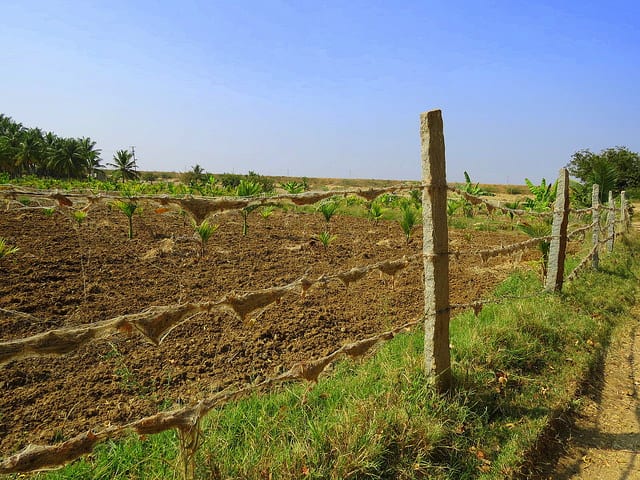
Or over plants, as you can see here:

However, there is another group of spiders which are commonly called Harvestmen or Daddy Long-legs (they have long, thin legs)! Scientifically their name is Opiliones, but they are also referred to as “shepherd spiders” in reference to how their unusually long legs reminded observers of the ways that some European shepherds used stilts to better observe their wandering flocks from a distance.

They suddenly came to my mind when I looked at what I thought was a dark patch of small twigs on the trunk of a tree…
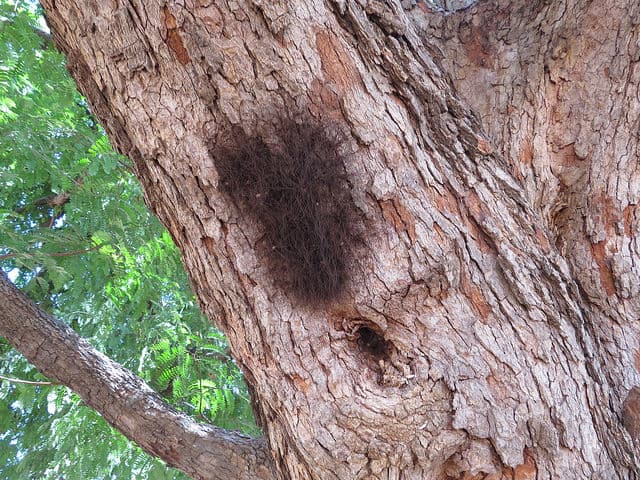
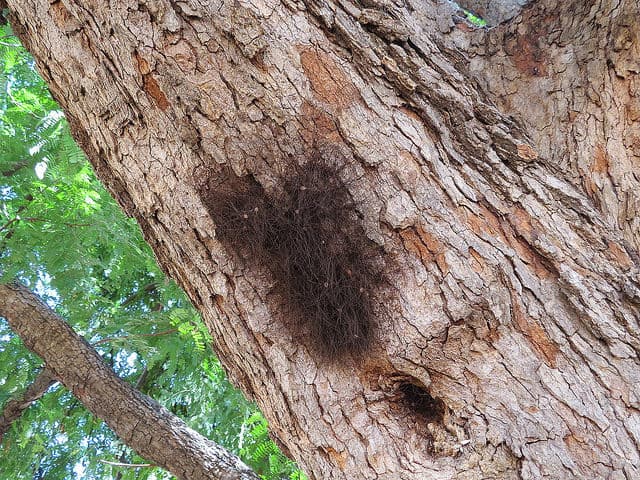
… and found that they were actually a tightly-clustered group of Havestmen:

I also took a short video. You can see them moving on their spindly legs, hardly seeming to touch the bark of the tree!

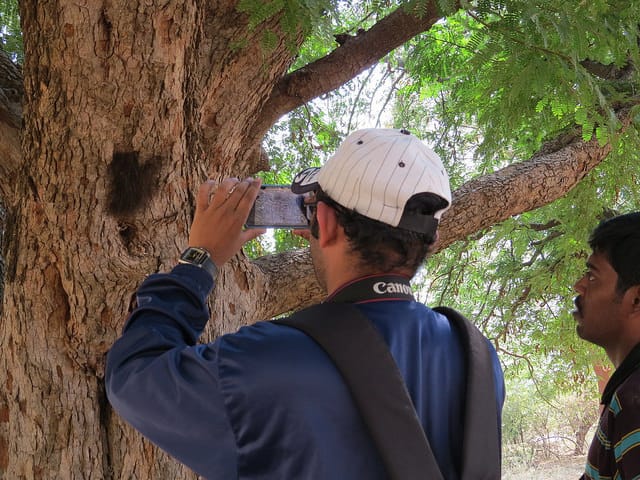
Here’s my friend documenting the congregation after I showed him the spiders:
Harvestmen are very old arachnids. There are fossils from 410 million years ago that prove that the group has lived on land since that time. How wonderful to come across these marvellous creatures!

I hope reading this post may help remove some of the fears of arachnids (spiders) that many of us suffer from, and allow us see them for the fascinating creatures that they are.

Related Articles

Umbrella Fishing by Painted Storks!
The rock on which Bengaluru sits
Purple is beautiful…and common!
The bird of State, with blue throat!

Comments:

  1. Ashok Kumar S says:

    Interesting 🙂

Leave a Reply

Your email address will not be published. Required fields are marked *

Similar Story

Beyond the parks and gardens, Bengaluru’s ‘wasteland’ ecosystems call for protection

Open Natural Ecosystems in Bengaluru harbour rich biodiversity. Take a look at what they hold and what we risk losing to unchecked development.

When we discuss urban nature, we often forget about real natural habitats. In Bengaluru, widely called the Garden City, most talks about urban nature focus on landscaped parks, roadside trees, and manicured gardens; in other words, artificial ecosystems designed for looks and human comfort. As lay citizens, we usually notice only such nature as we see around our homes, workplaces or other areas we generally pass by. While these places do have some ecological value, they mostly support a few highly adaptable species. This has strong negative implications for native flora and fauna that depend on open scrublands, grasslands, rocky…

Similar Story

The wild in the city: What citizen scientists tell us about Bengaluru’s biodiversity

Spatial and temporal biodiversity patterns, as observed by citizen scientists in the city during 2016-2025, were studied at a datajam in December 2025.

Imagine you’re out on a morning walk, phone in hand, when you spot a butterfly you’ve never seen before. You snap a photo, log it into a citizen science app, and voila! You’ve just contributed to crucial biodiversity monitoring. This isn’t just a hobby; it’s part of a global movement where ordinary people collect, record, and sometimes analyse data about plants, animals, and ecosystems. Citizen science stretches the reach of ecological research. Every observation adds to unique longitudinal datasets that reveal phenology — periodic events in the life cycle of a species — along with species distribution shifts and population…