He stays out till 11:00 pm working on his story. Once finished, he drives back home worrying only about the deadline. I, on the other hand, worry about getting home safe before worrying about that deadline. When I asked him if safety was not his prime concern, he shrugged nonchalantly. And it is not only about having to work late hours. Turns out he can visit any office, any official, any source, without much thought about safety, unless it is a crime story he’s reporting on.
I wondered then, what extreme worlds he and I must be living in! As I cannot fathom the thought of going out on an assignment without check listing my escape-defence plans from every place I visit. Maybe the core issue begins with the terminology ‘female journalists.’ It made me think: when did journalists take on a default masculine face which forces one to define differences in sex and gender?
Discrimination in assignments
The difference, however, does not stop at the mention of sex or gender, but also extends to the beats that get assigned. Having worked at a couple of media houses across Bengaluru, I constantly had to prove my knowledge and interest in crime and political reportage in comparison to my male counterparts. And yet when the stories got assigned, my sex was screaming out of the topics in that list. Having thought that maybe it was just my misfortune, it was disappointing to view my female peers nod aggressively in agreement to similar patterns of assignments they tolerated at their workplaces.
Read more: Post-pandemic labour market: Fewer women getting work
“The subtlety of it is what gets on my every nerve,” ranted a peer who is deeply passionate about political reporting, but has more number of articles under lifestyle beat. “Yes, my ‘male’ colleague is equally capable, but somehow every time, I get assigned with more number of softer stories than him and it’s crystal clear that it is not a coincidence, but a well-thought out decision”.
Extending the benefit of doubt that maybe we are a feisty generation, I was wondering if eventually with more experience, gender might not be the first problem in this profession.
But when I mentioned this to my former editor-in-chief, she chuckled sadly. “Women in journalism have held their own in the face of challenges through time,” she said, “However, the stares, murmurs and unsought opinions, from not just colleagues, but also sources, continue to flow in. This is rooted in extreme misogyny, common anywhere. And this field is no exception to it”. She hoped the present and future generations of women in this field would not have to prove themselves differently, as she and her peers had to.
That got me questioning my foolish idealism. Whom was I joking with, when a female quota for the role of chief editor was reserved at my university magazine level? Who’d known that amidst equally educated peers and for a qualified position, gender became a deciding factor? However today, I am less surprised with the terminologies, journalist and a female journalist.
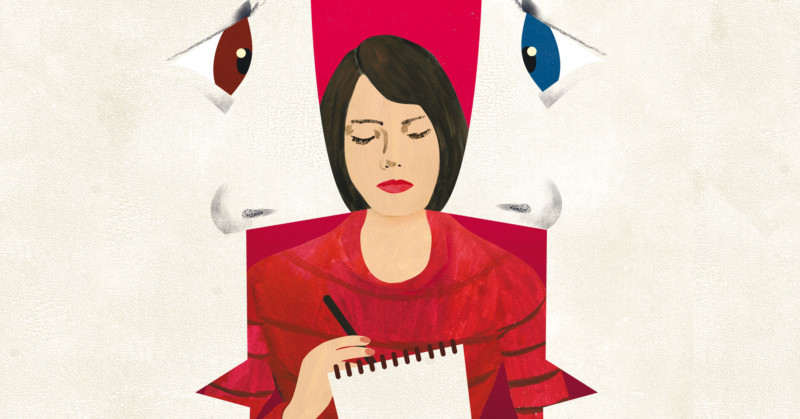
Journalism as a field, already puts one on the edge with safety, opinions, voices and biases. It makes me question why is it this necessary to force fit sex and gender amidst all this. There are countless reports on female journalists and the harassment they face at work. The topic never gets old and the heated discussions on it remain the same.
Read more: Women’s representation in apartment managing committees poor: Survey
There have been changes in terms of treating journalists without bias, and I acknowledge that. However, I hear, not only my voice, but those of my peers and seniors being as intolerant as they can ever be, because being called a journalist should not be attached to a golden male card.
What does independence mean to me? To be treated on par on the basis of my work alone, and no other parameters considered. Do I see my city play this out? Not entirely. And that’s not said with a sad or resigned tone. Rather an impatient one.