“PSU banks do not provide any kind of credit facilities for people who own lands in the urban villages, they say we belong to the Lal Dora. When we go to the MCD, they say we don’t belong to the Lal Dora and are an urbanised village now,” rues Deepak Tyagi, a 39-year-old resident and RWA president of Budhela village in New Delhi.
This intriguing in-between nature of urban villages is what led us to study these areas and the digitalization of land records here.
Lal Dora is a red thread that was drawn around the habitation or abadi areas of revenue villages by the land revenue department in the colonial times. It was done for the first time in 1908 to separate abadi areas from agricultural lands. As an act of preserving these habitation areas, this marking gave immunity from the jurisdiction of the municipal authorities and by implication, urban development plans. In essence, this marking has continued all over Delhi and now the areas inside Lal Dora boundary are called Urban Villages.
Pitfalls of urbanisation
Once the agricultural land is acquired by the government for development of planned colonies, the abadi regions are called ‘urban villages’. They are said to be urbanised villages once the villages lose their rural characteristics completely and become a part of the city.
In 1911, there were 0.23 million people living on 1800 hectares in Delhi, it has grown significantly on the agricultural lands of urban villages of today, to accommodate more than 23 million people in about 92,000 hectares with only 40 square meters for each person. Villages like Budhela, Munirka, Mehrauli, Shahpur Jat and so on have all been absorbed into the urban limits of Delhi, and lands acquired from them have led to the development of South Extension, Panchsheel Enclave, JNU, IIT Delhi and so on.
“A plot of land which has been in my family’s possession from 1908 is not worthy of credit in the capital of the world’s largest democracy; what kind of financial inclusion is the Prime Minister talking about!” exclaims Deepak Tyagi. He criticized the government for also destroying the feeling of community that existed in the villages with such urbanization.
The loss of agricultural lands has not only affected the livelihoods and means of income of the original inhabitants, but has affected social relations in the community as well. The villages have lost their commons and public spaces. An ever growing population of migrants, students and informal as well as formal labour find home in these urban villages, as they provide for cheap rental housing in this ever evolving and growing city.
Unmet demands
Today, Delhi has more than a hundred urban villages. These villages do not fall under the category of planned urban areas and they are not classified as rural areas as they are said to have lost their rural characteristics. Urban villages were also left out from the formal planning processes through the Delhi Master Plans as the state was working under the assumption that the urban surroundings of these areas will aid in the village becoming urbanized over time.
“Our demands of land consolidation, access to credit, change in land use, roads, sewerage, piped water were ignored by the government and to benefit the investors and politicians who now own large parcels of land in the villages, a land pooling policy was launched which was projected as a farmer friendly policy, which is actually an INVESTOR FRIENDLY POLICY,” said Devender Singh a 64-year-old farmer from Nangal Thakran, a rural village of Delhi. There is also a visible state of apathy displayed by the government.
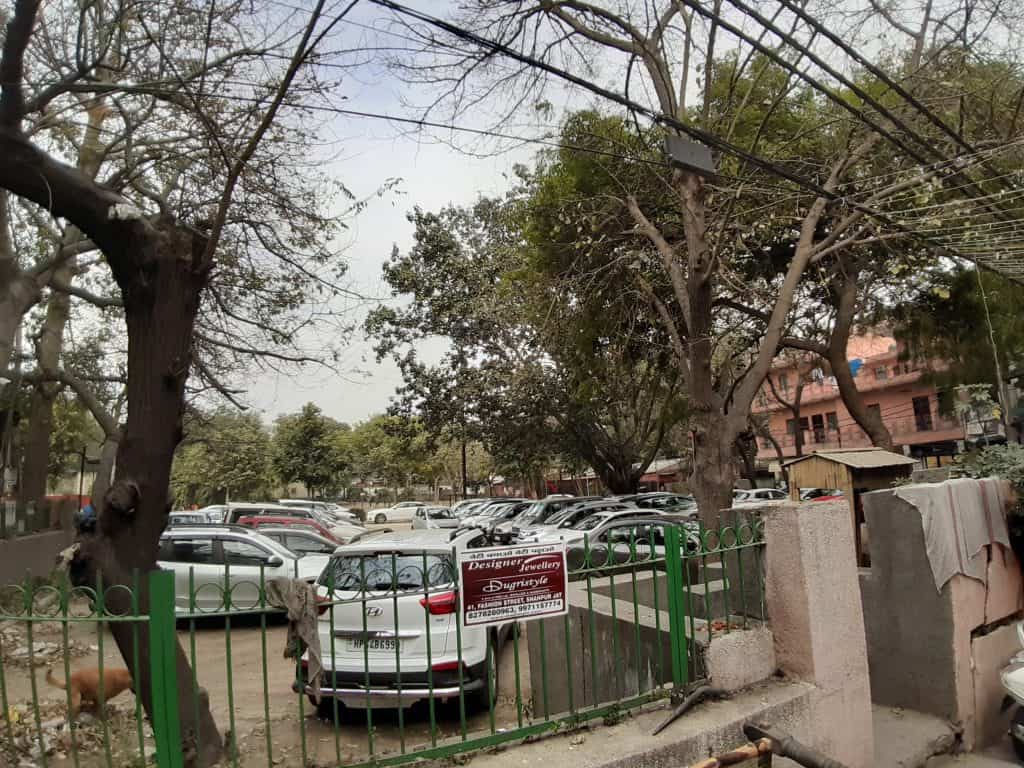
Development for whom?
“Complications around land are maximum in Delhi. There are little pockets of land that have been unnoticed by the government for so long that the situation there has deteriorated over time, especially in terms of public infrastructure provision,” explained Nivedita Haran, retired IAS officer for revenue department, at a workshop titled “One City Many Faces: Lal Dora Lands in Delhi.” This workshop was organized by the Centre for Youth Culture Law and Environment (CYCLE) with Housing and Land Rights Network (HLRN), as part of India Land and Development Conference in March 2020.
CYCLE helped us throughout the process of data collection with field visits to villages like Budhela, Nangal Thakran and Shabad Mohamedpur and in understanding the contradictions existing in urban villages. Their work revolves around the litigation processes for common spaces in these urban villages; they also work to reduce the information asymmetry amongst the urban and rural villagers about recent policies in Delhi around land development.
The unruly expansion of Delhi has made the issue of redevelopment of urban villages inside Delhi an integral one and was briefly addressed in the Master Plan 2021 as well. But that has also been marred to an extent by the state’s intention to aid the private developers in entering the villages through a formal roadmap. The focus is on Private Public Partnership model.
The residents of the urban villages sitting in the audience and the panelists agreed that there was apathy in the state towards the urban villages, leading to major obstacles in the path of development and growth for the villages as well as the villagers. There are no clear Record of Rights, no clarity on who provides services in these villages, or on the land pooling policy for the residents. This further complicates matters in hand and makes it difficult for the villagers to navigate through the evolving city space. As a follow-up, the panel and the villagers were willing to initiate a dialogue with the government to formulate redevelopment plans, which would be led by the citizens.