Of pots and imports…

All creatures great and small, whether they come from some faraway place on our planet or make their home right near us, can be a wondrous source of fascination!

Winter is always a good season for an amateur naturalist like me; the cool weather suits me and I can certainly spend far longer outdoors without getting tired out by the relentless Indian sun. I like to go out as much with friends as possible, and come across interesting things…literally, from far and near.

One of the “far” birds that we went to see are the bar-headed geese, which fly in from Mongolia and other parts in the far north, to our relatively warmer climes.
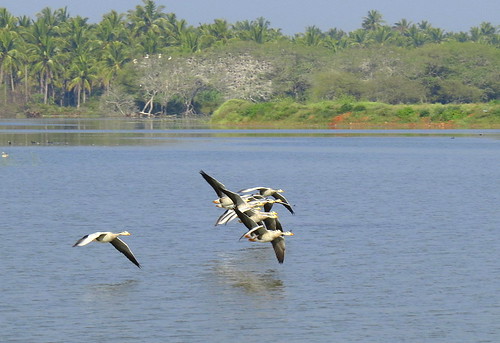
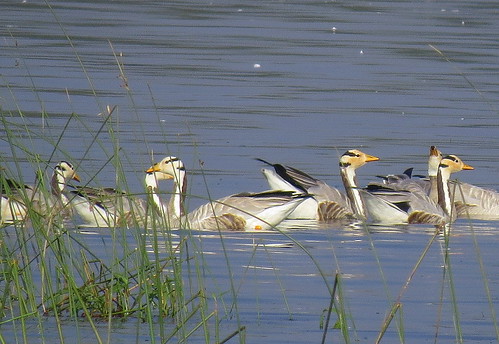
Bar-headed Geese

IMG_7489

IMG_7453

At Magadi lake at Gadag district, they arrive in large numbers; however, if you are not “chasing numbers”, lots of them can be seen at Kabini, and even nearer, at Hadinaru kere (lake in Kannada) near Nanjangud. Here is one handsome bird.
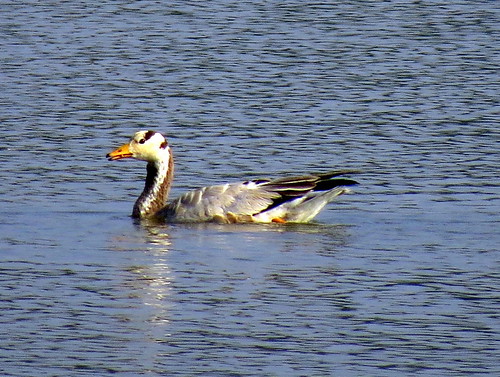
IMG_7476

The birds flying over the road from the fields, where they forage, on to the lake to settle down, is an amazing sight. One can only imagine what they must look like, flying through the high passes of the Himalaya, on their way here!

However, the nearby, and the small, can also be equally awe-inspiring and riveting. On a recent trip to the Valley School area, off Kanakapura Road near the NICE Junction in Bengaluru, we were done and were returning to our cars, when a small movement on the other side of a chain link fence caught my eyes.

It was a female

Potter Wasp

and there was no need to ask why she has been given that name. Look at the perfection of the home she is creating for her young ones!

She will find a spider or a caterpillar, stun (not kill) it, and put it in the home she has created. She will then lay her eggs on the paralyzed creature, so that her eggs, when they hatch into larvae, will have fresh meat and protein to feed on. All this for children she will never see…because once she’s put her young ones in “the pot”, off she flies, as you can see in this short video.

So…all creatures, great and small, whether they come from some faraway place on our planet or make their home right near us…are an endless source of fascination!

Leave a Reply

Your email address will not be published. Required fields are marked *

Similar Story

Explained: How Mumbai is losing its tree cover to infrastructure projects

Mumbai's landscape is changing with big infra projects. Experts suggest better use of government plots and improved street design to retain green cover.

Long before Mumbai’s relentless summer even began this year, the city was already simmering. In March, Mumbai was hit by a severe heatwave, with the temperature reaching a five-year high of 40° Celsius. As rapid urbanisation and a flurry of infrastructure projects replace dense tree cover with steel and mortar, heatwaves seem to have gone from being rare occurrences to an annual threat.   The Mumbai Metro Rail Corporation Limited (MMRCL) cut a whopping 3,093 trees in Aarey Colony to make way for Mumbai’s Aqua Line ( Metro 3). For environmentalist Stalin Dayanand, this is not just a temporary problem.…

Similar Story

Notes from the field: Why Begur Lake is losing its waterbirds

71% of waterbirds at Begur Lake are declining. A visit to one of Bengaluru’s rapidly deteriorating lakes shows what's causing the collapse.

During the Open City biodiversity datajam held in December 2025, our group examined the ecological trends around Bengaluru’s lakes. Our analysis suggests a majority of waterbirds are declining across the city's lakes. Earlier, we addressed crucial questions on how migrant and resident waterbirds are surviving across 14 of Bengaluru’s lakes, how the shape of the lakes influence microhabitats, and how a scoring system can be used to record the decline in lake quality and bird populations. The last of our four-part series turns its attention to an individual site. As part of this study of waterbirds in 14 city lakes,…