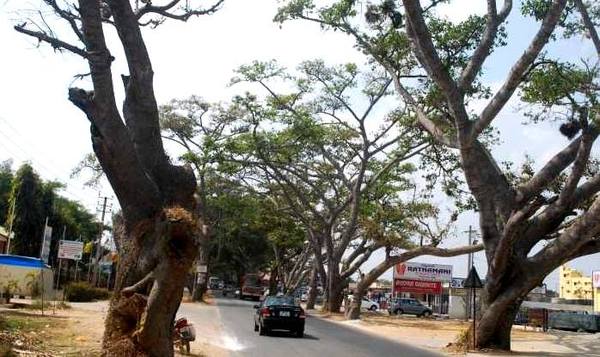
Documenting the trees in Bannerghatta

Wildlife Conservation Group is organising a workshop to record the various trees on Bannerghatta Road.

Pic: WCG

Avenue trees have provided unconditional shade and shelter, not only to fauna and avi-fauna, but also to human beings from time immemorial. We have depended on these old pillars of nature who’ve existed for centuries. Today we might not feel the need for them, because we have air-conditioned environments inside cities; but they continue to give so much to the living world around.

 
To ensure that we are reminded of the presence and importance of trees, the Wildlife Conservation Group (WCG), a local group interested in conservation, is organising a Tree Documentation event on March 8th and 9th 2014. The purpose of the event is to document the trees of Bannerghatta Road, across the stretch from Bannerghatta to Anekal.
 
The event aims to make a record of the population and species of avenue trees in Bannerghatta, an area under-looked by passing traffic and pollution. The trees need to be documented so that people ensure that their presence cannot be forgotten.
 
In case you wish to be a part of the tree documenting event, read on. 
 
 
Date: March 8th and 9th 2014

Venue: Assembly at Bannerghatta Circle

Time: 8 am to 12 noon


Why we are documenting:

 – Its good to know our trees – they are our lifeline

 – Documentation will help to spread the love and value of trees to younger generations

 – Documentation will certainly help to preserve the existing trees


How do we document:

 – GPS coordinates with species name and detail 

 – Photographs

 – Birds and insect diversity

 – Short film on trees (in the planning stage)


Who can participate:

 – Students

 – Photographers

 – Tree Lovers

 – Environment enthusiasts & conservationists

 – Taxonomy experts 

 – Birders 


Materials to carry along with you:

 – Hat and water bottle 

 – Meter tape 

 – Books on avenue trees

 – Bird books

 – Binoculars 

 – Camera


Registration is free. For more details, contact any of the numbers listed below. 

 – Subbu Badal : +91 9742786628 

 – Shankara Kp :+91 7760517769

 – Ashwatha Kn: +91 9740919832

 – Mail :wcg.bnp@gmail.com

 – Facebook group: https://www.facebook.com/groups/398400153542916/

Leave a Reply

Your email address will not be published. Required fields are marked *

Similar Story

Where are the pollinators in Bengaluru?

Despite the volumes of citizen-generated data on the city's biodiversity, pollinators who sustain the urban ecosystem do not seem to be getting their due attention.

Urban biodiversity is often discussed in terms of tree cover, lakes, or flagship species, but far less attention is paid to pollinators—the insects and birds that quietly sustain urban ecosystems. In Bengaluru, a rapidly urbanising city with a strong culture of citizen science, large volumes of biodiversity data are now being generated by the public. But what does this data tell us about pollinators in the city? This article draws from a data jam hosted by OpenCity in Bengaluru that explored pollinator observations using publicly available, citizen-generated datasets. By analysing long-term observation records and spatial data on land use and…

Similar Story

Beyond the parks and gardens, Bengaluru’s ‘wasteland’ ecosystems call for protection

Open Natural Ecosystems in Bengaluru harbour rich biodiversity. Take a look at what they hold and what we risk losing to unchecked development.

When we discuss urban nature, we often forget about real natural habitats. In Bengaluru, widely called the Garden City, most talks about urban nature focus on landscaped parks, roadside trees, and manicured gardens; in other words, artificial ecosystems designed for looks and human comfort. As lay citizens, we usually notice only such nature as we see around our homes, workplaces or other areas we generally pass by. While these places do have some ecological value, they mostly support a few highly adaptable species. This has strong negative implications for native flora and fauna that depend on open scrublands, grasslands, rocky…