The bird of State, with blue throat!

It takes mud baths to cleanse itself and get rid of ticks. Our State’s bird, Indian Roller, is a bird-watcher's delight.

Everyone knows of the national bird, the Indian Peacock. But do you know what the State bird is? Karnataka, along with other States (Andhra Pradesh,Bihar, and Odisha) has chosen the Indian Roller.  It’s a bird that almost as beautiful as the Peacock, and as interesting too.

These birds can often be seen perched on telephone or telegraph wires, and they feed on  insects, spiders, small lizards, snakes and frogs, too.
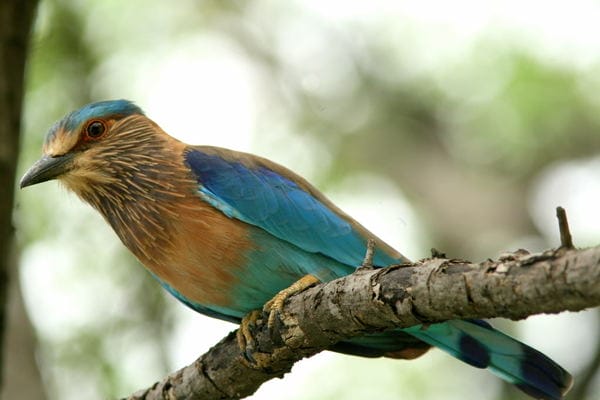
Pic: Deepa Mohan.

Contrary to the belief that birds are afraid of fire, these birds seem to know that fire attracts insects, and they can often be found swooping on insects near fire. Again, they have learnt to make use of artificial lights and feed on insects attracted to them.

This is a great way to adjust to humans and their lifestyles. My friend Naveen Toppo got this delightful shot, near the Bannerghatta Zoo, of a Roller having a mud bath, which many birds do, to cleanse themselves and get rid of ticks.
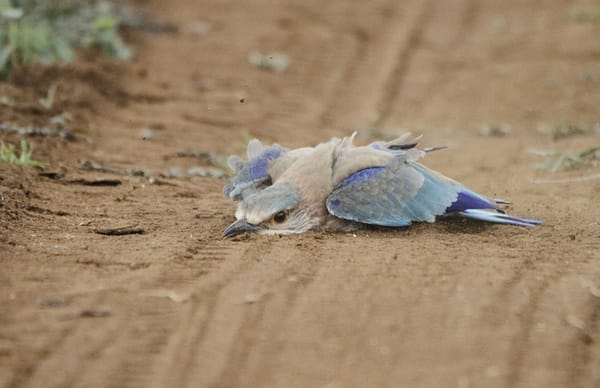
Pic: Naveen Kumar Toppo.

The bird has a beautiful aerobatic display, with the twists and turns that give this species its English name. In Karnataka, it is called the “Neel kanth,” a name associated with Shiva, who drank the Halahala poison that stayed in his throat and made it blue.

So, the next time you see a flash of bright blue in the suburbs of our city, look carefully, and you may see our State bird!

Comments:

  1. Usha Srinath says:

    Nice! Thanks for the information. Didn’t know it was the state bird. I have seen this bird many times while driving to Mysore. I thought it was called blue jay?

  2. Deepa Mohan says:

    It was, indeed, called the Blue Jay, but since that could confuse it with the American Blue Jay, the name is no longer valid.

  3. Santhosh Krishnamoorthy says:

    lovely pics and nice informative post……

  4. Deepa Mohan says:

    Thank you, Santosh 🙂

  5. Anusha says:

    awesome column Deepa… “Neelkanth” is really beautiful……… Delightful pic Naveen sir hats off 🙂 🙂 🙂

Leave a Reply

Your email address will not be published. Required fields are marked *

Similar Story

Mumbaikars are fighting for their mangroves. Here’s how you can join them

Mumbai is about to face a monumental loss—its mangroves are being cut to build the coastal road. Citizens, however, have not given up the fight to save them.

​“What happens when we remove this natural infrastructure of the city? What happens if it floods? What happens if the air quality (index) goes really high?” asks Pooja Domadia, a member of the Save Mumbai Mangroves campaign. These are questions that many Mumbaikars have as work begins on the Versova-Bhayandar Coastal Road, which is set to affect 45,000 mangrove trees. In March this year, the Supreme Court dismissed a petition challenging the Bombay High Court order to greenlight the cutting of mangroves for the project. Is the SC decision a fatal blow to the movement? The BMC has already begun…

Similar Story

Where are the pollinators in Bengaluru?

Despite the volumes of citizen-generated data on the city's biodiversity, pollinators who sustain the urban ecosystem do not seem to be getting their due attention.

Urban biodiversity is often discussed in terms of tree cover, lakes, or flagship species, but far less attention is paid to pollinators—the insects and birds that quietly sustain urban ecosystems. In Bengaluru, a rapidly urbanising city with a strong culture of citizen science, large volumes of biodiversity data are now being generated by the public. But what does this data tell us about pollinators in the city? This article draws from a data jam hosted by OpenCity in Bengaluru that explored pollinator observations using publicly available, citizen-generated datasets. By analysing long-term observation records and spatial data on land use and…