Carrying death on its back!

At first sight, the caterpillar appeared to be carrying its food, but it was actually the eggs of a wasp; the larvae would consume the caterpillar when they hatched. One more drama by Nature.

I had taken the children of the Sindhi School, in Malleswaram, on a nature trail to the Bannerghatta Zoo area, and it was they who spotted this very interesting-looking caterpillar, and asked me what it was.

“Looks as if the caterpillar has also packed a lot of lunch for a picnic in the Zoo!” joked one of the children. The reality, as I found out, was very, very different… this caterpillar was actually carrying its own death on its back, not its food!
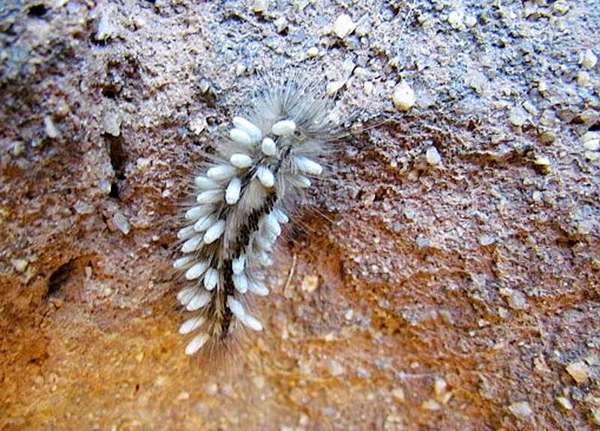
 

A variety of wasps called ‘Braconids,’ deposit their eggs on the backs of certain caterpillars, like this one. They cause these “host” caterpillars to become less active, and often sterile. When the eggs hatch, later, the newly-emerged larvae will feed on the caterpillar. So… the caterpillar was not carrying food… it was going to *be* the food!

This is just another example of the drama that nature provides, under our feet, and right in our gardens. So the next time you look at a caterpillar, do indulge your curiosity about any details you may notice about it. Thanks to the students of the Sindhi School, and their tireless teacher, Subbalakshmi (she takes the children on outings on her own initiative), I too learnt this riveting lesson of the natural world.

Comments:

  1. Uma says:

    Yes, even I have seen this type of caterpillar in our apartment wall. One day my son came running and asked my phone to take some photograph of something very odd. He was saying “Mummy I have seen a new variety of caterpillar, come soon, It’s awesome”.

    I went and saw. I too thought like that only. Maybe a different variety of caterpillar. Now after reading this article only I understood.

  2. Deepa Mohan says:

    Nice observation…our children notice more than we do!

Leave a Reply

Your email address will not be published. Required fields are marked *

Similar Story

The wild in the city: What citizen scientists tell us about Bengaluru’s biodiversity

Spatial and temporal biodiversity patterns, as observed by citizen scientists in the city during 2016-2025, were studied at a datajam in December 2025.

Imagine you’re out on a morning walk, phone in hand, when you spot a butterfly you’ve never seen before. You snap a photo, log it into a citizen science app, and voila! You’ve just contributed to crucial biodiversity monitoring. This isn’t just a hobby; it’s part of a global movement where ordinary people collect, record, and sometimes analyse data about plants, animals, and ecosystems. Citizen science stretches the reach of ecological research. Every observation adds to unique longitudinal datasets that reveal phenology — periodic events in the life cycle of a species — along with species distribution shifts and population…

Similar Story

Air quality management is a governance problem, not just an environmental one

Despite massive funding, Indian cities face weak governance, poor data, and limited capacity, as air pollution continues to worsen.

Indian cities are struggling to breathe. Air pollution is a year-round governance challenge. In 2024, 35 of the 50 most polluted cities globally were in India, with PM2.5 concentrations above 66.4 μg/m3. This is at least 13 times the World Health Organization (WHO) guidelines and at least 1.6 times the National Ambient Air Quality Standards (NAAQS) in India. Citizens continue to bear the brunt of worsening air quality, and urban local governments (ULGs) are at the forefront of the problem, being primarily accountable for their citizens' first mile. While they do have a role to play in addressing this threat,…