The Karnataka Lake Conservation and Development Authority (KLCDA) is on the look out for lake wardens, to work on a voluntary basis. The government order and other relevant information can be seen here.
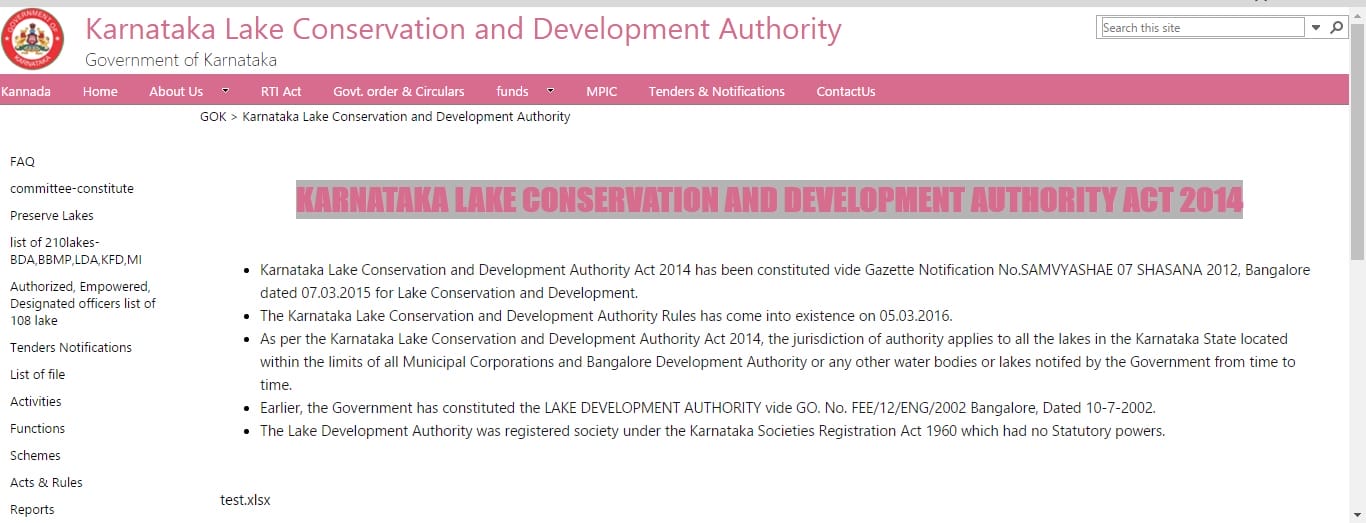
The Karnataka Lake Conservation and Development Authority Act 2014 was constituted (vide Gazette Notification No.Samvyashae 07 Shasana 2012, Bangalore dated 07-Mar-2015) for Lake Conservation and Development.
The Act finally came into force in March 2016, with the following mission:
– To establish a strong system of well linked lakes and tanks free from organic and chemical pollutants, and
– To intensify official concern and motivate community vigilance to the extent where pollution and encroachment of Lakelands would become impossible.
The functions of KLCDA are:
– to exercise regulatory control over all the lakes within its jurisdictions including prevention and removal of encroachment of lake;
– to protect, conserve, reclaim, regenerate and restore lakes to facilitate recharge of depleting ground water by promoting integrated approach with the assistance of concerned Government departments, local and other authorities;
– to take up environmental impact assessment studies for any or all lakes;
– to take up encironmental planning and mapping of lakes and their surrounding areas with the help of geographical information system and prepare database and atlas of lakes and their catchments;
– to prepare a plan for integrated development of lakes;
– to improve and also create habitat (wetlands) for acquatic biodiversity, water birds and aquatic plants for reducing sullage water and non-point sewage impacts;
– to facilitate for impounding storm water drainage system, reduce or remove siltation of lakes by taking up appropriate soil and water conservation measures including afforestation and to augment recharge of ground water aquifers and revive bore-wells;
– to improve and monitor water quality, conserve lake ecology on need basis and to protect them against domestic and industrial pollution;
– to utlize or allow to utilize the lakes for the purpose of drinking water, fishing, irrigation, education or tourism or anynother purpose as the Authority may determine;
– to encourage participation or communities and voluntary agencies and to launch public awarenessw programmes for lake conservation, preservation and protection of lakes;
– to advise on any matter that may be referred to it by the Government or any institution
– to promote integrated and co-ordinated applied research on all the relevant issues pertaining to lakes;
– to do such other acts as the Authority may consider necessary, conducive or incidental, directly or indirctly, to achieve the object of this Act.
The Authority has appointed Mr Ajai Misra as CEO and the officials can be reached at its office located at Parisara Bhavan, 2nd Floor, No. 49 Church Street, Bangalore 560001 (Phone: 80-25590098). More information can be found on the Authority’s website here.
So the next time you have a concern regarding a lake, you know where to go!
At the community/ citizen level, you can also get in touch with the One Bengaluru For Lakes program manager Vignesh Vicky at 8296612494 / vigneshv954@gmail.com. One Bengaluru for Lakes is a citizens’ initiative that supports people on lake related issues. You can find it on Facebook here and you can also join the google group SaveBangaloreLakes@googlegroups.com.