I guess the heat was too much and not many volunteers turned up this weekend. Those who did brave the sun did a wonderful job though. Yesterday, 6th April, some eight of us were scattered on the lake bed, bent over or squatting on the ground. We were searching for lurking bits of the Salvinia between the cracks and under stones since even a teeny bit is enough for it to sprout and cover the water in no time.

Fresh Salvinia spotted earlier in the week (Pic: Nupur Jain)
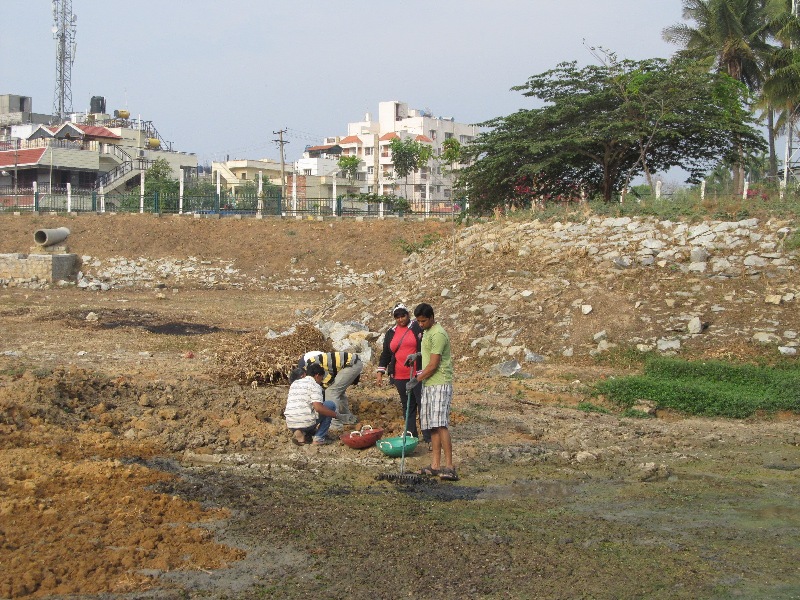
Searching for Salvinia (Pic: Usha Rajagopalan)
It was back breaking work all right but we didn’t realize just how much Salvinia we had collected till we saw how OPR had got it packed into a plastic sack and filled a big plastic bucket. If ever we were happy to see a plant browning and dying, it was the Salvinia. 🙂
Their enthusiasm soaring high, Arvind Venkatadri from Brigade Millennium, Shankar Iyer from South City and Grishma from Jayanagar 4th block started work as early 6.15 a.m. this morning. Each working in his/her space, the only time they got together was to come out after a good one hour or so. By then, the other volunteers were assembling, ready to start work. We decided to water our little garden near the Gazebo and pluck out the weeds. A few women walkers saw us at work and joined us. How gratifying it is to know that more and more people are beginning to accept the lake as their own and are slowly taking a little responsibility for it.

Working in the Gazebo Garden (Pic: Usha Rajagopalan)
As the number of volunteers was less, we were not able to do some other chores such as painting our new dust bins, clearing the front (near the cycle stand) and making it ready for planting, etc. So those who had intended to work at the lake this weekend but were unable to, join us next weekend! Those of you who have never worked in a garden, come and try it out. Get your kids along as well. Have gardening fun next weekend at our Puttenahalli Lake.
References