Traffic restrictions in T Nagar for Deepavali
Given the expected traffic congestion ahead of the Deepavali shopping in T Nagar, the Greater Chennai Traffic Police have announced new traffic arrangements from October 8th to 24th. Accordingly, commercial and goods vehicles will be permitted only between 11 pm and 7 am. Meanwhile, vehicle parking will be allowed at the Chennai Corporation School, Prakasam Salai; Ramakrishna High School, Bashyam Salai and Ramakrishna High School, Dhandapani Street. Paid parking facilities will also be available.
Besides, the autorickshaws will be restricted on the routes including those from Thiyagaraja Street-Thanikachalam Salai towards Panagal park; from Brindavan Junction towards Panagal Park; from North Usman Road-Coats Road Junction towards Panagal Park; from Rohini signal Junction towards Panagal Park; from North Usman Road-Maharajapuram Santhanam Salai towards Panagal Park and Kannammapet Junction towards Madley Junction.
Source: The Hindu
Read more: A citizens’ traffic plan for Perambur High Road
GCC speeds up stormwater drain work with precast technology
The Greater Chennai Corporation (GCC) has identified more than ten stretches with traffic congestion where precast technology is to be used to expedite the stormwater drain work ahead of the monsoon. The drain work from Kolathur Poompuhar Nagar that traverses and crosses Paper Mills Road near Velavan Nagar, which is a very tough stretch, was completed in 36 hours using precast technology.
According to GCC officials, the cast in situ process, which is usually used, would have taken a month to reach completion, while the precast technology helps in completion of the same work in less than 2 days.
Source: The Hindu
CMDA rejects approval for 128 buildings for violating fire safety norms
A special task force of the Chennai Metropolitan Development Authority (CMDA) and Tamil Nadu Fire and Rescue Services (TNFRS) conducted a joint inspection of 128 buildings in Chennai that applied for regulation approval. The task force found that the buildings were built in violation of the Directorate of Tamil Nadu Fire and Rescue Services norms and permissibility under the regularisation scheme announced by government. Around 80% of these buildings were in the city limit with most of them being commercial establishments.
To expedite the inspection process, the government is considering the use of drone technology to review the buildings as it will require lesser manpower, save more time and also find the exact measurement of the buildings. Notably, the CMDA has issued 31 lock and seal notices and has subsequently locked 5 buildings in 2022 alone.
Source: The Times of India
Read more: Explainer: How do you get your building plan approved in Chennai?
Metro Phase II Project: Japanese company to supply rails
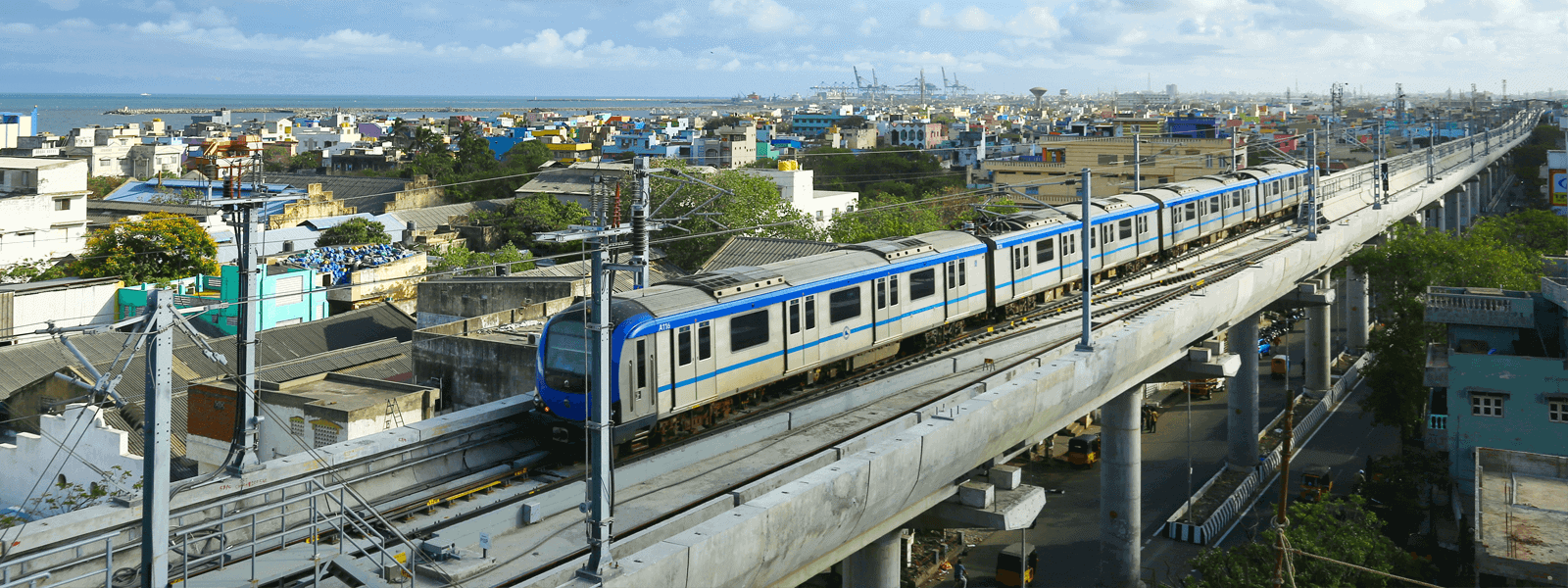
The Chennai Metro Rail Limited (CMRL) has awarded the contract supplying head-hardened rails to a Japanese firm, Mitsui & Co Ltd. The firm will supply the rails, with minimal maintenance and a longer lifespan, that will be used for laying tracks on two stretches of the Phase II project.
The two stretches include Madhavaram to Shollinganallur, a part of the Madhavaram to SIPCOT corridor which passes through Purasawalkam, Mylapore and Adyar (Corridor 3) and Madhavaram to CMBT, a portion of Madhavaram to Sholinganallur corridor which touches CMBT, Vadapalani, Porur and Madipakkam (Corridor 5).
While the contractor who was awarded the tender to carry out the track works purchased the rails in Phase I, the CMRL has awarded separate tenders in Phase II to cut down the overall cost of the project.
Source: The Hindu
Chennai Corporation to get new parks and playgrounds soon
As part of the Singara Chennai 2.0 project, the Greater Chennai Corporation has planned to set up 42 parks at the cost of Rs 16.19 crore and 11 playgrounds worth Rs 4.5 crore. A work order in this regard was passed earlier this week.
The parks are to be equipped with pathways, a play area for children, an open gymnasium and compound walls. The existing facilities, which include 738 parks, 424 playgrounds and 173 gymnasiums will also be getting a facelift.
Source: The Times of India
[Compiled by Shobana Radhakrishnan]