New ‘Chennai Bus’ application launched to help commuters navigate city
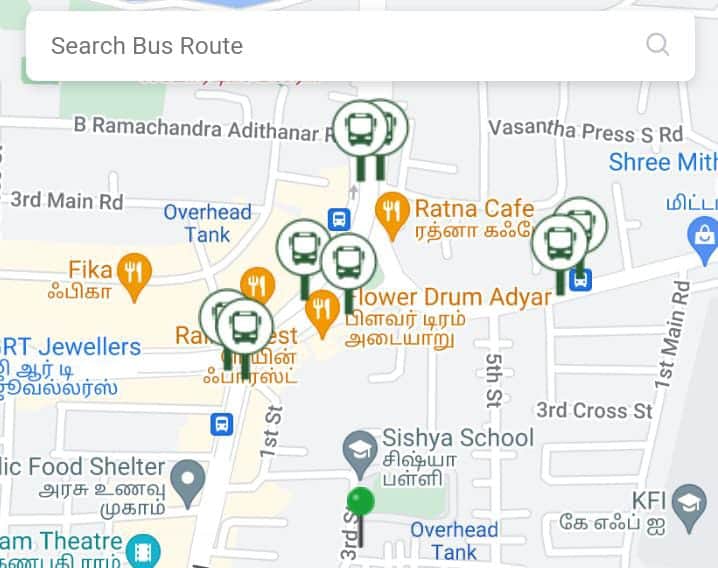
Transport Minister S.S.Sivasankar launched the Chennai Bus App to provide commuters with real time information on the location of MTC buses in the city. The app was developed in collaboration with ‘Chalo’, a transport technology company. The application tracks around 3233 MTC buses, running through 622 routes, and halting at 6022 stops.
The application is currently only available for android devices, but will be branching out after its initial launch. In addition to tracking, users can also send distress signals to their contacts or police offices in the case of an emergency.
Users can plan trips around the city by checking bus routes, search for stops in different areas, and view which buses are arriving soon at these stops.
Source: The New Indian Express
Read More: How can MTC win back Chennaiites as fuel prices surge?
Another death due to manual scavenging in Chennai
Two men, Gunasekharan (35) and Muthu (25) went down a septic tank for cleaning, on Thursday, in Avadi. One of them, Muthu, died from asphyxiation due to exposure to poisonous gas while cleaning the tank.
The other man, Gunasekharan also inhaled the poiosnous gas and was rushed to the hospital, after the Avadi Fire and Rescue team, reached the tank.
Manual Scavenging is the practice of removing human excreta by hand, from sewers and from septic tanks. The hiring of individuals to carry out the practice is banned in India under the Prohibition of Employment as Manual Scavengers and their Rehabilitation Act, 2013 (PEMSR). The act bans the use of any individual to manually clean or handle human excreta till its disposal.
In 2013 the definition of Manual scavenging was expanded to include people employed to clean septic tanks, ditches or railway tracks. While employing for manual scavenging is banned, the practice is still prevalent as can be seen in the above case. Data provided by an NGO, Safai Karmachari Andolan shows how as of January 2022, 55 deaths due to manual scavenging were reported in Tamil Nadu over the past three years.
Source: India Today | The Indian Express | The Times of India
Read More: Law on paper, manual scavengers in Chennai struggle for respite
Select railway stations to get solar power plants
In order to minimise emissions, the Southern Railway is planning to install solar power plants in Tamil Nadu railway stations. A total of 17 stations in Chennai and its suburbs will be receiving these plants. The Tamil Nadu Pollution Control Board has granted consent for operation of these plants as per the announcement of Chennai Divisional Railway manager.
These stations include: Egmore, MGR Central, Tambaram, Chengalpet, Guindy, Velachery, Avadi, Singaperumal Koil, Perungalathur, Guduvanchery, Thiruvallur, and more.
The move to install eco-friendly power plants is part of the state government’s endeavour to make Chennai carbon neutral and zero waste. Chennai Central station has already been meeting its energy demand during the day time via solar energy, according to the Divisional Railway Manager.
Source: The Times of India
Marina Beach Lighthouse to be new location for shallow underground station
As part of the Metro Rail Phase 2 project, a station will be built underneath the Marina Beach Lighthouse. The stop will be called the Lighthouse Station. It will be the longest station of the phase 2 project, spanning 300 metres.
The station will be an important terminal to connect Marina Beach to Poonamallee. The station will be built in such as way that passengers will have to collect their tickets at the lower floor and then board the metro on the upper floor. This will be the first ‘shallow’ station in the city, with the train operating on the first floor, and a concourse in the second. This is different from the usual plan of construciton by CMRL, whereby the train usually operates from the lower level with the concourse at the upper level of the station.
The station is proposed to be shallow in order to protect the marine ecosystem as per reports of CMRL officials. CMRL as also obtained the Coastal Regulation Zone (CRZ) clearance to start the project.
Source: The Hindu
[Compiled by Savitha Ganesh]