I have been following rafiki, a theatre group, from the time when they used to stage the plays of Athol Fugard, South African playwright and novelist.
They stage plays with ideological contexts and started working with children in the field of theatre, too. I have seen their struggles and their hard times, and so it was with even more satisfaction than usual that I noted that they collaborating with “Toto Funds the Arts” (TFA) to stage an adaptation of Anton Chekhov’s work at Ranga Shankara, on September 6th and 7th, 2012.
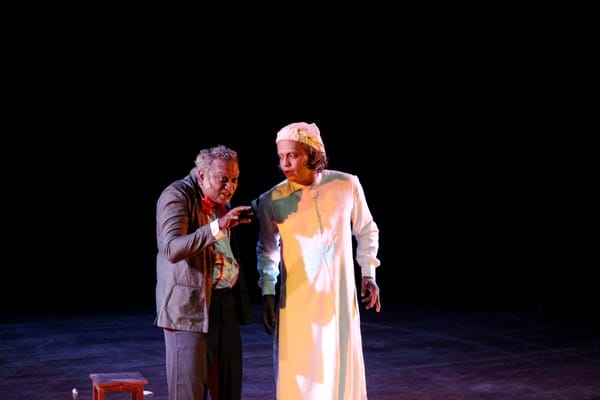
A scene from Rafiki’s play. Pic: Nitye Sood
At first, the line-in-waiting seemed sparse, but there was a good-sized crowd for the performance, given the fact that it was the middle of the week. Three short stories, and one play by the Russian author and playwright, were adapted for a 70-minute presentation.
The four playlets were The Harmfulness of Tobacco, A Man With a Violent Temper, A Reluctant Tragic Hero and Swan Song. All of these playlets seem to concentrate on the failings of men, and their inability to take responsibility for their lives and failures.
The first two playlets were adequately handled. Ashish D’Abreo, who played Nyukhin, his nitpicky mannerisms as an orator forced to give a speech, and telling the audience about his unhappiness with the wife who does the forcing, had the audience settling down to be entertained. Sharanya Ramprakash who played Enka, was a bit hackneyed in her gestures and speech mannerisms as the termagant “lover” of Nikolay, who, in turn, does not love her but lacks the courage to even say so. Nakul Bhalla was quite convincing as Nikolay.
But the minute the founder-members of rafiki, Sachin and Anish took the stage in “A Reluctant Tragic Hero” and “Swan Song”, respectively, the entire quality of the stagecraft soared. Their experience in serious theatre showed.
As Ivan Tolkachov enumerates his various difficulties and begs for a revolver so that he can end his miserable life, the character completely came to life. Despair and misery raised their heads as he strode around the stage.
And when Anish and Ravindra took the stage for the last playlet, it made me realise, once again, why rafiki is one of my favourite theatre groups, doing serious theatre, in this city. I have watched Anish acting in “Master Harold and the Boys” and was privileged, that evening to see Ravindra’s very authentic etching of a `stage prompter who’s seen the comedian in his heydays and who watches the declining actor now. Both Ashish and Ravindra declaimed from Shakespeare. and that, too, was a delight to hear and watch.
The direction and stage adaptation by Anmon Vellani was very good indeed. The stage props were absolutely minimal – a stool, a hat rack, a bench. But there was good stage management by Rency Phillip. The excellent lighting by Mohammed Mustafa, barring a small mistake in the first playlet, where the spotlight failed to follow Nyukhin as he moved from the lectern, added to the theatrical impact.
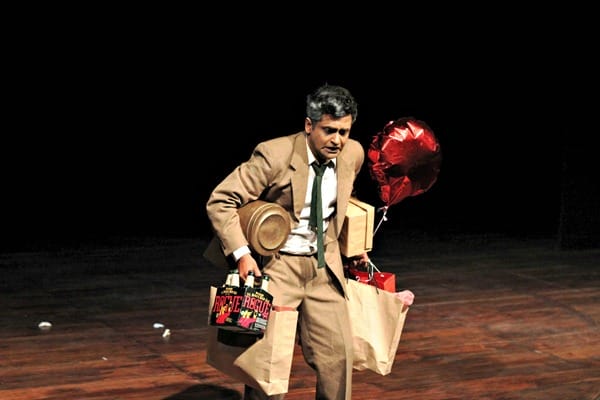
Rafiki’s play. Pic: Nitye Sood
A special word about the costumes, by Sunitha and Rency Phillip – they were very well done, with the tailcoats, the long gowns, and the costume of the comedian, with red accents. Hats seemed to play a major part in “A Man with a Violent Temper”. Handkerchiefs, too, played their part, including the Reluctant Tragic Hero showing the audience how he knotted his kerchief to remember things, and it was full of knots!
Rafiki and TFA had also produced an excellent two-page brochure, clearly giving the names of the cast and crew, with a director’s note, two short paragraphs about TFA and rafiki, and the vote of thanks overleaf, so that they did not have to do all the announcements on stage.
However, when the cast came to take their bows, I felt that they could have introduced themselves, the director, and the crew to the audience. When we have watched a play and enjoyed it, we surely do not mind spending a few more minutes finding out more about the people who brought the illusion to life for us.
Also, there were a couple of occasions when the dialogues were fluffed, and this was rather surprising in a group of rafiki’s standing. However, these were minor imperfections in an otherwise very well-done production of some of the lesser-known works of Chekhov.⊕