The layout has 23 wells with an average holding capacity of 4000 litres each. We have been recharging 4.5 million litres into the ground with rainwater harvesting, with about 50 rainy days in a year.
Ferns Paradise is a 48 acre layout, in Whitefield, consisting of around 300 residential plots. The residents are completely dependent on groundwater. Realizing the importance of having a sustainable water resource, the WMC, constituted by the Layout’s Resident Welfare Association (RWA) comprising people passionate about water conservation – Babita Saxena, Radhica Kanniganti and Rajesh Thakkar.
The WMC has made it mandatory for all the new houses to install rainwater harvesting and are encouraging existing houses to install one. We are also working hard on community rainwater harvesting and reusing STP water for gardening purposes.

Opening well- for measurement. Pic: Babita Saxena
In order to assess the feasibility of doing a community rainwater harvesting system, we partnered with Biome Consultants (Biome Environmental is a Bangalore-based firm focused on ecology, architecture and water) . We realised that there was no overnight solution, and would require a significant investment over a period of 3-5 years. The results would be seen only over a long term period.

Notice the different colours and different layers of soil. Pic:Babita Saxena
We faced a lot of challenges, we lacked open spaces where runoff water could be collected and we had to convince the community of investing in this long term project. We overcame these challenges, since the layout had sufficient slopes to ensure good runoff, and it was relatively easy to find spots where water would collect. Also, barring a few areas, percolation rates were fairly good across the community.
In their detailed study, Biome Consultants (Biome Environmental is a Bangalore-based firm focused on ecology, architecture and water) suggested that rainwater harvesting at the community level can and should be driven through stormwater drains (SWD). Due to quality issues, the water from storm water drains is usually used for recharge through a recharge well.
Recharging the stormwater would serve a dual purpose of avoiding floods while helping borewells in the layout. Hence, recharge wells were dug at strategic points along the storm water drains for groundwater recharge. About 70% of houses in our layout have individual rainwater harvesting systems for reuse or recharge or both.
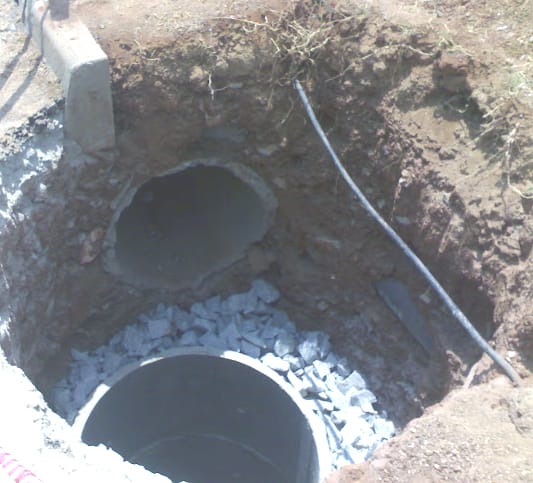
The well gets its water from the hume pipe storm water drains. Pic: Babita Saxena.
Achievement so far:
Though it is too early to give a definitive answer as its only been a year since we have 23 wells, we have observed that layouts and apartments in our immediate neighborhood are either heavily or wholly dependent on outside tanker water. Several borewells in Nekundi area have dried up. In spite of this, our layout still has an ample supply of water, even though number of families have increased from 50-60 in 2009 to 100 in 2012. Our dependence on outside water is negligible as of now.
Our eventual goal is to have a sustainable supply of water for the requirements of our layout. Later we hope to find a few solutions to store and use rain water, especially from common areas such as clubhouse rooftop. ⊕
References
Babita is a resident at Ferns Paradise and also a member of Residents Welfare Association.
Very commendable. Can we also do something in Fern’s City?
Wow! congratulations on a wonderful effort. You guys are raring along on the right track and with these heavy rains I am sure you have cut back on the tanker supplies!