The Chennai Corporation has intensified its drive to seize abandoned vehicles from around the city. The operation, which began in March this year, is currently in its third phase with the seizure of a total of 7912 vehicles so far. The list of seized vehicles has been posted on the website of the Chennai Corporation. The first list was published on June 5th and the second list on July 14th. The third list is expected shortly.
When is a vehicle deemed abandoned?
According to clause 380 of the Tamil Nadu Motor Vehicles Rules,1989, a vehicle is considered abandoned
1) If it is “allowed to stand in any place other than duly appointed parking place in such a way as to cause obstruction to traffic or danger to any person”
2) If “the vehicle has been stationary in one place for a continuous period of ten hours and adequate steps have not been taken for its repair or removal by the owner.”
3) If “a motor vehicle has been stationary in a duly appointed parking place for a period exceeding the period specified by competent authority in respect of the said place or if no such period has been specified, for a period exceeding six hours”
However, in practice, these rules are rarely enforced as violations of this nature are highly common and seizures for the aforementioned reasons become impractical and a logistical nightmare for the enforcement agencies.
What happens to abandoned vehicles, then?
A bulk of the abandoned vehicles are those idling in police stations after seizure on account of traffic violations such as speeding, driving under the influence and driving without adequate documentation. These have not been claimed by owners. Police also claim vehicles reported by residents and concerned citizens, which are deemed abandoned. Then there are those vehicles that lie unclaimed in the various nooks of the city or in prominent places like the parking lots of bus stands and railway stations.
Periodic drives such as the one ongoing in the city become vital to the clearing out of these vehicles. After the seizure of the vehicles, the list containing details such as vehicle number and model, date of seizure and the police station under which the vehicle can be claimed are displayed on the website.
Owners can stake claim to their vehicles by producing the necessary proof of ownership to the concerned Deputy Commissioner of Police (Traffic) within 15 days of the publication of the list.
If there are no claimants for a vehicle after the 15-day window, a No Objection Certificate (NOC) is obtained from the traffic police. The vehicle is then put up for e-auction to the highest bidder. The Corporation of Chennai has a contract with Government of India’s public undertaking, the Metal Scrap Trading Corporation for the smooth facilitation of the e-auctions.
The current drive
The ongoing drive in Chennai is expected to help clear much-needed public space in the city and in police stations of abandoned vehicles. The vehicles that have been unclaimed since their damage in the floods of 2015, those that have been seized for non-payment of dues, those that, in rare cases, have been forgotten by the owner, are all set to go under the hammer.
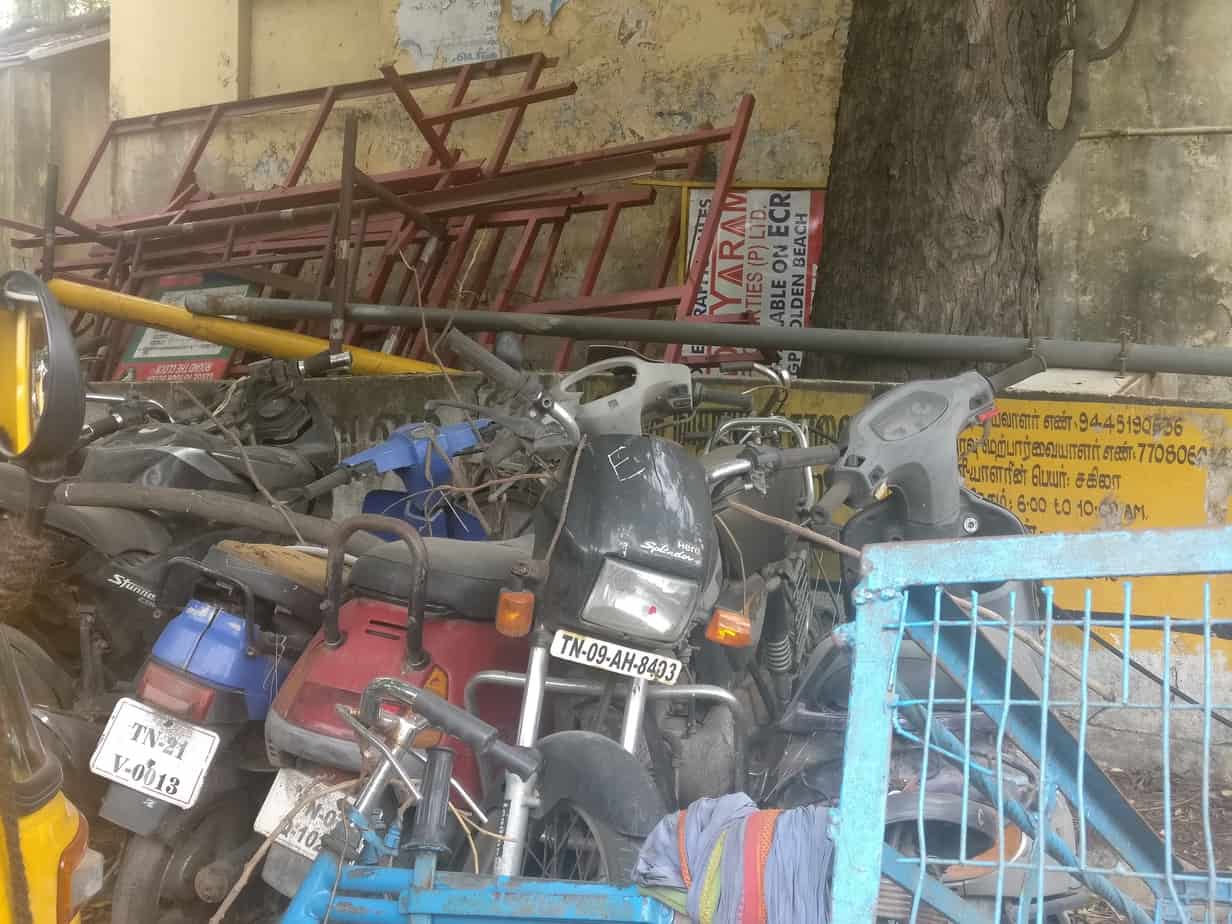
Abandoned vehicles around the Pondy Bazaar Police Station.
The vehicles have been currently parked in three lots across the city – an open ground on Avathana Pappaiya Street in Royapuram for zones 1-5, Mayor Sathyamoorthy Salai near Gengu Reddy Subway for zones 6-10 and old Pallikarnai Garbage Yard for zones 11-15.
“This is a much-needed initiative. The premises of the police station have been cluttered with these vehicles and there is a crunch of parking space. Most of the vehicles are in unusable condition. It is unlikely that anyone will claim them after all this time. So such a move is essential remove such vehicles across the city and free up space”, said a constable at the Pondy Bazaar Police Station.
While this process will take some time, the bulk clearance of vehicles provides Chennai an opportunity to rethink ways to deal with abandoned vehicles. More frequent, periodic drives in public spaces, timely disposal of seized vehicles in police stations and finding dedicated space for the mass storage of vehicles on the outskirts could all be possible solutions to avoid congestion in the city caused by abandoned vehicles.