Mere formation of a body, planning and allocation of funds to rejuvenate the water bodies cannot be the ideal solution to the water crises that we have in our nation, said Dr Rajendra Singh Prasad, better-known as Waterman of India, at a gathering in Chennai last weekend at Goethe-Institut.
The discussion on making Tamil Nadu drought-free was organised by Goethe-Institut, Chennai in association with Asian College of Journalism, Confluence 10, Kalakshetra Foundation and with coordination of several other colleges, universities and NGOs.
“We must start a dialogue with the Government for identifying, demarcating and notifying the water bodies. Once it is done, the locals should take it up and the communities should start managing the water bodies as the locals know the rainfall pattern well,” he added.
In every state, the cause of ill-maintained waterbodies is different. In Tamil Nadu it is encroachment. It can be tackled if the government starts documenting the waterbodies. The traditional crop patterns are failing due to the state of the waterbodies. “To conserve the natural resource—water better, we must roll back to the ancient system of storing which is seven centuries old,” pointed out the recipient of Ramon Magsaysay Award and Stockholm Water Prize.
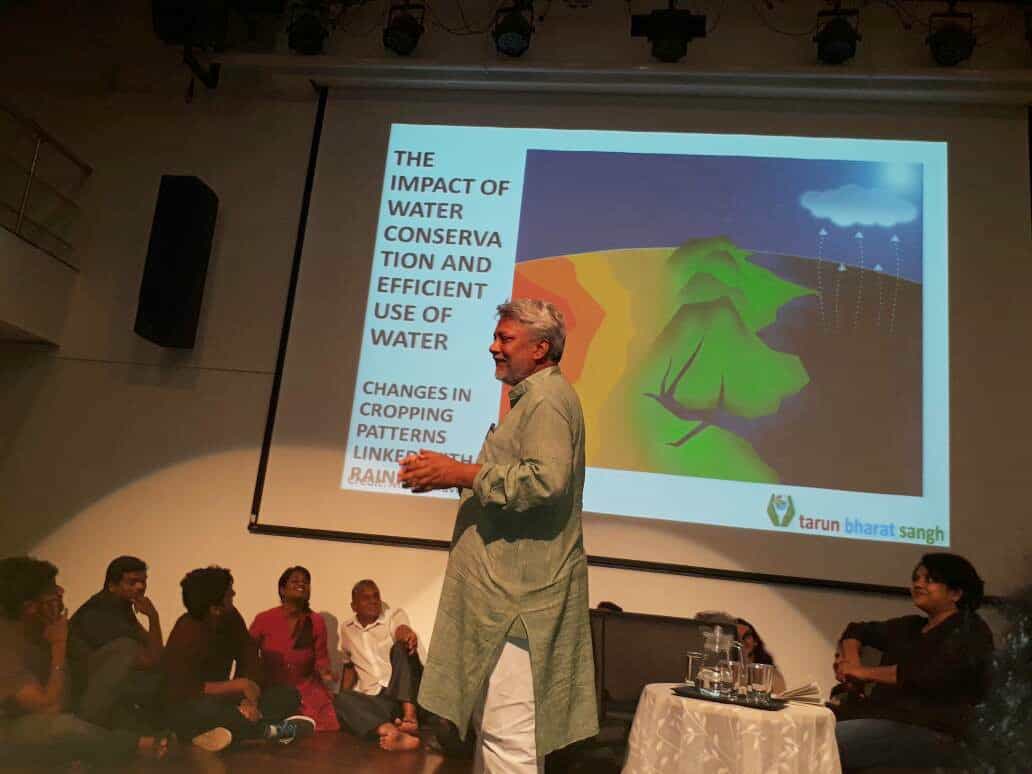
Dr Singh explaining the advantages of efficient conservation of water and crop failure. Pic: Usha Venkatesan
The introduction of water extraction techniques by the bureaucracy, change in the paradigm of development, state’s ownership of what is meant for the community to work on, disintegration of community institutions, creation of dependency syndrome which makes the government interfere into the issue and negligence of traditional methods for conserving the water are the foremost reasons for the drought. In addition, the speaker emphasised on maintaining a balance between recharging the groundwater while we discharge.
“To make Tamil Nadu drought-free”, he said, “We must start interacting with people who deal with the resource, be it for exploiting, polluting or whatsoever the reason, and try to understand it better. The second step is to conserve the natural resource, make others understand the status of the resource and finally fight against the encroachers, polluters and exploiters.”