Have you ever stopped to read an advertisement board nailed onto a tree trunk? Or stared in awe at the pretty strings of lights used to adorn many a tree during the festive season? Now place yourself in the position of the tree and think again! These fixtures or constricting elements on our mature trees actually kill them silently. However, the good news is that even as a concerned citizen, you can save the city’s trees, free them from such abuse and give them a new lease of life and respect.
Free the Tree Campaigns or FTCs organised by Nizhal, the Chennai organisation devoted to planting, nurturing and caring for trees in the city, gives you an opportunity to stand up for trees and take necessary steps to free them from any form of abuse. The organisation’s volunteer teams have been conducting such drives in various neighbourhoods around the city. In early April, there were two FTCs by Nizhal’s YuVa team at Madhavaram and Velachery.
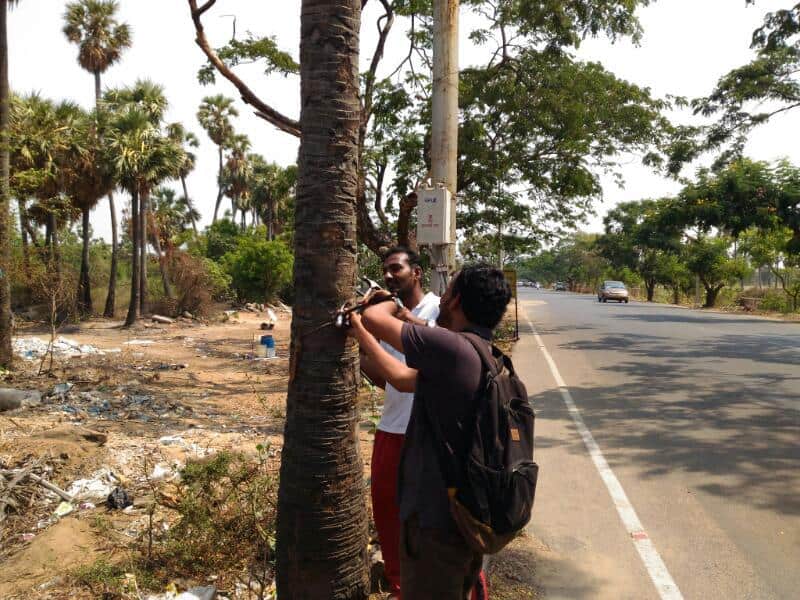
FTC at Madhavaram
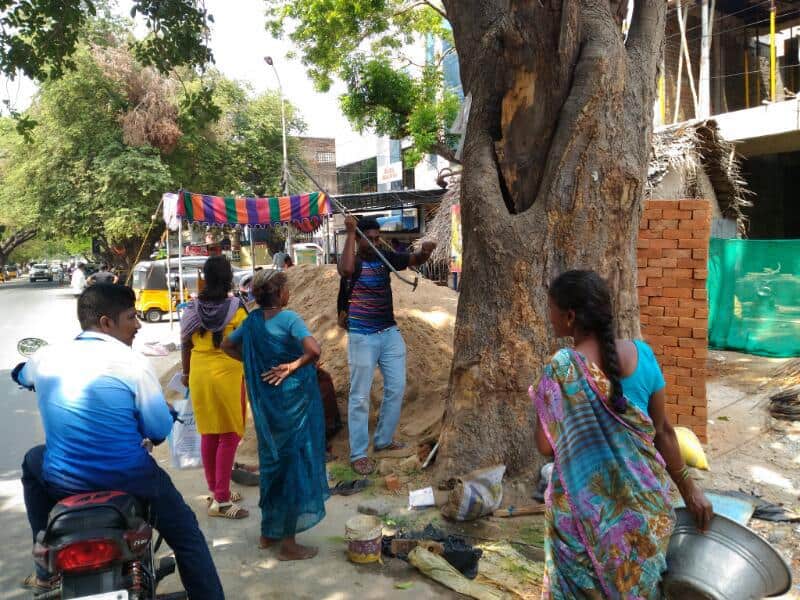
FTC at Velachery
On the weekend of April 17th, the Nizhal FTC team freed trees in the Kottur neighbourhood. During the drive, they also took time to name-board the Magizham restored post Vardah. One of Nizhal’s focus areas in the aftermath of cyclone Vardah was restoration of fallen giant trees. This Magizham was one such.
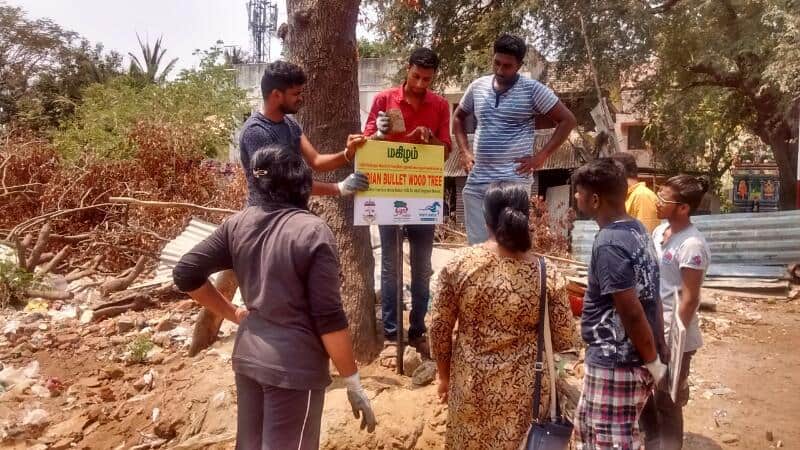
FTC Team name-boards the Magizham tree restored post Vardah in Kottur.
On April 23rd, trees were freed by the YuVa team during an FTC in Anna Nagar. Their enthusiasm and zeal prompted some of the local residents and even police personnel to pitch in and pledge their support in future.
FTCs like the above can be undertaken in any locality as long as there is a group of interested citizens, who can approach Nizhal for guidance. Schools and colleges can take up these campaigns as part of their extra curricular activities. The activity could be as simple as devoting an hour or two, every week or fortnight in the respective neighbourhood.
Recognising the fact that real progress in nature conservation can occur only through the collaboration and participation of local communities, organizations and citizens, Nizhal has also put out a guide for all Chennaiites, which talks about the appropriate response to tree cutting and abuse. If you see trees in public places defaced by advertisement boards or banners, constricted by lights or cables, suffocated by cement at the base, stifled by tree guards or vandalised by indiscriminate cutting, here’s what you should do:
- Immediately call the toll free number 1913 and register a complaint
- Register an online complaint with the Corporation of Chennai at https://erp.chennaicorporation.gov.in/pgr/; You can upload appropriate pictures, if any.
- Reach the local Assistant Commissioner of the concerned zone by dialing 9445190 0XX (XX is your zone number)
- Give a written complaint to the local zonal office and also to local police.
- If it is very urgent, call the Mayor at 9840048944.
- Once done, you can pass on the reference number from Corporation or the CSR number from the police station to Nizhal for follow up.
[The information in this article has been collated from various group mailers and public messages issues by Nizhal, and published here with minimal edits.]