After a steady reduction from 2017 to 2020, the city witnessed an increase in waste collection from 5500 Metric Tonnes per day (MTD) in 2020-21 to 6300 MTD in 2021-22, says a report released by Praja Foundation. The highest contributor is wet (food) waste which comprises 73% of the total garbage collected at the landfills.
The report on the status of civic issues in Mumbai, highlighted challenges in solid waste management, sewerage and water bodies. Moreover, due to the deteriorating sanitisation facilities, the Brihanmumbai Municipal Corporation (BMC) failed the Swachh Bharat Mission (SBM) 5-Star Rating of ‘Garbage Free Cities’ in 2022, says the report.
The waste generated in the city had reduced from 7,350 MTD 2017-18 to 5500 MTD in 2020-21. The 15 per cent increase in the past year could be related to resuming of post-pandemic activities.
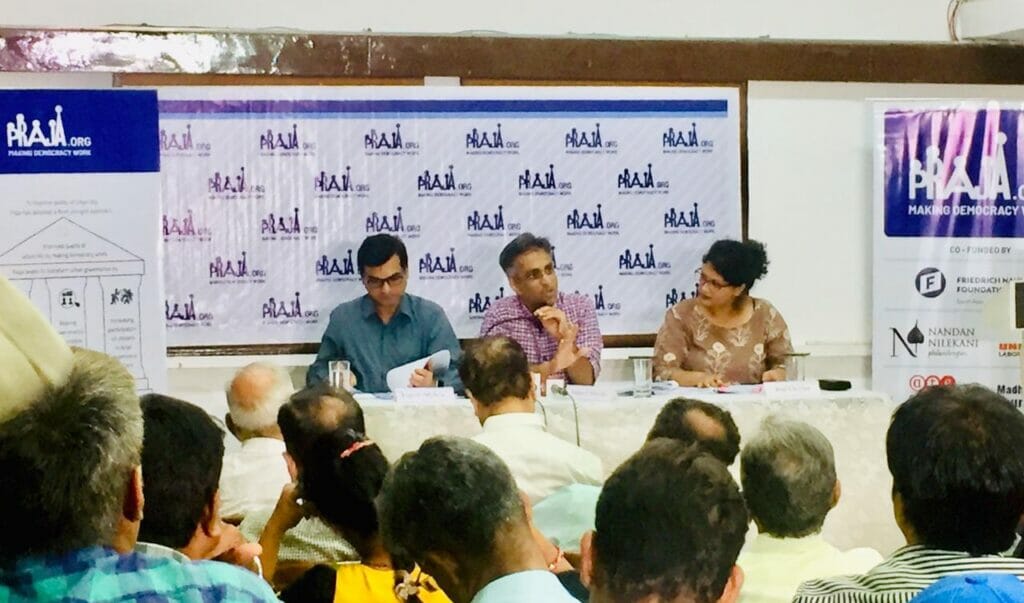
“The National Institute of Urban Affairs (NIUA) recommends the Integrated Solid Waste Management (ISWM) system to reduce waste generation, process waste at source and reduce waste sent to landfill. The ESR 2021-22 states, Deonar dumping ground receives approximately 12% (700 MTD) and Kanjurmarg landfill receives 88% (5,500 MTD) of waste on a daily basis since Kanjurmarg has a waste-to-energy plant,” said, Milind Mhaske, CEO, Praja Foundation.
Cost benefits of decentralisation of waste
According to the report, the BMC can save Rs.1,485 crore with a decentralised waste management. The operation and maintenance of landfills, the fuel prices for transport of the waste are the major areas where the BMC can save money using a decentralised system.
The cost to collect and transport One MTD of waste to the landfill from all 24 wards is Rs. 3,840/day. Hence, to transport 6,300 MTD of waste, it costs BMC Rs. 2.42 crores/day and annually, this cost is as high as Rs. 883 crores. While for the landfill, the cost of operations and maintenance Rs. 3,000/- for one metric tonne per day, thus for 5,500 MTD of waste annually it costs Rs. 602 crores.
“To reduce these costs, BMC should adopt decentralised SWM, which has been done successfully in Councillor Ward No. 203 in F/S ward through the Swachh Mumbai Prabodhan Abhiyan (SMPA) model. This scheme involves community-based organisations that collect waste from slum households and process within the ward,” added Mhaske.
Bulk waste generators to treat waste at source
The Solid Waste Management Rules, 2016, states that the BMC must achieve waste management at the source, and should reduce its dependence on dumping grounds. The civic body made it mandatory for bulk waste generators like housing societies and commercial establishments with more than 20,000 sqm area, or generating 100kg waste daily, to treat waste at source. However, the NGO pointed out that currently only 50% of societies are processing the waste in their premises.
“There is a significant gap in waste management practices, the BMC should come up with an effective plan to improve waste processing and management in these societies, as 50% (1,401) of the 2,825 BWG societies in Mumbai are not processing their wet waste at source,” said Rini Cherian, programme coordinator, Praja Foundation.
Read more : Plastic pollution from landfills poses severe risk in Mumbai
Rise in citizens’ complaints
Over the past decade, citizens’ complaints related to Solid Waste Management have increased by 124% (from 5,519 in 2013 to 12,351 in 2022). The highest number of 4,356 complaints in 2022 were related to garbage not lifted and the removal of debris. These complaints have been constant in the past 10 years, stated the NGO.
While Air Pollution complaints increased by 237% (from 65 complaints in 2013 to 219 complaints in 2022) and drainage increased by 35% (12,708 in 2013 to 17,121 in 2022) in the same period. However, the average time taken to resolve these complaints was as high as 31 days in 2022.
“Mumbai faces major climate change issues such as air pollution, heat waves, and contaminated water bodies due to inefficient sanitation and waste management processes. In 2022, the BMC’s Mumbai Climate Action Plan (MCAP) included targeted interventions to improve the efficiency of solid waste management, sewerage treatment, and measures to ensure good air quality, which is a positive step,” said Nitai Mehta, Founder and Managing Trustee, Praja Foundation.
Mithi River pollution
Mithi River is heavily polluted with fecal coliform (17000MPN/100ml), much higher than the prescribed norm by the CPCB limit of less than 2500 MPN/100ml.
Moreover, the average maximum Biochemical Oxygen Demand (BOD) recorded in all major beach outlets was 22 mg/it. in 2021, much higher than the prescribed norm by the CPCB of <3 mg/lt.
“The focus should also be given to restoring Mumbai’s rivers and beaches and ensuring effective measures to curb water pollution. The effective implementation of MCAP and robust monitoring can help tackle climate change in Mumbai, ensuring a better future for generations to come,” concluded Mishra.