How Mumbai gets its water: A discussion

A tweet chat held by Citizen Matters on Mumbai's water supply; how we source it, treat it and allocate it, with Sitaram Shelar and Purva Dewoolkar.

On October 3rd, Citizen Matters hosted a tweet chat on water supply in Mumbai with Sitaram Shelar and Purva Dewoolkar. The discussion covered how water is sourced in the city; the condition of lakes, the treatment plants, and reasons for water shortage.

Sitaram Shelar is the Convener of the Pani Haq Samiti. He is a member of the core committee of the Hamara Shaher Mumbai Abhiyan and has initiated the 51 Mumbaikar campaign. His work has focused on youth development, governance,  poverty and the built environment.

Purva Dewoolkar is a SEED funded PhD Scholar at the University of Manchester.  Her research investigates the processes of negotiations and struggles through which the sanitation infrastructure is produced in Mumbai, India.
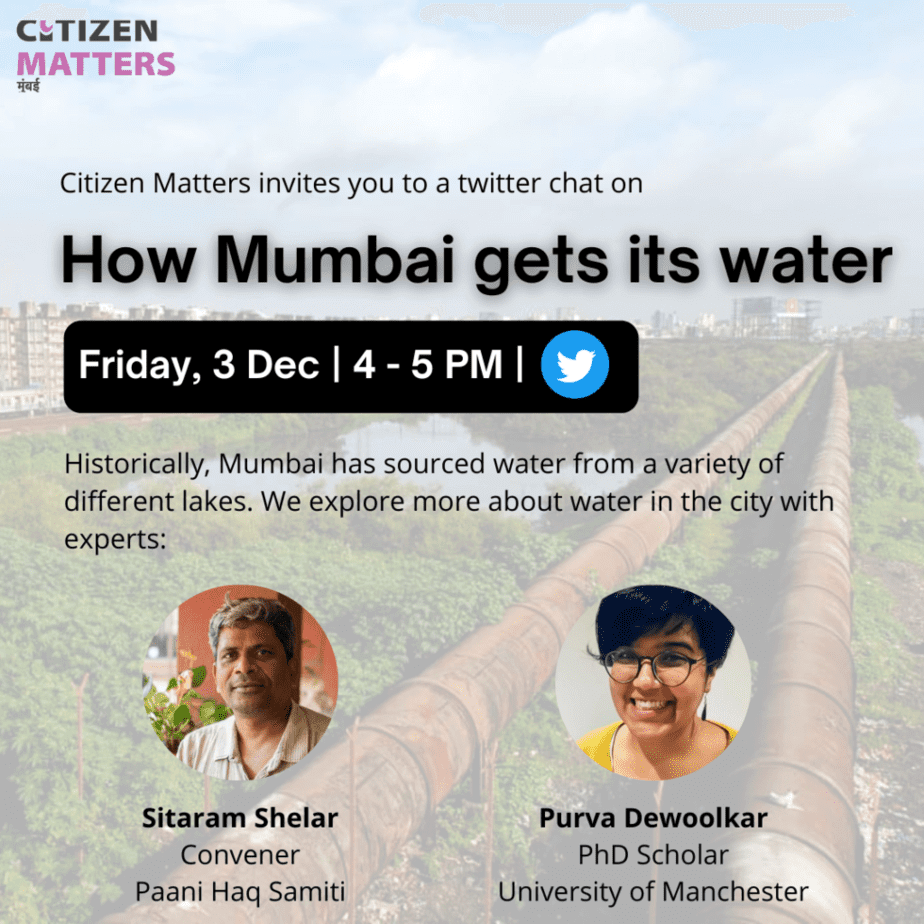
poster of citizen matter's tweet chat on Mumbai's water supply

Mumbai gets its water from a complex network of pipelines, tunnels, balancing reservoirs, pumping stations and lakes. Despite being one of the world’s largest water supply networks, why does Mumbai still struggle with water supply? These questions led the conversation.

The first question was about water demand and supply. How much water does Mumbai need and how much does it get?

“‘Need’ has various calculations, one of them being MCGM claims to calculate as per the Chitale committee report: 240lpcd” said Sitaram Shelar. 

Is there a disparity between how much water the rich get as compared to the poor? and how far are we from getting WHO recommended water supply per capita, which is 135l per day? Were additional questions asked.
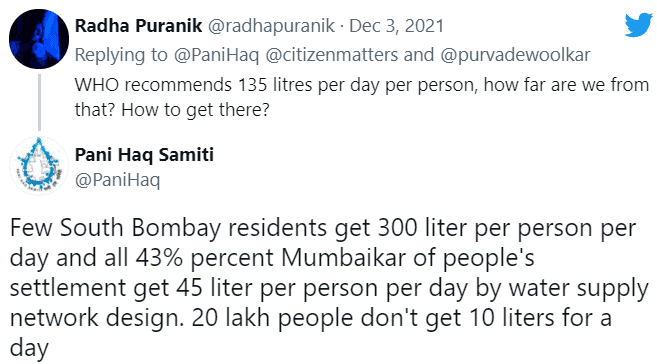
South Bombay residents get 300l water per person per day
What South Bombay residents get in a day

“Mumbai sources around 4175 megalitres of water per day, and 100% of this is from the dams” said Sitaram Shelar. But, are we utilising all our resources?
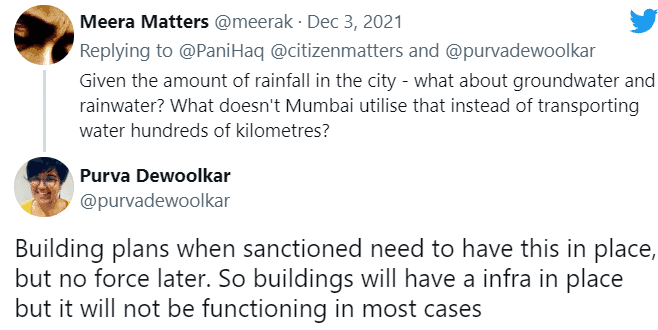
Buildings' groundwater infrastructure does not work in most cases
What happens to groundwater?

The second question was on how Mumbai sources water and how it is carried into the city.
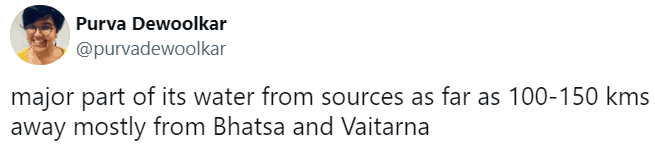
Mumbai gets its water from Bhatsa and Vaitarna
Mumbai’s water resources
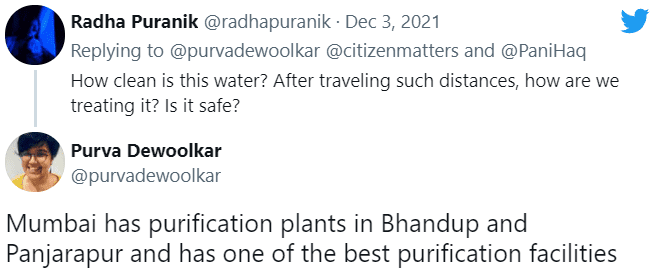
Mumbai's purification plants in Bhandup and Panjarapur
Mumbai’s purification plants

Water, however, remains more contaminated in some parts of the city like Dadar, Dharavi, Sion, Goregaon and Mulund according to the BMC’s water contamination report of 2020-21.

Is there a regulated rate of water? Who is paying how much for water?
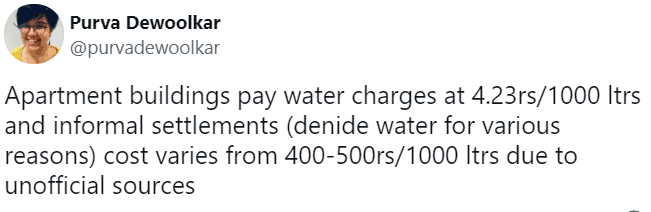
Apartments buildings pay 4.23rs/1000ltrs and slums pay 400-500rs/1000ltrs
Cost for apartment buildings as compared to informal settlements

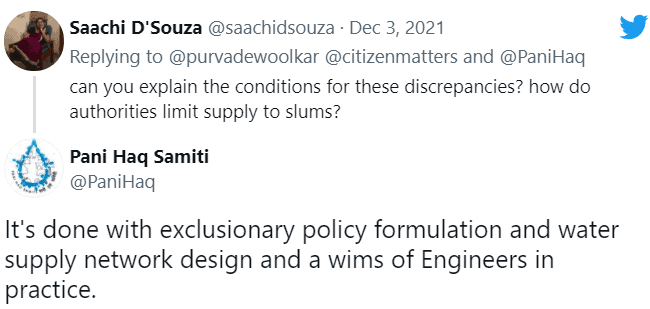
The fourth question asked if we are implementing any regulations to conserve water, is there incentive for good work, or penalisation for bad work?
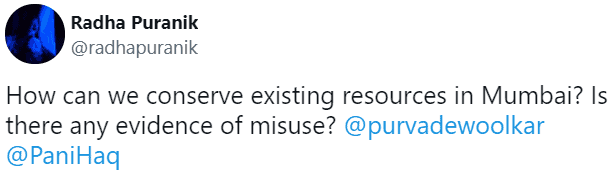
existing water resources in Mumbai
Are we conserving our water bodies?

“Dubious activities like filling ponds to create land, Constructing roads around the existing lakes are some examples of misuse of water resources” said Sitaram Shelar.


Read more: An apartment complex saved 187 houses from going dry
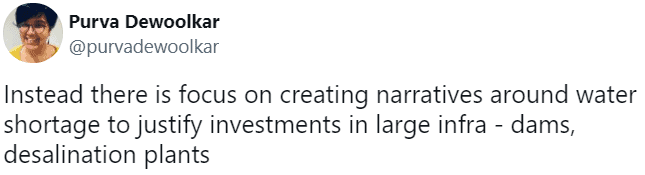

Mumbai's investments in dams justified?
Investments in dams

According to Sitaram and Purva, citizens’ constructive and consistent engagement, awareness about water sustainability and political will are the only ways to make clean water equally accessible to all. 

Also read:

Leave a Reply

Your email address will not be published. Required fields are marked *

Similar Story

Water is everyone’s right, says Pani Haq Samiti

Pani Haq Samiti, a rights campaign, completed sixteen years this year. Here is their story — how they secured thousands of water connections in informal settlements.

Maya Pawar was only 14 when she got married and moved to Pardhi Wada, an informal settlement located at Raey Road in Mumbai. Surprisingly, it was just a month ago that Maya, now a 62-year-old woman, received a legal water connection in her home.  For nearly fifty years, she was deprived of access to water. Her daily routine of fetching water was filled with challenges. Along with a group of other women, she walked 1.5 kilometres four to five times a day to collect water from a  Brihanmumbai Municipal Corporation (BMC) toilet. At one point, their desperation led them to…

Similar Story

Preventing water contamination: How citizen data and chlorine monitoring can save lives

In Indore, sewage leaks and intermittent water supply increase contamination risks. Maintaining residual chlorine in pipelines can avert crises across cities.

Recent media reports have highlighted the presence of bacterial contamination in drinking water samples collected from several locations in the Bhagirathpura area, Indore. The reports point to a few possible reasons: leakages from nearby septic tanks, soak pits, sewage pipes or drains, and poor septic tank design. Other possible causes could be ageing and corroded water pipes, and cracks or leakages in the distribution network.  However, intermittent water supply is also one of the most critical factors behind such incidents. In these systems, pipelines are often empty or partially filled, and may operate under negative pressure at certain times. These…