Exclusive interview: ‘Our focus is on regulating traffic,’ says Bengaluru traffic commissioner

M. A. Saleem, Special Commissioner of Police, Traffic, explains how ITMS and synchronised traffic signals work, and about IPC section 283.

Bengaluru’s infamous traffic jams have been the subject of much discussion for over a decade. With the roads burdened with vehicles beyond its capacity, traffic congestion has increased as the city itself has expanded. Last year, Chief Minister Basavaraj Bommai said his government’s priority is to ease traffic.

To ensure better traffic management, M A Saleem, IPS, was brought back to head the Bengaluru Traffic Police as Special Commissioner of Police, Traffic, in November 2022. He is a 1993-batch IPS officer who has a PhD in traffic management.

In his previous stints with the Bengaluru Traffic Department, M A Saleem introduced several initiatives such as Safe Routes to School and adopting technology under BTRAC (Bengaluru Traffic Improvement Project). In his previous role, he introduced around 128 one way roads in the city, which earned him the name ‘One-Way Saleem’.


Read more: How to make Bengaluru traffic jams go away


The Bangalore Traffic Police is devising ways to manage the city’s mammoth traffic, from working in co-ordination with other civic bodies, such as the BBMP and BDA, to exploring technology-related systems, such as ITMS (Intelligent Traffic Management System), synchronised signals, and installation of Artificial Intelligence at signals.
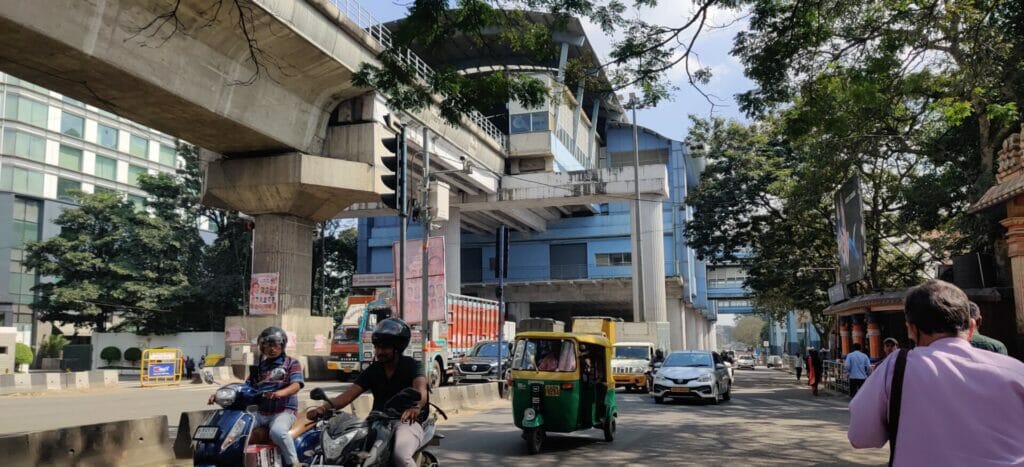
Vehicles plying on a road
Representative image. CM Basavaraj Bommai said his government’s priority is to improve traffic. Pic: Sherin Sunny

In conversation with Citizen Matters

In an exclusive interview with Citizen Matters, M A Saleem spoke about the use of technology in controlling traffic. He explained how ITMS is used for transparent booking of violations and how synchronised traffic signals work. He also spoke about the need for the enforcement of IPC section 283 to avoid footpath parking and ensure pedestrian safety.

Watch the full interview and know more on how Bengaluru Traffic is being regulated.

Also read:

Leave a Reply

Your email address will not be published. Required fields are marked *

Similar Story

Reshaping driving lessons: Road safety should be the ultimate priority

A Bengaluru driving school is rethinking how people learn to drive. Watch the video to find out how.

Nine two-wheeler riders die every hour in India. In 2024 alone, more than 4 lakh road accidents were reported. Nearly 1.7 lakh people lost their lives in these crashes. While Indian roads aren't the best, Dimpu Chindappa also attributes accidents to driver behaviour. Dimpu is an engineer who was building roads and now she own a driving school in Bengaluru, "Drivonaut". Drivonaut is a unique driving school which prioritises road safety and prepares drivers to prevent accidents. While most driving classes cut through the system to get their students the driving license, Drivonaut ensures that they are fully prepared for…

Similar Story

How a citizen-backed feeder bus service in Bengaluru transformed local commute

HSR Layout’s unique intra-layout feeder bus serves 1.8 lakh commuters monthly — a story of how citizen involvement made public transport better.

43-year-old Saridha from Hongasandra works as housekeeping staff at an apartment complex in HSR Layout, an affluent area in southern Bengaluru. There was a time when her work commute meant a one-hour, 3-km walk from her house to the apartment. And then the same way back after a tiring day's work. Till she came to know of the HSR Feeder bus.  Now, she can take a BMTC bus from her place to Bommanahalli. It's a short 400 metres from there to the Mangammanpalya stop, where she takes the feeder bus, which drops her off right next to where she works.…