In a previous article, Citizen Matters had traced the anti-encroachment drive by the BBMP in the Mahadevapura zone to clear constructions blocking stormwater drains. Following this, the Outer Ring Road Companies Association (ORRCA) and National Association of Software and Service Companies (NASSCOM) submitted a proposal that the 17-kilometre stretch of the Outer Ring Road, housing tech parks and Special Economic Zones (SEZs) be declared a separate municipal zone. But is such a zone feasible under the current law?
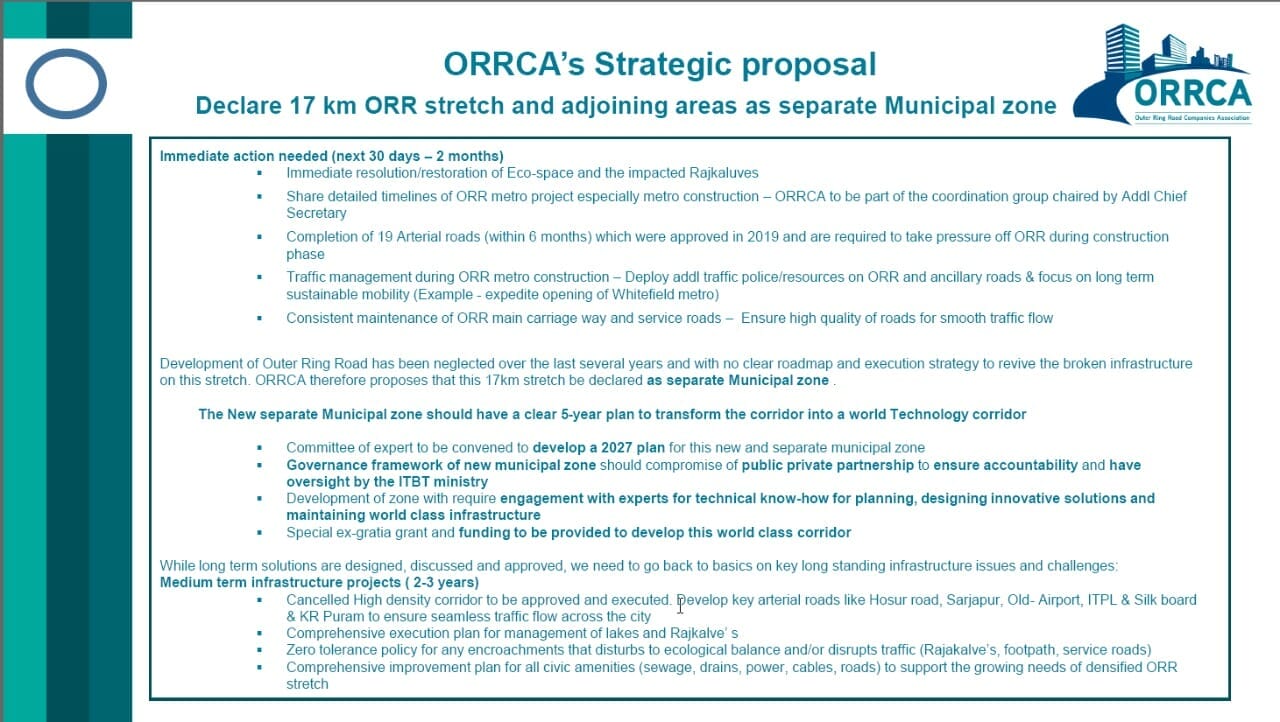
In a bid to transform this stretch into a “world technology corridor”, the proposal seeks a committee to be set up to draft a plan for the separate municipal zone whose governance model should comprise public-private-partnership with oversight of the ITBT Ministry, with an initial ex-gratia government grant to fund its operations.
[Click here to view full-size image]
In terms of immediate action, the proposal demands the restoration of the inundated tech park RMZ Ecospace, the clearing of rajakaluves, the completion of 19 arterial roads, and detailed timelines of metro construction. For long-term projects, the Association has asked for the approval and execution of the cancelled high-density corridors plan. This Rs 1,116 crore project, which sought to transform existing corridors into high-density corridors for seamless traffic flow, has been put on hold after CM Basavaraj Bommai voiced concerns about corruption surrounding it.
The proposal for a new municipal zone was submitted to the Minister of the Department of Information Technology and Biotechnology (ITBT) CN Ashwath Narayan. Echoing the sentiments of the companies, the minister admitted that “Brand Bengaluru” has taken a hit, but the government will overcome the temporary setbacks.
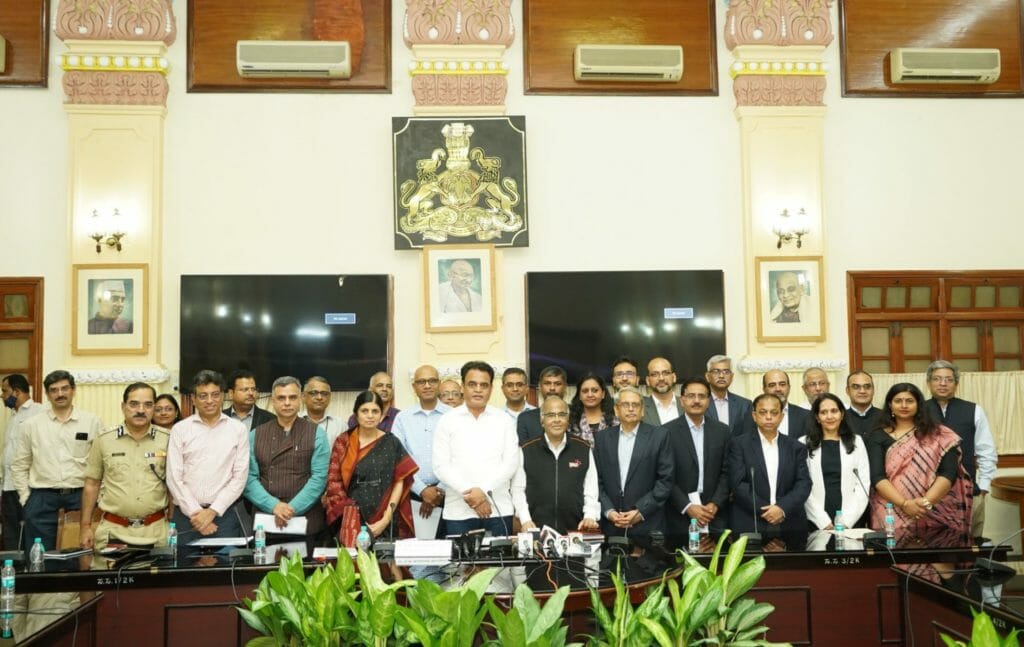
The ORRCA members also highlighted the need for a comprehensive improvement plan for all civic amenities, including sewage, drains, power, and roads to support the growing needs of the dense stretch. The proposal, which is currently under evaluation by the ITBT Department, lays emphasis on the need for private intervention to strategise and develop the broken infrastructure that the stretch currently faces.
Why the proposal of a separate municipal zone?
In June this year, Bengaluru Political Action Committee (BPAC), a citizens group, conducted a Citizen Perception survey, which was used to gauge how satisfied residents were across the different municipal zones with the governance and provision of civic amenities. Responses from 8405 residents across the eight BBMP zones, which included 198 wards, were tabulated.
The analysis showed that only 14% of the respondents were satisfied with the city’s governance. Not surprisingly, respondents from the Mahadevapura zone stood out for their consistent dissatisfaction with conditions of mobility, roads, lighting and other safety conditions at the zonal and ward levels, despite paying the lion’s share of property taxes.
Respondents from the zone along with their Yelahanka counterparts also attested to their ex-Corporators (elected for 2015-2020) having not engaged with the community in terms of proactively identifying problems or resolving them.
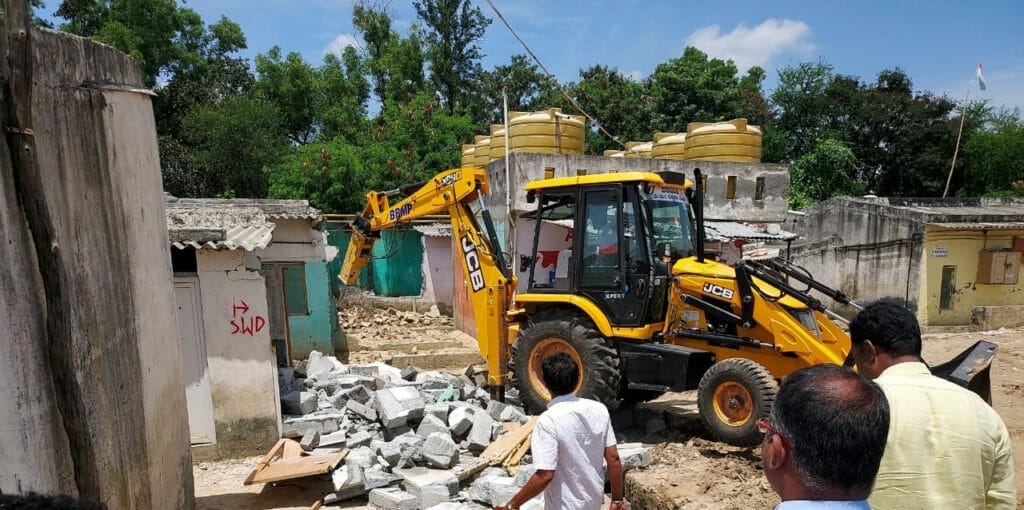
Around 12 kilometres of the ORR stretch proposed to be hived off falls in the Mahadevapura zone while the rest is in Bommanahalli zone. In the aftermath of the recent flooding, it has been widely reiterated that the lessened width of the drains, the lack of appropriate management and irregular cleaning and desilting of lakes to be the main reasons why the zone flooded. Hence, the proposal for a separate municipal zone is not surprising.
Referring to the handling of the floods, Mathew Idiculla, legal consultant and urban governance expert associated with Azim Premji University, says that any effort that allows for local-level decision-making where stakeholders have a larger say is a positive move. “Given the kind of absentee governance in place, it is justified for them to seek a separate municipal zone,” he says.
What the rules say
Mathew Idiculla: Under the new BBMP Act, 2020, the government can issue a notification to divide the BBMP areas into various zones, which was not possible under the previous Karnataka Municipal Corporation Act. The rules and bylaws for this are yet to be drafted as it is a new Act.
However, the kind of zone that ORRCA is asking for is different from the regular zones under BBMP, which means there are no clear provisions to enable the creation of a body governing the zone. It will have to be either an ad-hoc body or require drafting of new legislative provisions.
While at a broad level, any form of decentralised administration that is allowed to address the specific problems people face is to be welcomed, Mathew states that this has larger implications. Attempts to contact the Mahadevapura zonal officials did not evoke any response.
Read more: Why was the BRTS plan for Outer Ring Road killed?
The concerns
“The stretch has undergone tremendous development in terms of companies as well as the population over the years. We are hoping for an expert committee to be constituted that will look into this and draw feasible solutions for effective management,” says the ORRCA representative.
While receiving the proposal, the ITBT minister mentioned that they will “explore ways to implement the ‘ELCITA‘ (Electronics City Industrial Township Authority) model of governance in the affected zone as well as collaborate with industry.”
Read more: How is it that roads in Electronics City have no potholes?
Mathew says this is a cause for concern. “ELCITA is an independent authority that does not require democratically elected representatives. The Board just boasts representation from companies as there are no residents living in the area. However, this is not the case of the Outer Ring Road, which has a lot of residents who do not work in the IT sector”.
Besides, the proposal was submitted to the ITBT Ministry, which “has nothing to do with local governance,” says Mathew. “It is a clear indication and proof of the failure of governance, and this trend of demanding a separate municipal zone could set a dangerous precedent”.
Weakening of BBMP
“The proposal indicates that we are moving in a direction where there is no level of trust in urban governance or in bodies like the BBMP, and associations like ORRCA would prefer a completely different and privatised form of administration,” Mathew says.
A post by PRS Legislative Research outlines how the Urban Local Bodies in India are among the weakest in terms of financial autonomy or devolution of fiscal revenue. This limits their capacity to raise revenue through their own sources like property tax, increasing their dependence on state and central governments. However in Karnataka, the BBMP ACT, 2020 allows the municipal body to levy property tax on buildings (residential, commercial) and vacant land.
While a lot of cities have control over their sewerage, water, and sometimes even transport, Mathew states that BBMP does not have control over any of these as they are governed by parastatal agencies like the BWSSB or BMTC. “There is a sense of weakening of BBMP, ” he adds. The government did not bat an eye when ELCITA was formed because it is located in the city’s fringes. But taking a core region like the ORR out of this zone, claims Mathew, will lead to the splintering of BBMP’s governance as they stand to lose revenue in the form of property tax from these companies.
Read more: Audit report: BBMP, other Urban Local Bodies powerless and cash-strapped
The new forms of urban governance being mooted are prompting conversations on the need for a separate administrative system. While BBMP’s misgovernance is accepted, “the proposed solution of going beyond municipal governance and each zone going its own way has larger implications of imbalance in governance,” remarks Mathew.