This is the third in our series of Cycle2work interviews of men and women employed in diverse sectors. The series will bring you the stories of these green commuters. We hope that these stories will inspire and encourage more Bengalureans to cycle, and not drive, to work.’
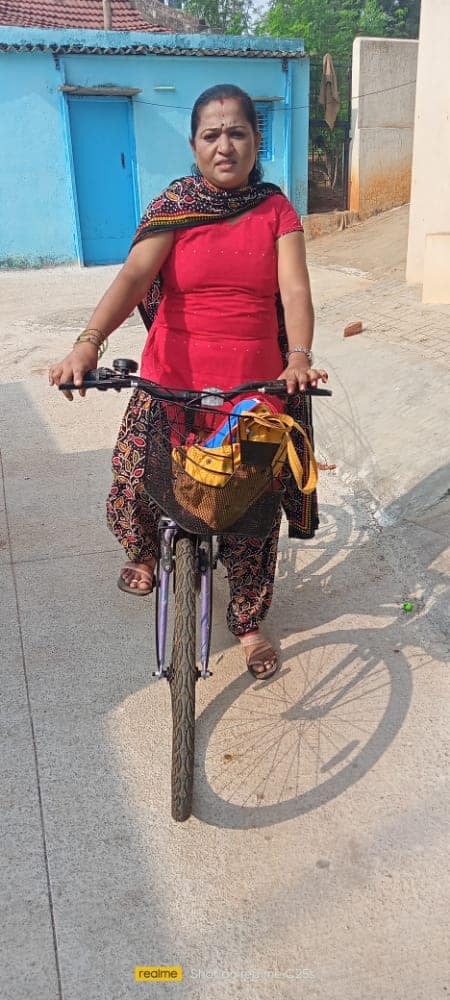
Sheela Sahi works in a garment factory in Bengaluru and has been cycling to work for over three years. Cycling to work has reduced Sheela’s commute time from two hours to 30 minutes. She also feels more empowered and requests nonprofits to support her women colleagues in switching to commuting by cycle.
Excerpts from the interview.
When did you move to Bengaluru?
My native place is Chitradurga and I moved to Bengaluru 11 years ago to look for work. I am working in a garment factory near 8th mile, Nagasandra.
When did you start cycling to work?
I started cycling three years ago when Greenpeace (a nonprofit campaigning for sustainability) gave me a cycle.
Read more: “Need a mindset change in how people see commute in cities” – Shilpi Sahu, Cyclist
How has cycling to work helped you?
Cycling to work has reduced my commute time by an hour. I used to walk 2.5 km to work earlier and now I commute by cycle. I now feel happy and more energetic when I reach my workplace. I also get to spend more time with my family which is a real boon. Society says many things — your age is not right for cycling, cycling is not safe for women etc. As long as your life is made easy, your family is supportive. Take necessary precautions and move on and ignore roadblocks from society.
Read more: Green commuters: “I see no reason why I should not cycle to work ” – Karthik
People complain that Bengaluru weather is not suitable for cycling, roads are not safe… How do you respond to this?
The route I take has narrow roads with high traffic, which can be intimidating. I used to initially find it challenging to cycle on elevations but now, with practice, I am able to do it.
Are you aware of the cycling lanes in Bengaluru?
I have heard of dedicated cycling lanes in some parts of the city. It would be good to have such lanes here so cyclists, especially women cyclists can commute in peace without worrying about being run over in traffic.
We sometimes hear it is not safe and not the right time for women to cycle to work. Your thoughts on this?
I have not had a single issue concerning safety. People say many things. I feel as long as it is making your life easy and you get your family support at home, you should go ahead. My husband and children give me full support. My work shift is from 8:30 am to 5:45 pm. I use the cycle only to commute to work and as the distance is not much, I am able to manage it. I carry an umbrella and generally wait it out when it is raining.
What other support are you looking for?
I am personally happy with my lifestyle. There are many women including single mothers in my factory who come from long distances and are looking for support to get cycles to reduce their commute time and make their commute easy. I would request the government and nonprofit organisations to provide similar support to them.
[This article is part of the series of Cycle2Work interview series, a project of Global Shapers Bangalore Hub, which is part of the Global Shapers Community, an initiative of the World Economic Forum]
Also read:
- Need parking fees, congestion tax to regulate private vehicles
- Fix public transport to reduce car, bike trips
- Better mobility design can encourage the use of public transport, cycling and walking
- New network for all citizens bound by a love for cycling
- Cycling will transform Hyderabad and create a happier city: Santhana Selvan, Bicycle Mayor
Biggest threat to cyclists like me are two wheelers driving on wrong side. Secondly
it is pedestrians walking on roads due to uneven and encroached foot path.