Bengaluru, a rapidly expanding landlocked city without proximity to major water sources such as rivers, is largely dependent on its groundwater resources. And with summer fast approaching, the city’s water needs will only increase even as its availability declines.
Bengaluru is blessed with rains throughout the year, which makes it ideal for rainwater harvesting. Even though Bengaluru is listed as the second-highest in rainwater harvesting in Indian cities, is it enough? According to a World Bank Group report, over the last 50 years, the total number of borewells in the country has grown from one million to 20 million, making India the world’s largest user of groundwater.
The depth of borewells in Bengaluru is estimated to have reached unprecedented depths of over 1500ft. This is largely due to the fact that without recharge wells to direct rainwater into the aquifers, the quantum of rainfall recharging groundwater can be as low as 4% depending on the soil as most of the water tends to run off.
Read more: Bengaluru, second highest in rainwater harvesting in Indian cities
Considering the urgent need to address this issue, Biome and BWSSB, in collaboration with Citizen Matters, is organising a webinar – ‘Well’ Connected ಅಂತರ್ಜಲ ಮತ್ತು ಬಾವಿಗಳ ಸಂಬಂಧ – on Saturday, February 26th, to emphasise the necessity of citizens’ engagement in maintaining and replenishing groundwater through the digging of wells.
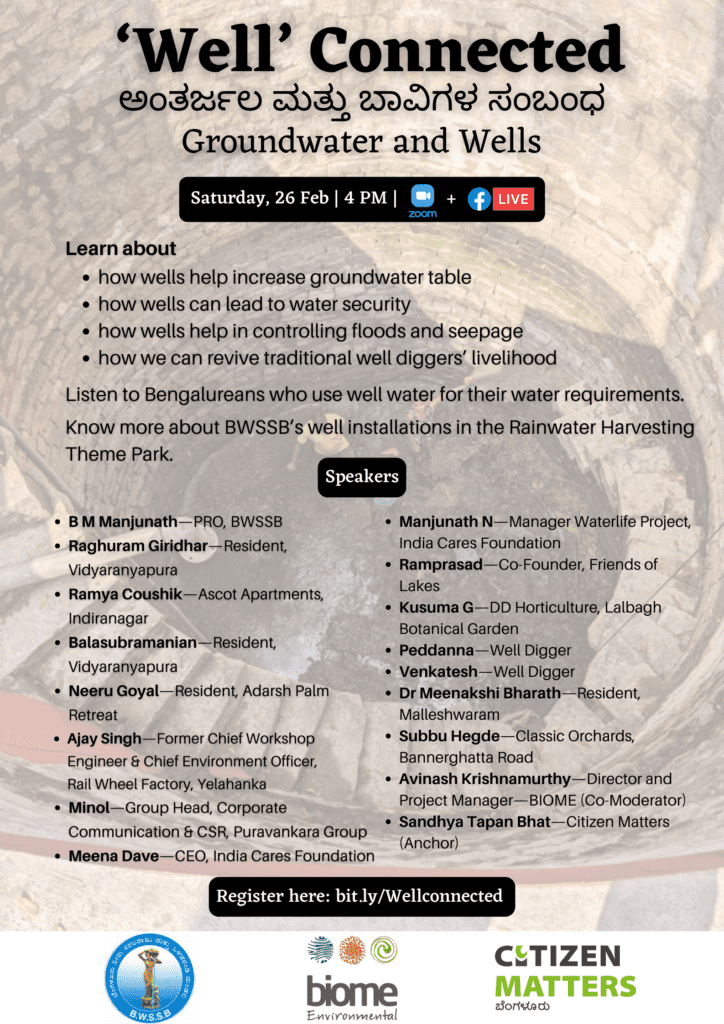
The objective is to highlight the significance of having more open wells and recharge wells to reduce demand for Cauvery water and the use of borewells, mitigating flooding issues and enhancing the groundwater table.
We will hear from senior BWSSB officers about the importance of managing groundwater tables and how open wells are an integral part of this.
Read More: Rainwater harvesting: Apartment’s water bill goes from over a lakh to zero in monsoons
The webinar will focus on groundwater/shallow aquifers and their significance, besides giving an overview of the history of open wells, their current status and locations. Also on the agenda are how these wells can be used as a water source which contributes to recharging aquifers, helps in flood mitigation and helps reduce dependence on Cauvery/borewell.
BWSSB, which is responsible for managing water demand in Bengaluru, has come out with clear rules to reduce consumption. The agency has also developed a Rainwater Harvesting (RWH) theme park in Jayanagar, which has demo installations to guide citizens on ways to reduce water demand.
The webinar will be followed by a brief Q & A session open to participants.
Event: “Well” Connected ಅಂತರ್ಜಲ ಮತ್ತು ಬಾವಿಗಳ ಸಂಬಂಧ
Date: Saturday, February 26 2022
Time: 4:00 pm onwards
Register here: https://bit.ly/Wellconnected
Speakers:
- B M Manjunath PRO, BWSSB
- Raghuram Giridhar – Resident, Vidyaranyapura
- Ramya Coushik – Ascot Apartments, Indiranagar
- Balasubramanian – Resident, Vidyaranyapura
- Neeru Goyal – Resident, Adarsh Palm Retreat
- Ajay Singh- Former Chief Workshop Engineer & Chief Environment Officer, Rail Wheel Factory, Yelahanka
- Minol – Group Head – Corporate Communication & CSR, Puravankara Group
- Meena Dave – CEO, India Cares Foundation
- Manjunath – Manager Waterlife Project, India Cares
- Ramprasad – Co-Founder, Friends of Lakes
- Kusuma G – DD Horticulture, Lalbagh Botanical Garden
- Peddanna – Well Digger
- Venkatesh – Well Digger
- Dr Meenakshi Bharath – Resident, Malleshwaram
- Subbu Hegde – Classic Orchards, Bannerghatta road
- Co-Moderator: Avinash Krishnamurthy, Director and Project Manager, BIOME
- Anchor: Sandhya Bhat, Citizen Anchor, Citizen Matters