No new coins if you want platform tickets

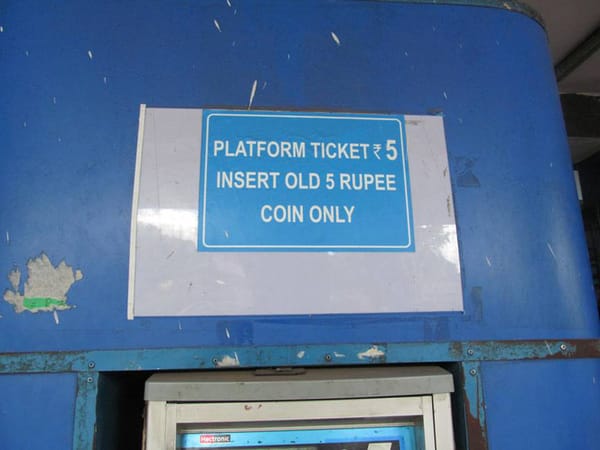
The vending machine dispensing platform tickets at the city railway station is slowly falling into disuse, since it accepts only old coins.

The manual ticket counter is functional again at the city railway station, as the e-ticket machines for platform tickets take in only old-five rupee coins, which are not being minted anymore. Passengers have started depending more on the manual ticket counters as majority of them have only new-five rupee coins.

This has led to a drastic drop in the printing of tickets by the machines to one or maximum two tickets a week.
Pic:author

Hariharan Narayanan, who had come to drop his wife at the railway station said: "The city railway station has e-kiosk to dispense platform tickets. It accepts only old-five rupee coins. What is the use of such a machine?"

People often do not have change, especially when there is a constraint that only old-five rupee coins are accepted. With manual dispensing of platform tickets, congestion is back.

The machines were upgraded last after the budget session of 2012, much after the new-five rupee coins were introduced. C Narendra, Publicity Inspector of Railways, Bangalore says, "The machine is customized in such a way that it accepts only the size of old five rupee coins. The new five rupee coins are smaller and thinner and this is not acceptable by the e-kiosk machines". He said they are aware of the problem and are trying their best to fix it soon.

The machines were first introduced in 2007, when the cost of the platform tickets was Rs 3 per ticket. Post the budget session 2012, the machines were updated as the cost of the tickets was increased to Rs 5 per ticket. At that time, the machines were programmed to accept old-five rupee coins, which is not being minted anymore by the RBI.

Leave a Reply

Your email address will not be published. Required fields are marked *

Similar Story

Exclusions and evictions: Mumbai Pardhi community’s struggle for shelter and dignity

In Borivali’s Chikuwadi, BMC demolitions left Pardhi families homeless and harassed. They demand housing and basic facilities.

Over a fire of burning newspaper and cardboard, Madhuban Pawar, in her mid-60s, sits on the cold stone floor brewing tea. It is 11 pm, and her husband waits beside her for their only meal of the day: a single glucose biscuit and a glass of tea. In the wake of the December 2, 2025, demolition drive in Mumbai's Borivali, a lone cooking utensil is all the Brihanmumbai Municipal Corporation (BMC) left her with. Madhuban, like many from Borivali's Chikuwadi, has inhabited the slums for over 20 years. "I work as a sanitation worker. During monsoons, our job is to…

Similar Story

Voting in Mumbai: Complete guide to BMC elections and making your voice heard

Mumbai citizens will vote on January 15 to elect 227 councillors. Here's all you need to know about the BMC and the voting process.

After nearly four years of delay, Mumbai is finally set to hold its municipal elections on January 15. The last elected council completed its term in 2022, and in the absence of fresh polls, the city’s civic body was placed under an administrator for the first time in forty years. The Brihanmumbai Municipal Corporation (BMC), established in 1888, is the governing authority responsible for delivering essential civic services — from water supply, sanitation, and solid waste management to public health, infrastructure, roads, and education. With a staggering budget of ₹74,427 crore for 2025–26, it is the wealthiest municipal body in…