On June 24th, the Bannerghatta Road Neighbourhood Association (BANA) organised "Connect", a knowledge sharing seminar at Purva Panorama Apartments at Bannerghata Road. BANA is a federation formed by a group of RWAs of apartments and layouts in and around on Bannerghatta Road. The forum will be used to resolve common issues and create a strong local community. The founding members include resident associations of L&T South City, Purva Panorama, South Avenue Layout, Pride Regalia, Ajmera Green Acres, Vithola Apartments, Nandi Park, Mantri Woodlands, Esteem Enclave etc.
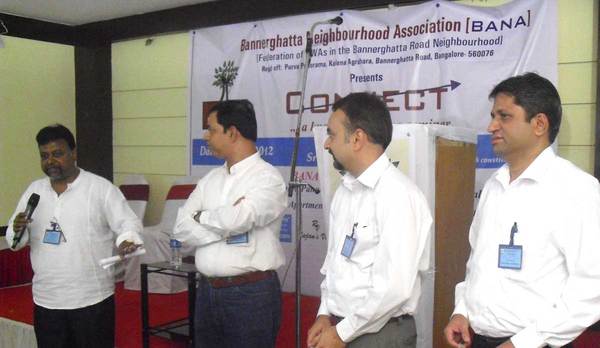
BANA office bearers at the meeting. Prem Sarkar, Shankar Bharadwaj, Kedar Nayak, Vivek Baliga. Pic: Sankar C G
The seminar was inaugurated by Bangalore South MLA M Krishnappa. Dr. Harsha, DCP South East, launched BANA’s online portal (www.nammabana.in).
Krishnappa promised the residents, his support to solve major issues they face. “Small issues like garbage not being cleared, drainages etc., you can sort out easily. If the problem is beyond your control, let me know in writing, I will be there with you,” said Krishnappa.
Gurudutt Rao, Vice President of BANA, Vivek Baliga, Joint Secretary, and Kedar Nayak, General Secretary introduced BANA and their vision: To unite the voice and action of residents of Bannerghatta Road on a common platform in governance through active participation in local issues, through ethical and morally upright means.
Knowledge sessions followed this. The attendees listened with rapt attention to the talks on managing security, understanding issues related to solid waste, water and waste water, legal procedures related to RWA registrations, etc.
Raja Sekhar Kommu, Director of Apna Complex an apartment management software company, explained how technology or egovernance can help make the work of an RWA easier. Nagesh explained the issues related to STP operation and KSPCB procedures. He said it is the builder who is responsible for the STP operating properly. RWAs should use the STP handbook published by KSPCB to help verify if their STPs were working properly. He also shared some ideas for improving water situation by using treated water for flushing, recharging ground water with the treated water etc.
Meera K, co-founder, Citizen Matters, talked about various community initiatives like lake rejuvenation, and neighbourhood planning. She also talked about how citizens can use Citizen Matters to share their experiences so others can learn. Akshay Yadav from Janaagraha introduced their portal, ichangemycity.in.
The session concluded with Suneet Kumar V P, L&T South City explaining the importance of apartment associations registering under the KAOA act.
⊕
With Multi story buildings popping up, dime a dozen, and the water scarcity looming large, to enable equitable distribution of water to all and control over mis/ wrong use, it is ESSENTIAL that the plumbing of fresh water lines allows for metering of the consumption of each apartment individually/For this necessary Code of Pracice/ Standards have to be establised and it must be made mandatory that the builders adopt it.UNLESS there’s is a clamour by Federation of RWA like yours , and you take up the issue with the concerned authorities to establish the COP/Standards nothing will come out and there will be a severe crisis and even physical assaults during water shortage.
TRUST YOU WILL TAKE UPTHIS ISSUE
As an individual I have addressed to all the authorities for the last seven / eight years enclosing self addressed stamped envelope to at least acknowledge receipt.But none of the has had the courtesy even to do that .
ONLY INSTITUTIONS with clout can do something.
Vedanthan: 02 03 2013