Disclaimer: this information is provided by Prithvi K, an expert on snakes, it is for your information only. Please do not attempt to catch snake(s) based on the information provided here.
Prithvi K, a trained snake catcher and resident of Sarjapur Road started rescuing snakes from January 2008. According to Prithvi, out of almost 270 varieties of snakes found in our country, only four are venomous. By learning to identify these four, we can allow non-venomous snakes to live in our surroundings, and maintain the balance in our ecosystem.
Prithvi says, “If you are interested in pursuing herpetology as a hobby/ profession, I suggest you do it only after proper training and in-depth knowledge in this area. For this you can contact me and I will direct you to the right person.”
Here are the snakes that have been found by Prithvi around Sarjapur Road.
Venomous snakes

Spectacled Cobra

Saw-scaled Viper

Russell’s Viper
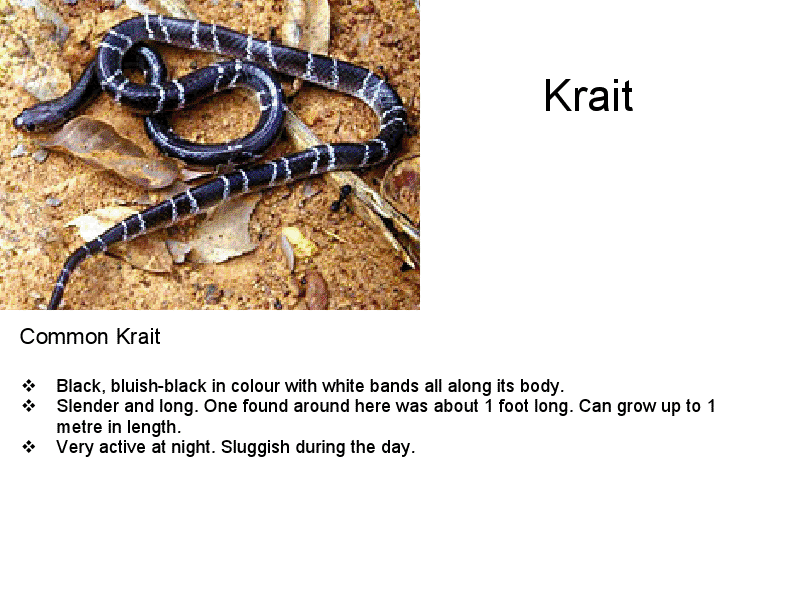
Krait
Spectacled Cobra
* Colouring – light brown, dark brown, greenish-brown.
* Colouring is generally uniform through-out the length of the body, except for the head and neck.
* It has a distinctly visible black mark in the neck area, that forms the ‘V’ when the snake opens its hood.
* Scales on the hood and body are oval-shaped, and look like grains of wheat (clearly visible in the pictures). It gives a loud hiss and opens its hood when disturbed or feels threatened; more active during the night.
* Largest one found around here was approximately 7 feet long. Can grow upto 8 feet in length.
Viper
* Has a distinctly triangular head, prominent because of a slender neck, with a thick body, and a thin tail.
* It is slow-moving but strikes very fast. Very active at night
* Has interesting patterns all over the body.
* Common ones found here – Russell’s Viper, Saw-scaled viper
* The largest Russell’s Viper found around here was approximately 5 feet long. This is the size of a fully-grown adult.
* The Saw-scaled Viper found here was about 10 inches in length. It can grow up to a maximum of 3 feet in length.
Krait (Common Krait)
* Black, bluish-black in colour with white bands all along its body.
* Slender and long. One found around here was about 1 foot long. Can grow up to 1 metre in length.
* Very active at night. Sluggish during the day.
Note: It is possible that there are other venomous snakes in our area (Banded Krait, Coral Snake, King Cobra, Bamboo Pit Viper, Black Krait, etc.), which have not been included here.
Non-venomous snakes
* Rat Snake
* Water Snake
* Green Vine Snake
* Striped Keel Back Snake
* Banded Racer
* Russell’s Kukri
* Common Kukri
* Sand Boa
* Common Wolf Snake
* Common Trinket
The full presentation including pictures of all snakes spotted in the area can be seen here.
Tips by Prithvi on avoiding snakes bites:
⊕