The Clean Buddha Nullah programme, which had become a symbol of the extreme apathy shown by successive governments towards citizens raising this issue for years, seems to have received a much-needed impetus.
“The Buddha Nullah issue had been in a state of limbo for the past 30 years,” said Jaskirat Singh, State Executive Committee Member of the Naroa Punjab Manch (NPM), a citizen body formed to highlight issues related to water pollution. “It was around the time the Citizen Matters story appeared that we formed the Naroa Punjab Manch and since then we have been actively taking it up with all stakeholders.” Led by its convener Gurpreet Singh Chandbaja, NPM has now evolved into an umbrella organization representing over 50 NGOs across the state.
Kahan Singh Pannu, Punjab’s Director, Environment and Climate Change says that the issue is now being confronted “head on by the Punjab Government. If we give weightage to various factors contributing to pollution in the Sutlej river in Punjab, I would say 90% of it is because of the Buddha Nullah. It is now top priority of the government. We are going about it in a systematic manner, involving all stakeholders, and the results will be there to see,” he added.
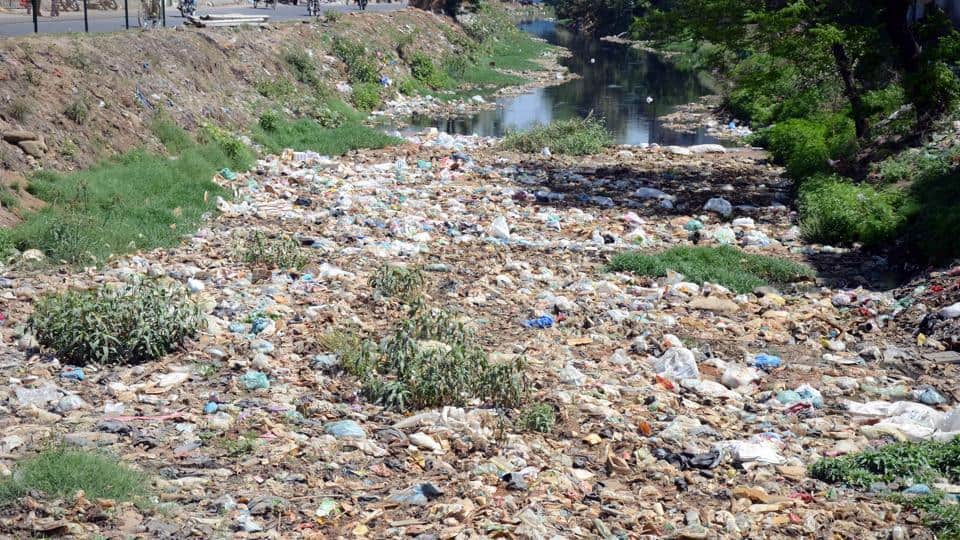
Will this picture finally be erased? Pic: Raj Machhan
The authorities are in the process of constructing three new Effluent Treatment Plants and a Sewage Treatment Plant. “But it cannot be done in a day as there are multiple stakeholders involved. For example, dairy owners. Shifting of dairies is a major process in itself. We are trying to build a consensus: PPCB, NGT, MC, State Government departments, and civil society, all are involved. The chief secretary is coordinating the effort at the highest level. We are going to find a permanent solution,” said Pannu.
Pannu’s words are echoed by Ludhiana MLA and Punjab minister for Food and Civil Supplies & Consumer Affairs Bharat Bhushan Ashu. “The dairy owners have agreed to shift to a new venue,” said Ashu, himself a diary owner. “The district administration is identifying land for the dairy complex in two nearby villages”.
A high-powered committee has been formed to monitor the entire exercise. “The preparation of the project report is underway. It would be a comprehensive report to clean and beautify the nullah. As soon as the project report is approved by the Central government and funds released, work will start immediately (the Punjab Government is looking for Rs 1500 crores from the Central Government under a Special Purpose Vehicle on the lines of Clean Ganga Mission). It is an issue that has been flagged at the highest levels, with the Chief Minister himself co-ordinating with the Union Government. One of their teams had visited us recently and held detailed discussions with PPCB among others. We have already taken administrative action against the dyeing units which were polluting the Nulla,” added the minister.
On the legal front, a local court granted bail on August 9th to Ludhiana municipal corporation Commissioner Kanwalpreet Kaur Brar, Mayor Balkar Singh Sandhu and two others who were booked in a criminal case filed by Punjab Pollution Control Board (PPCB) upon the directions of the National Green Tribunal (NGT). The officers were booked under Water (Prevention and Control of Pollution) Act on charges of polluting the Buddha Nullah as a sewerage treatment plant (STP) run by the civic body at Jamalpur was non-functional while another at Balloke was not functioning as per norms. Now, much of the newer follow up measures planned will be Commissioner Kanwalpreet’s responsibility.
Prof Satwinder Singh Marwaha, Chairman, Punjab Pollution Control Board, who had told us two months ago that the clean-up process would start moving within two months, confirmed that preparation of project report and issuing of tenders was happening at a fast clip. “The implementation of the clean-up process rests with the department of local bodies,” said Prof Satwinder. “Since PPCB is a regulator, our job is restricted to monitoring of the process. Having said that I can share with you that things are moving forward. In fact, recently they had a meeting with the Chief Secretary where they made a presentation on the process for finalizing a DPR, calling for EoIs, tenders etc. It is being taken up very seriously.”
When asked about the roadblocks in implementation, all that Satwinder could say was that the plans had been accepted by the CPCB and the NGT by March 31 and these are being monitored. “The job is to be completed within three years after finalizing the DPR, that target has been accepted, People have realized they have no option left but to work and show the results.”