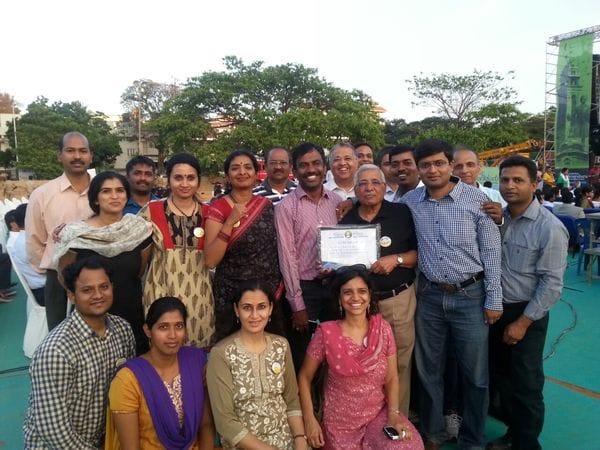
Members of the Whitefield Rising group with the Namma Bengaluru award
We gave no consent and we got awarded for that! You read that right. On March 14th, Whitefield Rising won the Namma Bengaluru Foundation award for disagreeing and sometimes being disagreeable! Strange, isn’t it? Read on to find out why.
We all agree that the state of affairs around us is, putting it mildly, not good. Child rape, sewage in the lakes, garbage on the streets, inequality in our society and many more civic and humanitarian issues. As Ela Bhatt says, this is ‘violence to our own with the consent of state and society’. Ouch!
WE ARE THAT SOCIETY! And by watching on and not acting, WE ARE GIVING OUR CONSENT.
Not anymore… Whitefield Rising provides that platform through which all those who don’t give such consent engage, and find strength in working with others like them. In short, we demonstrate that we ‘care’. Because the line between inaction and indifference is not that far from apathy.
We realise we are not just automatically entitled to what we have, be it a roof over our heads, food in our stomachs or money to send our children to school. We realise we have a responsibility that goes with this privilege. And we heed to it so we can sleep at night.
You may very well ask, “So, what change have you made? We don’t see massive impact?”
- It’s what our eyes want to see :). We see impact, and all over the place! We see a sea of people who have come together to demand change. Ask the father of a victim of circumstances what it feels like to have his entire neighbourhood stand by him. That we care, matters.
- We look around and support all those who do amazing work for those who have become invisible around us.
- A sea of volunteers agonise over the circumstances of those children you see running around in rags instead of being in school, and do something about it.
- Another group worries over the stray dogs that society wishes away. They labour over every dog, vaccinating them and spaying them, so that the next round of puppies does not show up.
- A group encourages disilluisioned, ignored school dropouts and gives them 3 months of rigorous training on unconventional topics – ethics, NLP (Yes!), time management, hope and persistence, apart from useful practical skills and guaranteed employment.
- Yet another takes our empty juice cartons, employs local women and converts them into products of pride, while bringing them self-esteem.
- Another goes from community to community, to encourage them to be responsible with their waste by sending as little as possible to the landfill.
- Some have managed to break through the world of corruption. Thanks to them, we no longer need to pay a bribe for khata registration or BESCOM meter transfer.
- Another group has slowly started gaining strength in numbers as citizen traffic wardens.
- Yet another group chose to build a safety app connecting all of us in Whitefield so that we look out for each other.
- A school is trying to bring “Khan Academy” to our government schools
- And some builders, for no visible benefit to themselves, are bringing their capabilities to fix local civic problems.
This is only a hundredth of our list. Still, we must explain the lack of ‘visible’ difference
- What is visible is the infrastructure (or lack thereof) around us. And it’s true that there isn’t visible impact yet. People are labouring over understanding the problem, the way the government works, utilising all the collaboration tools possible, and occasionally straying into non-collaborative tools such as protests. But the truth is that we have an uneven return on investment – MASSIVE citizen efforts, with tiny movements from the government side.
- There is 110 crores allocated to the main road project they call the Signal Free Corridor; but the contractor has not been paid yet, so he will not work.
- An entire group is working hard to rejuvenate Varthur Lake. But even months after the Upa Lokayukta demanded for some action from a government official, there is no change.
- Another group labours over trying to get BMTC buses to stop at bus stops, but until the RTO comes down on private buses, this problem will not go away.
- We were promised increased traffic police staff, as well as consideration regarding the truck ban in our arterial roads, that is causing havoc to school children and others. But no, there isn’t any response yet.
Though there are a zillion more issues like the above, the good news is that our efforts aren’t entirely wasted. There appear to be some people in the government who do want to help and have the ‘capability’ to help. Many who want to are simply unable to, because of the system in which they are mired. That deep change is not something that is easy. It can only come when the majority of the citizens, wake up and realise their responsibility to the state of affairs we are in and bring their own creative solutions to the table. This is our society and we have to step up to it.
Like moths to a light, many of you have come forward to contribute your bit. We don’t have all the answers and you are accepting of that. So if you haven’t already, write to hello@whitefieldrising.org and share what your inclination is, along with how much time you can spare. We have something for everyone. Even the busiest amongst you can still do something.