More than 200 residents living in BBMP’s Mahadevapura Zone walked peacefully on Borewell Road in Whitefield recently, demanding restoration of the road and civic amenities. Young and old, women and men, joined hands to cover the 1.5 km stretch from Post Office to Ambedkar Statue in one hour. En route, around 200 school children and residents stood with placards in solidarity for the cause.
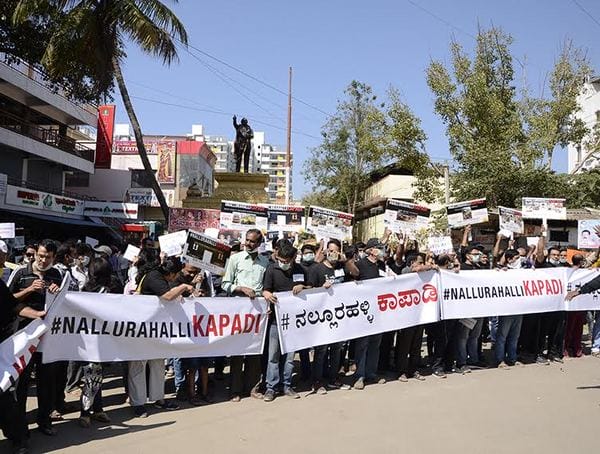
Pic: Shanthi Chandola
Organised by Nallurahalli Rising along with Whitefield Rising, the protest in Hagadur ward drew people from far and near, including Kadugudi and Garadacharpalya and Hoodi wards.
Led by a band of drummers and accompanied by a contingent of police, traffic police and traffic wardens, the protesters held placards, wore black and donned masks, symbolising the pathetic condition of one of Whitefield’s oldest roads.
The walkers ensured smooth movement of traffic and dispersed peacefully after assembling at Nallurhalli junction. The venue is the epicentre of today’s Whitefield, linking the nineteenth-century Inner-Outer Circle and Main Road to India’s high-tech hub: Export Promotion Industrial Park (EPIP) and International Tech Park Bangalore (ITPB).
Many residents stood outside their homes in support of the march. Children and teachers from many of the 14 pre-schools in the area participated by standing with banners and posters outside their premises.
Office goers took half-day leave to take part. Every day, especially since BWSSB dug up the narrow road in August 2016, commuters and residents have suffered. Those impacted include the newspaper boy and the milkman, the schoolchildren and the senior citizen. People carried their own water bottles and took them back – no litter was created.
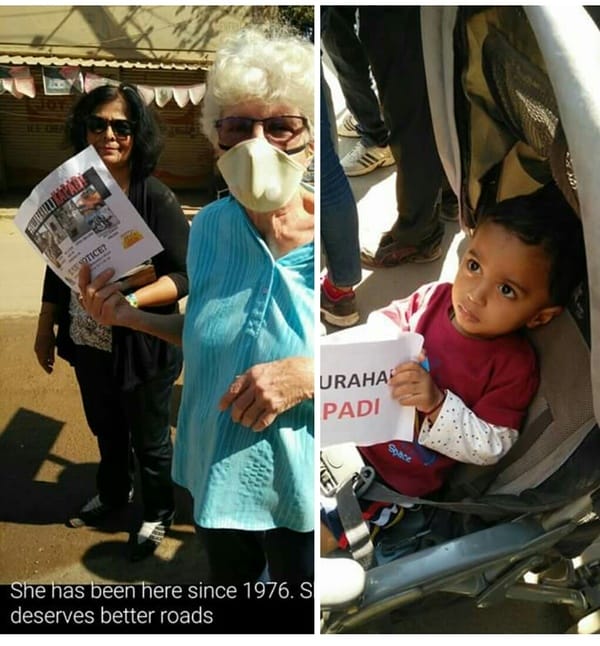
Pic: Shanthi Chandola
Banners made for the event were given to ‘Joy of Work’ in Nallurhalli for recycling and upcycling. As a resident put it, “Borewell Road (and much of Whitefield) is sinking and stinking! A portion of Outer Circle caved in when an SUV passed by on Monday. This was a chance for people’s voices to be HEARD.”
BACKGROUND
Borewell Road and nearby areas:
- No of residents: 8,000+
- No of heavy vehicles using the road daily: 5,000 (approx.)
- No. of pre-schools: 14
- No. of accidents that have taken place in the last 12 months: 6 fatal, countless minor mishaps
- No of streetlights not working: 50% of the fixtures
The reasons for the protest:
Underground sewage network: BWSSB started work on installing chambers and laying pipeline in August 2016 and was supposed to complete the work by October 2016. However, despite repeated requests and follow-ups, UGD work has not been completed.
- BWSSB contractor has just poured quarry dust and pebbles wherever it has dug pits and channels. “We do not have a road anymore.” The stones and dust are particularly dangerous for pedestrians, cyclists and two-wheelers.
- The air pollution caused by the movement of vehicles on this dirt track causes breathing problems for everyone, particularly school children and senior citizens.
- Footpaths and storm water drains are either incomplete or damaged. It is dangerous for people walking on the road and for vehicles, too.
- Streetlights do not work in certain parts of the locality. The dark stretches are hazardous and unsafe. There have been a spate of burglaries in the area. A few electricity poles are weak and need to be replaced.
- Peak hour traffic is between 8 a.m. and 11 a.m. and between 5 p.m. and 9 p.m. Traffic needs to be regulated during these times. Movement of heavy vehicles and water tankers needs be restricted.
- The road is narrow for the volume of traffic; it is only 40 feet. There are numerous illegal shops that encroach footpaths and cause parking woes.
- The village folk of Nallurahalli, which was amalgamated into BBMP in 2007, are also impacted by the terrible road conditions and traffic. Two-wheelers often go through the narrow village roads, creating congestion, air and noise pollution.
- Nearby roads from Ramagondanahalli and Siddhapura, the Nallurahalli New Temple Road, Outer Circle and Inner Circle are also similarly affected