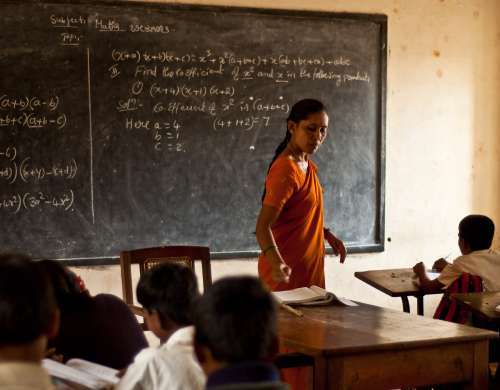
A Mathematics teacher at Corporation Malleswaram High School teaching a 9th standard class. Pic: Shamsheer Yousaf
What can we do to improve public schooling, tangibly? Ever since the terrible PU results came out showing more children failing than passing, I’ve got a lot of letters asking what can be done about this. To my understanding, we need to do at least the following three things, to have any chance of intervening swiftly in the lives of millions of children.
Increase the funding levels for education
I know we are perfectly capable of wasting money, but even so, without proper investment in education we cannot hope to get anywhere. The state spends about Rs 9,000 to Rs 13,000 per year per child in the education system, and a very large part of this on salaries. It needs to spend at least three times as much, and put money into materials, methods of learning, better infrastructure, technology, design, and much more. There are already many private initiatives that do wonderfully well at these levels of cost, and there’s no reason why the state cannot adopt similar efforts.
Bring skills learning into the formal school
What happens now is that we first wait for children to fail in tenth standard or PU, and then ask ourselves, “Now that they have failed at that, how can we teach them some useful life skill?” This is a stupid plan. Given the very large numbers of students failing in the system, it would be much better to bring skills training into the school itself. I once asked the government if they would allow this to happen in 100 schools. As always they said yes and meant no, so it went nowhere.
This is all the more important because many skills trainers are saying that they are having trouble finding kids to teach, for logisticial reasons. Any skills training program needs physical space for instruction and a place for the learners to stay while they learn. These things are already available in the school/home environment, and that should make it easier to teach children job skills in their later years of school.
Separate the regulation from the Education Department
This is the heart of the problem, as everyone knows. The sarkari system produces very low learning outcomes itself, and yet it is the one that is regulating and ensuring the quality of the private schools? Who are we kidding? This is just a cosy rent-seeking arrangement by which corruption in the education sector has flourished. And with the RTE strengthening this ‘arrangement’, what we are getting is even more of terrible learning, zero accountability, and plenty of grease money.
Amidst all this, more ‘local control’ would help too, and surely more native language learning. But those are more complex steps, and requires some capacity building first and restructuring as well. We will have to do that too. Let us start with these three things. God knows there are many more milestones to be crossed before any of the money we spend each year in Education departments produces a result we can be proud of.
As we have talked about technology & new education skills in this article, we can surely recommend an extra help to students those who need it. By extra help here I mean tuitions and that too with quite advanced technologies. There are companies who are taking initiatives in making our education system smarter by introducing Online as well as Home Tutoring. Vedaantu, fliclass and Eduwizards have been doing the same thus, making the Indian education system more polished in all ways.