Mumbai’s population growth is attributed to the influx of migrants due to the textile mill boom in the 1900s. By 1921, migrants made up about 84% of the city’s population. Historically, Mumbai’s large migrant population has been its backbone. However, since the dissolution of the mills, Mumbai went from an industrial hub to a service industry hub, changing migration patterns from intrastate to interstate. For a long time since this shift, migrants have been blamed for ‘stealing’ jobs from locals, and for contributing to the city’s vastly spread slum habilitation. However, contrary to the opinion that migration to Mumbai from other states is an ever-increasing, uncontrollable problem, Census data has revealed that migration in the city has slowed down in the last two decades. High costs of living and slowly reducing economic opportunities seem to be reasons why people are choosing against settling in Mumbai.
Public Domain Dedication
In the backdrop of this, how do we address glaring discrepancies in the city’s socio-economic structure? When 55% of Mumbai’s population lives in slums and is routinely excluded from access to necessities, what is the future for this large population of the city’s residents? What we want to ask and answer is: Has urban planning in Mumbai failed?
Read more: New rental law could leave up to 2.5 million Mumbaikars homeless
Building on this context, our panel discussion would focus on different facets of city planning: land use, design, environment, infrastructure, and transportation, by commenting on where Mumbai currently stands in these areas, and how we can begin to think about its future. In the face of a third COVID-19 wave, BMC elections and the Mumbai Climate Action Plan in the works, the city stands at a key stage in determining its economic, health, and climate future.
The discussion will be based on our past stories that cover infrastructure, environment, and public health.
Some of the broader questions we want address are:
- Why are developmental projects like the coastal road continuing in face of Mumbai’s degrading environment? What are the possible solutions?
- Why does a large population of Mumbai – 55% – still live in slums? How can this be rectified?
- Roughly 20% of the budget allocated for public health in Mumbai is left unutilised. Where is Mumbai falling short in health services?
- Taking lessons from the pandemic, what should urban planning for a city like Mumbai entail? What does a post-pandemic city look like?
The webinar will be followed by a brief Q & A session open to participants.
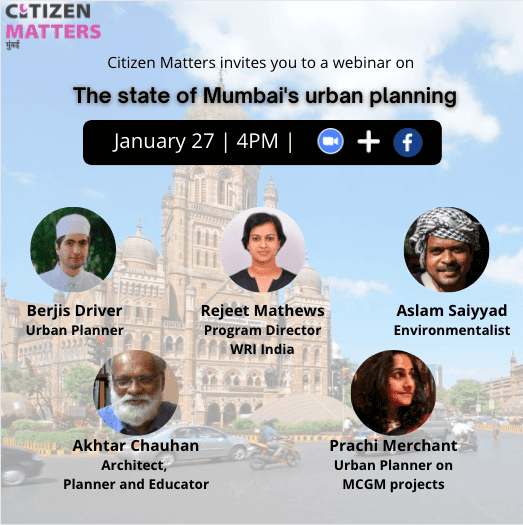
Event: The state of Mumbai’s urban planning
Date and time: Thursday, Jan 27, 2022 04:00 PM IST
Panelists
Berjis Driver
Urban Planner, Associate Member of the Institute of Town Planners India, COA Registered Architect, Accredited Professional Indian Green Building Council. Primary research interests are related to the natural environment, governance, land and water management – with much of my efforts relying on descriptive methods.
Aslam Saiyad
Aslam is a visual/ culture / ecological anthropologist and documentarian deeply interested in issues related to riparian communities. He is also the founder of Hallu Hallu, an initiative that introduces Mumbaikars to various communities and cultures and has worked extensively with and for the empowerment of Koli and Adivasi communities in Mumbai.
Akhtar Chauhan
Prof. Akhtar Chauhan is an architect planner and educator based in Mumbai, India. He is the former Director of Rizvi College of Architecture. He is the founder president of International Association for Humane Habitat (IAHH). He is the president of Maharashtra Association of Schools of Architecture (MASA). He is the Chairman of Comprehensive Development Consultancy Services Pvt. Ltd., architects and planners.
Rejeet Mathews
Rejeet Mathews is Program Director, Urban Development at WRI India, where she has been associated for almost 9 years. Her current work is around spatio-economic planning, the integration of land use and transport, city-region master planning, affordable housing, alternative mechanisms to acquire, plan and service land, revision of town and country planning acts and capacity building. She has provided technical inputs to various committees, reports and policies anchored by city, state and national governments in India.
Prachi Merchant
Prachi is an Urban Planner at The MCGM. She has worked towards setting up the Mumbai Parking Authority at the MCGM. She is part of the Mumbai Commission for Art, Music and Culture. She has been appointed as a member of the Advisory Committee on Gender for MCGM. Conducting Urban Studio at Centre for Policy and Governance, Schools of Habitat Studies at the Tata Institute of Social Sciences.